



Shortly before New York’s prime-time loss in Oklahoma City, Knicks center Karl-Anthony Towns was asked about his assimilation under head coach Mike Brown’s system — roughly eight months after the coach’s hire.
“I’m still working through it,” Towns said. “Still trying to figure out where I could impact our team and winning the most. Right now, I’m just utilizing my experience so I can do the best I can.”
A simple, brief, yet powerful statement. Towns’ words offered a sliver of understanding into a season of existential crisis, contextualized within the construct of who the Knicks think they are, what reality presents and the widening gap between the two. It’s simply shocking to realize Towns still finds himself attempting to fit 76 games into the regular season, but adaptability and viability have been two underlying storylines this season out of the Big Apple.
Following Tuesday’s humbling 111-94 loss to the Rockets, New York (48-28) finds itself just half a game ahead of Cleveland for the No. 3 seed in the Eastern Conference. The game itself was a mess: Jalen Brunson struggled to generate any real offensive threat, finishing with 12 points on 5-for-14 shooting; Towns ended his night with 22 but needed 17 shots to get there, with the bulk of his scoring coming in the fourth quarter when the game was well out of reach; New York shot a woeful 29% from behind the arc; and the team, despite a hefty advantage on the offensive glass (23 second-chance points on 12 offensive boards), scored a measly 80.7 points per 100 half-court possessions — good for 10th percentile of all games this season.
Draft your Yahoo Fantasy Baseball team for the 2026 MLB Season
But the real issue, a growing concern about performances against tougher competition as the postseason nears, is expanding itself at a rapid rate. Earlier this month, the Knicks were riding the highs of a seven-game winning streak — including convincing wins over Denver and San Antonio at the beginning of March. But their third straight loss to a playoff team (New York also lost back-to-back games to the Lakers and Clippers and twice to the Thunder in March) is loud enough to raise concerns, especially this close to the playoffs.
From the 50,000-foot view, the Knicks, much like New Yorkers, are a confident, arrogant bunch. And why shouldn’t they be? On paper, they’re an easy sell as a contender: An uber-efficient offensive hub in Brunson; aggressive, switchable, lengthy point-of-attack defenders in OG Anunoby, Mikal Bridges and Josh Hart; a generational second-chance opportunist in Mitchell Robinson in an era predicated on winning the possession battle; and an elite floor-spacing unit with nine rotational players shooting 36% or better from deep, with six of them essentially at or beyond the 40% mark.
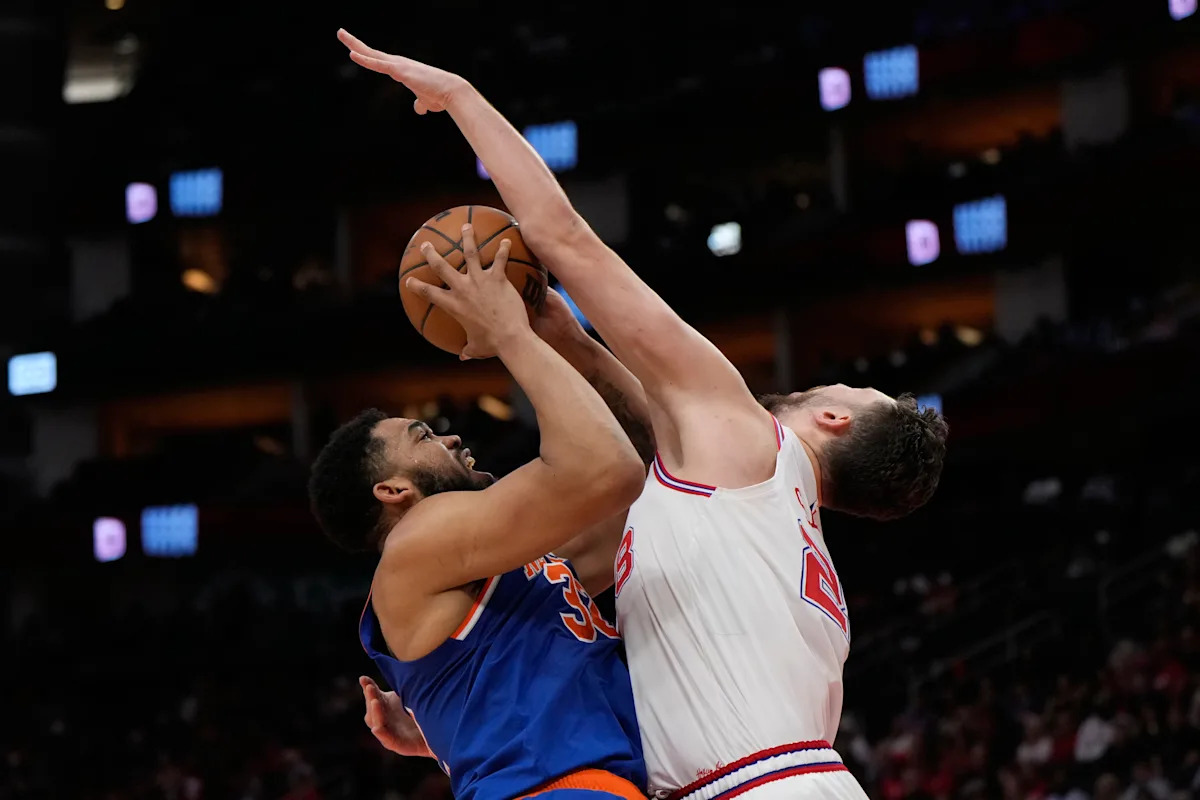
Rockets center Alperen Şengün fouls Knicks center Karl-Anthony Towns (32) during the first half Tuesday in Houston.
(ASSOCIATED PRESS)
Need more? New York is fifth in points scored per-100-possessions against top 10 defenses and sixth in points allowed per-100-possessions against top-10 offenses, according to Cleaning the Glass. It’s everything you should desire in a team built to win at the highest level.
The problems, the more you dig, are worrisome. The Knicks’ 3-point defense is essentially non-existent, 27th in opponent attempt rate and 21st in conversion rate, numbers that won’t get better after allowing Houston — which takes the fourth fewest 3s per game — to knock down 15-of-35 from deep, a 43% clip. But that’s not even scratching the surface of where their defensive issues reside.
The pairing of Brunson and Towns, which of course has a plethora of offensive perks, has become increasingly difficult to construct a Finals-worthy scheme to sustain them for 48 minutes. Houston repeatedly ran actions that involved either Brunson, Towns or both of them in pick-and-roll scenarios, extracting the worst attributes of both time and time again. Oklahoma City forced Towns to attempt to cover ample ground, which he’s clearly unable to do, exposing his backside for cuts, lobs and easy finishes at the rim. Brown bemoaned his team’s inability to contain the Rockets’ offensively, which is saying something considering Houston has hovered around the bottom five in half-court efficiency since October.
“Our pick-and-roll defense was not good tonight,” Brown said. “We tried a lot of different things. We tried to blitz, we tried to switch the matchups, we went to a little zone, too. But it was to no avail, and we have to do a better job in that area going forward, because it was really bad tonight.”
The Knicks are 16th in defensive rating over the last two weeks, they’re 16th in defensive rating since March 1 and … they’re 16th in defensive rating since the All-Star break. New York’s biggest strength (Brunson’s offense) is also their biggest weakness (Brunson’s defense). Its offense simply falls apart with him off the floor, 7.2 points per 100 possessions better in his minutes, 93rd percentile, per Cleaning the Glass. But the Knicks are surrendering nearly six more points defensively at the same time. (Hart, Jordan Clarkson and Robinson have all been net negatives at that end of the floor, too.)
“Mental lapses,” Brunson said. “And things that shouldn’t be happening in game 75 or 76 in the season. We got a long way to go.”
The challenge for Brown between now and when the playoffs commence will be figuring out if there’s a way to make all of this work. In the postseason, teams will take pages from Houston’s book, consistently hunting Brunson and Towns either separately or in tandem. Figuring out rotations might be an issue too, especially considering some of New York’s issues with double-big lineups and finding anyone who can actually initiate offense outside of Brunson, etc. Consider this: Towns, according to Synergy tracking data, is allowing opponents to shoot 62.5% on shots he directly defended. For context, former teammate Donte DiVincenzo, close in quantity of shots defended, has fared better.
Could this mean Brown puts more trust in his bench lineups? Prior to Tuesday, New York was outscoring opponents by nearly 18 points per 100 possessions when Jose Alvarado and Clarkson shared the floor, per PBP Stats. So far, however, Brown has been hesitant to play, say, Alvarado and Miles McBride together, likely because of the lack of size. He has, however, loved pairing Brunson with either of those — which has produced a +16 and +15.9 efficiency advantage, respectively, on a sizable sample size.
Still, context matters. We’re talking about a top-four seed in the East heading into the playoffs with arguably the deepest roster in basketball and three elite players, according to advanced analytics — Brunson 12th in Estimated Offensive Plus-Minus, Anunoby 17th in DARKO and Towns 26th in Estimated Plus-Minus. History tells us that teams with impactful players of this frequency — combined with above-average coaching — do well in playoff settings. But time is running out for the Knicks to find their groove.
“Overcommunication and holding each other accountable,” Brunson said. “Just not getting discouraged. This is obviously a bump in the road, but we can’t let outside noise mess us up internally. Just have to continue to fight.”
“The last few games, we haven’t had [a rhythm] and teams go through stretches like that,” Brown added. “We got seven more games to try to find it.”
Read the full article here


