

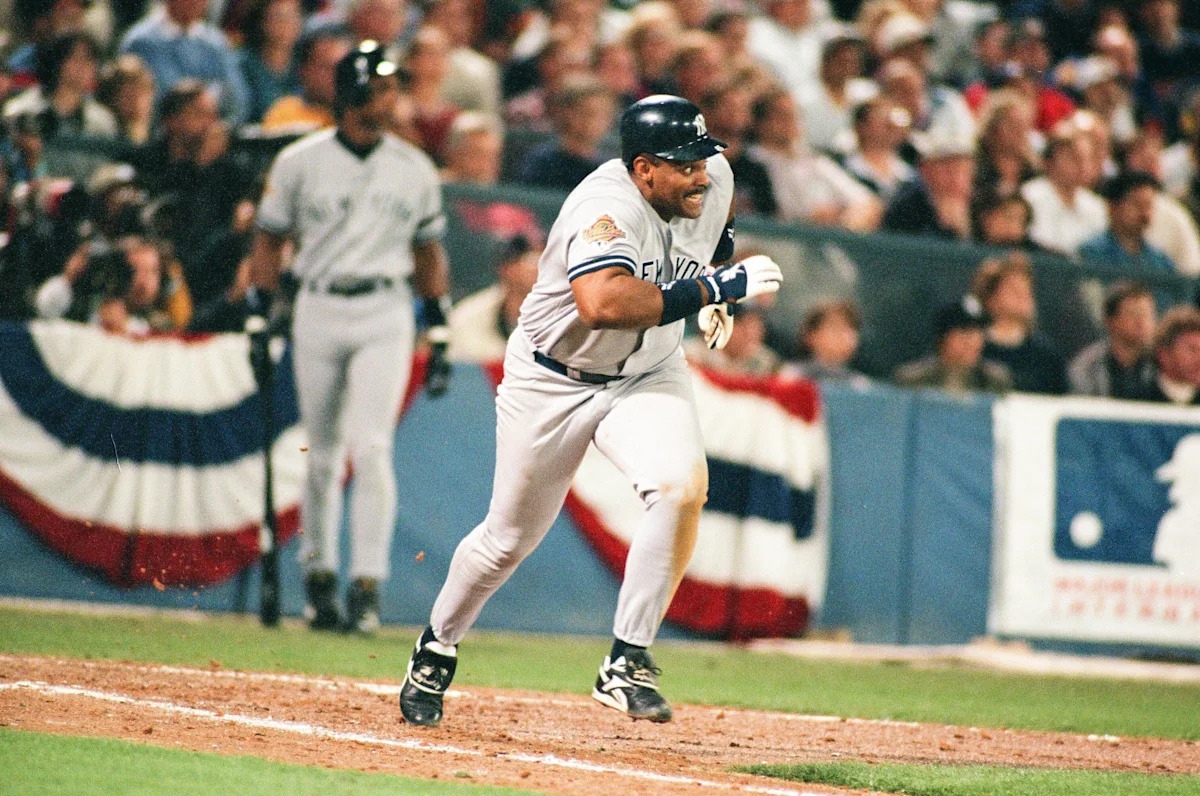
On August 22nd, during a divisional game between the Yankees and Blue Jays the YES Network invited to the booth a special guest: the retired slugger Cecil Fielder. Fielder had history with both franchises—he debuted as a member of the Blue Jays, and then later in his career came aboard with the Yankees after becoming a star, helping them win a championship in 1996.
Despite a brief detour in which he expressed befuddlement with modern hitting, Fielder’s conversation with Michael Kay and former teammate Paul O’Neill was ultimately a pleasant one. He spoke reverently about the 1996 team he helped bring to championship glory. “I didn’t have to do much; I just had to fit in,” he said. “All I had to do was come here and just play, and that’s what we did. We just went out, and if we play today we win today.”
Cecil Grant Fielder
Born: September 21, 1963 (Los Angeles, CA)
Yankees Tenure: 1996-97
Fielder grew up in La Puente, outside Los Angeles, and was so dominant an athlete during his youth that opposing parents continually accused his parents, Edson and Tina Fielder, of faking Cecil’s age. A three-sport star at Nogales High School, he enjoyed basketball more than football and baseball but chose to pursue baseball because he didn’t think his bulky frame would allow him to succeed at the point guard position he played. Concerns about his size, though, would follow him throughout the early portions of his budding baseball career.
After the Orioles took a flyer on him out of high school, Fielder played at the University of Nevada, Las Vegas—but only for one season. His college coach wanted him to lose a whopping 50 pounds; he quit the program two games into his sophomore year. Shortly afterward, in June of 1982, the Royals selected him in the supplemental draft—but they too had their doubts about Fielder long-term. In 1983 Kansas City traded him to the Toronto Blue Jays for veteran outfielder Leon Roberts.
Fielder made his MLB debut in the second half of 1985, the Jays’ first playoff season after a slow build. Over the next four seasons, he flashed the tantalizing power he was already known for, but couldn’t establish himself as a regular on a Toronto team which was perennially gunning for the World Series. So, Cecil went to Japan.
With Hanshin in 1989, Fielder overcame a sluggish start to become a fan favorite, wowing crowds with his prodigious pop. He hit 38 home runs and slugged .628 in his lone NPB season, earning some interest from a few MLB clubs. The Tigers brought him aboard on a two-year, $3 million pact, and were immediately rewarded, as Fielder tore the cover off the ball in a legendary 1990 season, once even demolishing a Dave Stewart pitch out of Tiger Stadium entirely. That was the kind of power that the man they called “Big Daddy” brought to the plate. His grand finale came in the Bronx.
On October 3rd, Fielder made history by hitting his 50th home run of the season off the Yankees’ Steve Adkins in the second inning. It had been nearly three full decades since a player last reached the 50 homer mark—and Fielder had done it in his first season as a true big-league starter. He went on to hit his 51st homer of the season off Alan Mills in the top of the eighth. At this point, his pursuit of history was the only compelling storyline; Detroit and New York both finished well out of the playoff picture.
View Link
The next season, the Tigers improved substantially, and Fielder clobbered another 44 homers, but it was not enough to carry them to the playoffs—they finished tied for second in a crowded AL East, seven back of Toronto. That was as close as they’d come to the postseason while Fielder was under their employ—and by 1996, Hall of Fame manager Sparky Anderson was gone and the Tigers were back in the basement. Indeed, it was the middle of a nearly two-decade stretch of no playoff baseball in Detroit until 2006. Well on their way to 109 losses, they shopped Fielder, who had a season and a half remaining on his deal.
The Yankees, leading comfortably in the AL East, were an obvious fit. They would be willing to take on Fielder’s big salary (he was the highest-earning player in the league in 1996), and the offense lacked a true power threat from the right side of the plate. To that point, no one had hit more homers in the ’90s than Cecil, surpassing even Barry Bonds, Mark McGwire, and Ken Griffey Jr. So on July 31st, they got their guy, sending Rubén Sierra—who Joe Torre wanted out of the clubhouse anyway—and preseason 12th-overall Baseball America prospect Matt Drews the other way in the deal.
Fielder’s production in pinstripes in the back half of the regular season was essentially consistent to what he did in Motown. He posted a 109 OPS+ before the trade, and a 108 after the trade. He socked 13 dingers to get to 39 on the season, and typically sat between O’Neill and Tino Martinez in the order. Despite Fielder’s quality play, the Yanks oddly scuffled to a 13-17 record in August before rebounding with a 16-11 September to clinch the AL East, their first division title in 15 years.
In the Yankees’ ensuing postseason run, Fielder made an immediate impact, hitting a home run in a 12-inning Game 2 win over Texas in the Bronx to even the ALDS. He added two more hits and RBI in Game 4 as the Bombers punched their ticket to the ALCS against the division rival Orioles.
Fielder provided quality over quantity in that five-game set. While he only grabbed three hits against Baltimore, one was a two-run homer against Mike Mussina in Game 2 which gave the Yankees some valuable insurance runs in a 5-2 victory. Then in the decisive Game 5, Fielder’s three-run jack was the first of back-to-back jacks with fellow powerhouse Darryl Strawberry.
View Link
It was easy to wonder whether that effort might be for naught when the Yankees fell behind the Braves two games to none to start the World Series as the series shifted to Atlanta. But the Bombers rallied heroically, first when David Cone outdueled Tom Glavine in a 5-3 win in Game 3, then when they overcame a 6-0 deficit to win Game 4 8-6 in extra innings. Fielder got the rally started with a two-run single to put the Yankees on the board. With no DH for the games at Atlanta-Fulton County Stadium, Torre had been tasked with a tough decision of whether to play Fielder or Martinez at first base. With Tino slumping, Torre had gone with Fielder; it was the right call.
With the series tied back up, it was Fielder’s RBI double off an otherwise-pristine John Smoltz in the fourth inning of Game 5 which provided the only run of the entire night—the Yankees pitching, led by Andy Pettitte, shut down the Braves and allowed New York to take control of the Fall Classic once and for all.
View Link
Fielder grabbed one last knock in Game 6, his ninth of the series, as the Yankees won 3-2 to clinch their 23rd championship.
Fielder stuck around in 1997, and remained a regular in the lineup until a thumb injury sidelined him in mid-July. He returned a few months later in time for the end of the regular season, but saw a reduced role in the playoffs. He only appeared in two games in the Division Series and picked up one hit as the Yankees bowed out to Cleveland. Fielder’s power had declined—across the full year, he only managed to hit 13 homers, the same number he had hit after the trade the previous season. His slugging percentage was .410, the lowest he’d posted in a full season to that point.
The Yankees, retooling their lineup with the additions of Chuck Knoblauch, Scott Brosius, and Chili Davis, let Fielder walk in free agency at year’s end. He signed with the Angels, and put together a solid first half near his hometown before struggling mightily after the All-Star Break. In August, the Angels released him—undeterred, he quickly joined up with Cleveland for one last opportunity to reach the postseason. But his steep decline continued there, and the AL Central champs cut bait after 14 games. Unable to catch on with Toronto the following spring, Fielder retired in 1999 with 319 career home runs: the exact total his son Prince would rack up in his own terrific career.
Cecil’s retirement was far from easy—he and Prince were estranged for a time and a purported gambling habit led to the collapse of his marriage. But by the time he joined the YES booth this August, he had repaired his relationship with Prince, remarried, and was able to reminisce about the good times with O’Neill, with whom he captured championship glory 30 years ago.
NEW YORK, NY – JUNE 26: Cecil Fielder is introduced during The New York Yankees 65th Old Timers Day game on June 26, 2011 at Yankee Stadium in the Bronx borough of New York City. (Photo by Al Bello/Getty Images) | Getty Images
Happy birthday, Cecil.
See more of the “Yankees Birthday of the Day” series here.
Read the full article here