

Thinking back about that moment in time, Todd Zeile doesn’t talk about the at-bats, the Mike Piazza home run or even the nervousness from that Sept. 21, 2001 game. The first Major League Baseball contest played in New York City after the Sept. 11 terror attacks has been boiled down to those video clips over the years.
But, Zeile, who started at first base that night for the New York Mets, remembers the hugs.
The Mets’ first game back at Shea after the attacks was a huge moment for a city that had not had any normalcy in the 10 days since two airliners hit the World Trade Center and sent them crumbling to the ground. Piazza’s home run that gave the Mets a 3-2 win that night became the signature image for the nation and history, but for the players on the field it was the emotions.
For Zeile, it was an impromptu moment long before then. Nobody planned it, but after the moment of silence and the national anthem, the players all walked to the middle of the field. The Braves and Mets players met and hugged before the game began.
“It was completely improved, organic hugs in the middle of the field, with guys that were our arch nemesis. It became less about the competition of that game and more about sportsmanship and camaraderie of guys from all over seeing the same thing. The beauty of the moment,” Zeile said.
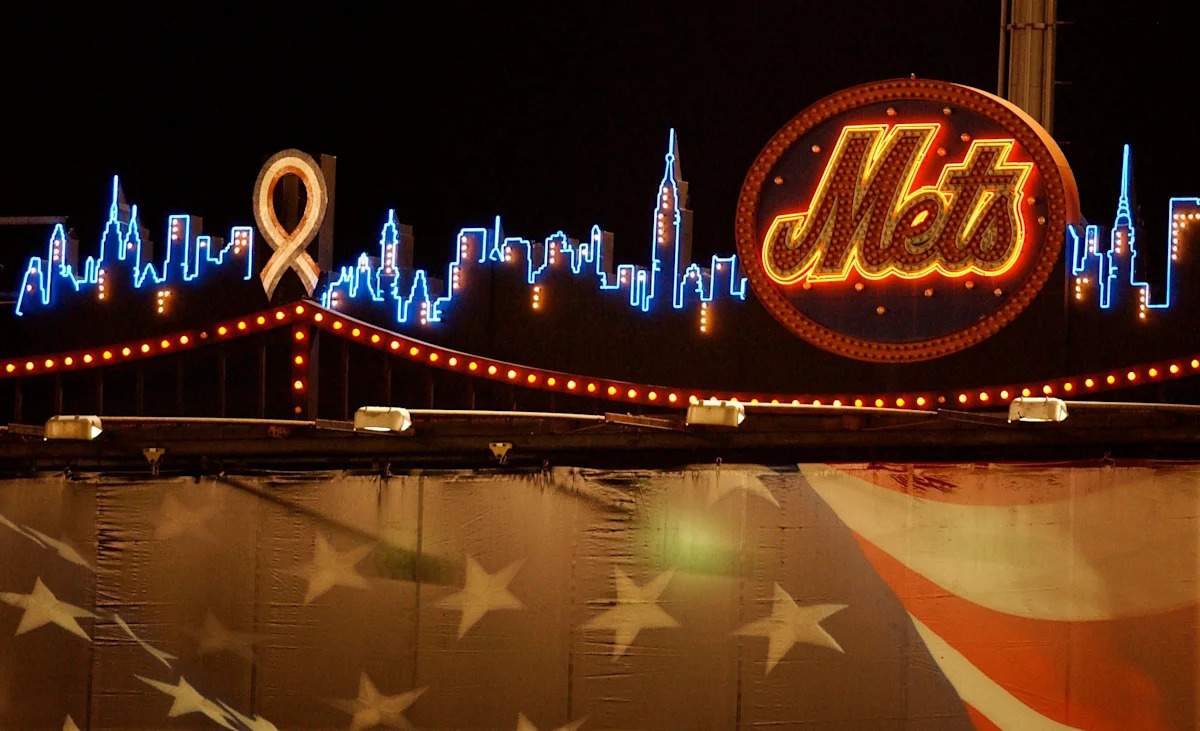
The New York skyline on top of the scoreboard at Shea Stadium on Sept. 21, 2001.
That moment, or really the emotions of all the moments, days, weeks, months and even years after the shock of the attacks is what has Zeile looking back now 25 years later as an executive producer on MLB Network’s “When America Took the Field,” debuting Thursday, Sept. 10 at 10 p.m. ET.
Zeile took about a decade off after retiring in 2004 to build his production company. He spent two seasons as co-executive producer on FX’s “Anger Management” with Charlie Sheen. He got back into baseball as a guest analyst for SNY’s Mets coverage.
Now was the time for him to combine both his baseball and film experience to make sure those moments are preserved as well as the Piazza home run and George W. Bush first pitch at the 2001 World Series.
“This, not just the documentary, just us being alive and going through this period, is the closest thing to the history being made in real time,” he said. “people are going to read about it and know about it, and I am like ‘Oh yeah, I was there for that. I saw that. I felt that.'”
That’s why every anniversary he and his Mets teammates, who were at Ground Zero and New York City firehouses in the days after, keep telling their stories. So people don’t forget.
Zeile wants to make sure his children and the next generations learn about what happened in the aftermath and the small part baseball played in the recovery.
That brought him back to New York, so he returned to the firehouses he visited in the aftermath of the attacks. He met the young firefighters who were the kids of the firefighters who were at Ground Zero. He saw their pride of carrying on that tradition and keeping the memories alive. That sparked his motivation about getting this on film while those who lived through it are still here to tell the stories for these kids.
Andrew Brenner directed the documentary and he had to figure out how to tell the story of one of the most infamous events in recent history with a fresh lens.
What Zeile and Brennen wanted from the film wasn’t another retelling of the 10 days everybody knows about: Shea Stadium as a staging area for rescue workers and the Piazza home run. The pieces he was interested in were the ones that “had been at least lost or never told.”
He wanted to make sure the story was about the months and years after, the “continued involvement and the continued passion that baseball as a whole has had for the (9/11) community.” That’s the community he lived through it with in 2001 and the families that are still connected to it now. That thread is what made the collaboration with MLB feel so different to him.
Zeile admits he was not sure baseball should have been played so soon after the attacks. Nobody was. What changed his mind is the trip the players took to Ground Zero.
“I recognized that the fire department and police department needed a little bit of a break from what they were doing, and baseball gave them that reprieve,” he said. “It gave up more confidence to not feel like we were intruding or doing something that could be deemed inappropriate.”
And after, as the Mets hit the road, something unusual happened.
“There certainly was a sense of pride, because we were representing New York and wherever we went guys (from other teams) would ask us ‘What’s it like there?’ Or say ‘I like that you are wearing the (NYPD and FDNY) hats’ or ‘How’s the city?'” Zeile said. “It gave us an identity that was a little bit different, maybe a responsibility, in our interactions with other teams.”
Those moments and the community that came out of the tragedy is what Zeile hopes people remember from this film.
They found three families with connections to baseball that were affected by the tragedy, they told the story of Joe Maddon, who was on the West Coast, but who lost a dear friend on one of the planes, and they found the story of the Secret Service agent who dressed up as an umpire and went on the field for George W. Bush’s emotional first pitch of Game 3 of the 2001 World Series at Yankee Stadium.
Brenner, who was 22 and in Hoboken on that day, remembers driving out of town and listening to the news on the radio. He said that he and Zeile used those memories and emotions, but also wanted to zoom out from just those moments in New York that have been so well documented.
One moment from making the film that has stayed with Brennen more than any other was of a boy who was nine at the time of the attacks. He is one of the families woven through the documentary and he told the film crew that he can no longer separate what he actually remembers about that day from what he’s simply been told happened.
“When he said that, it really struck me that putting together a film like this gives people like that a chance to learn,” Brennen said. “It’s so personal, so raw, they share these gut-wrenching emotions with us. But at certain times, they don’t really know exactly what happened.
“It’s a great way for people to learn some new stories and never forget.”
This article originally appeared on USA TODAY: The hugs at Shea Stadium that still define former Met’s post-9/11 memories
Read the full article here