

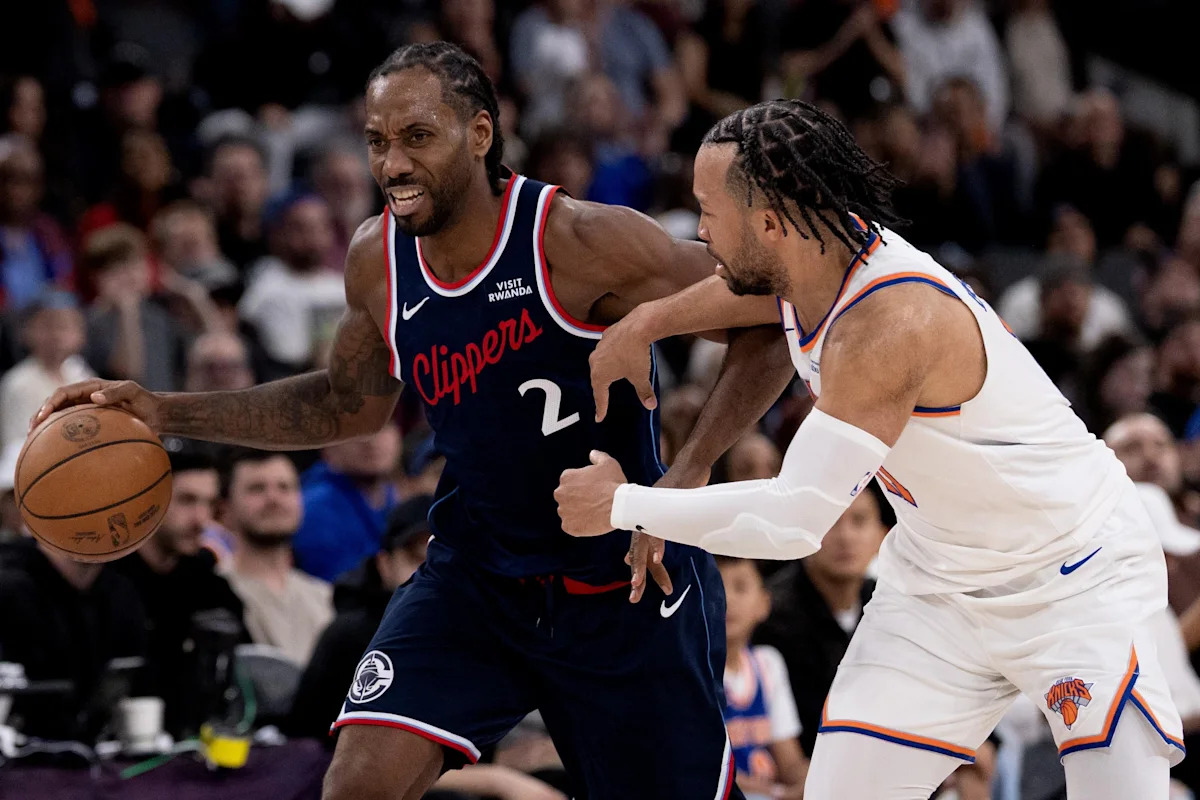
So… the Clippers, huh.
The year-long probe surrounding alleged salary cap manipulation ended on Wednesday and handed down one of the biggest punishments in professional sports history, suspending multiple key officials, fining the organization $30 million, and taking five first-round picks. It’s not entirely unprecedented (see: Joe Smith), but it’s pretty damn startling.
While there are many things to take away from this ruling (particularly with how Kawhi seems to have completely gotten away with this), the biggest thing might just be how unimaginably bad the Kawhi Leonard era went in LA.
To get Leonard to sign with them in 2019, the Clippers had to trade for Paul George, a trade that has gone down as one of the worst in league history due to the sheer magnitude of picks traded and how it kickstarted the Thunder’s contention window by giving them Shai Gilgeous-Alexander.
In seven years, it was disappointment after disappointment, with the highlight being a trip to the 2021 Western Conference Finals that ended in a blowout defeat at home in Game 6. George left and was replaced by James Harden; Harden left, and Leonard is choosing to return to Toronto after burning this franchise to the ground behind him.
In total, with Leonard (likely) going to the Raptors at some point, this is what the Clippers gave up for his services, both to convince him to sign and convince him to stay:
-
2021 MIA 1st (#18 – Tre Mann)
-
2022 LAC 1st (#12 – Jalen Williams)
-
2023 1st Pick Swap (not conveyed)
-
2024 LAC 1st (#26 – Dillon Jones)
-
2025 MIA 1st (Lottery Protected, became Thomas Sorber)
-
2025 1st Pick Swap (Conveyed, Nique Clifford)
-
2026 LAC 1st (#12 – Aday Mara)
-
2029 IND 1st (voided by NBA)
-
2030 LAC 1st (voided by NBA)
-
2031 LAC 1st (voided by NBA)
-
2032 LAC 1st (voided by NBA)
-
2033 LAC 1st (voided by NBA)
Good grief.
This is, hands down, the worst trade in NBA history. It destroyed an entire franchise’s future 10-15 years for three playoff series victories in seven years. At least Billy King only messed up the Nets for five years.
It does get you thinking, though. How bad has it gotten for the Knicks? We can recall some pretty nasty trades from recent or even less recent history, but just how close do they get to the utter franchise-alteringly bad level as the Paul George trade?
Gene Shue To Detroit Fort Wayne (April 1956)
Knicks Receive: Ron Sobie
Pistons Receive: Gene Shue
We’re starting old school, back when the Pistons were still based in Fort Wayne. Before researching this, I had no clue who these guys were and would be very surprised if we had anyone in our community who’s been around long enough to remember watching them play (prove me wrong if so!)
Shue, the No. 3 overall pick in 1954, was sold to the Knicks just six games into his rookie year, but was nothing more than a regular role player in his near-two years in New York, averaging 9.2 points, 2.9 rebounds, and 2.5 assists in 1955-56.
Very shortly after the season, the 6’2″ guard was dealt on draft night to Fort Wayne for Ron Sobie, the No. 7 overall pick. Sobie didn’t do much in four years, playing 191 total games and averaging 8.5 points and 4.1 rebounds before being sold to Minneapolis in December 1959, where he’d play just one more game ever.
As for Shue? He grew into his own as the Pistons moved to Detroit, being named to his first All-Star team in 1958 before getting down-ballot MVP votes over the next several seasons. He eventually grew into a 23-PPG scorer and made First-Team All-NBA in 1960. Five All-Star teams, two top-10 MVP finishes, and two All-NBA selections in six years in Detroit.
The Knicks would actually get a chance to rectify their mistake with Shue, re-acquiring him for Darrall Imhoff before the 1962-63 season, but he started to regress in his age-31 season, and he was out of basketball by the end of 1964.
While Shue never won Detroit a championship, he would’ve been a tremendous help to a Knicks team that went through its first Dark Ages prior to the 70s revival. In the six years with Shue in Detroit, the Knicks had one losing season and won sub-30 games in three of those seasons.
Choosing $4.8 Million Over Julius Erving (1976)
This is, unequivocally, the worst decision in franchise history. All of these other moves were trades that went wrong, but in the spirit of bad decisions, we’re going to cover this as well.
When the Nets were among the teams chosen to join the NBA after the ABA merger in 1976, the Knicks demanded that they pay a fee of $4.8 million (over 10 years) for encroaching on their territorial rights, a request that was sustained by the NBA alongside their $3.2 million fee for joining the league. In total, the Nets had to come up with $8 million just to exist.
The Knicks would get their money, alongside eventually suing the Nets and forcing them to move from Long Island to New Jersey, but made an unforgivable, disgusting error in the process.
Dr. J made $350,000 during this time, but wanted a renegotiation. As such, the Nets were willing to offload his salary and offered him to the Knicks, then owned by the Graham Paige Corporation and ran by Eddie Donovan in the front office.
The Knicks said no. They chose a few million, which was a lot at the time to be fair, over a future Hall of Famer.
Philadelphia purchased Erving for $3 million, and the rest is history. The Knicks let a rival get the best incoming ABA talent available and watched him lead the Sixers to a championship in 1983 while spending over a decade as a top-five player in the game.
Oh yeah, not to mention that the Knicks were mostly irrelevant during his time in the league and got swept twice by the Sixers in 1978 and 1983. Imagine if the Knicks could’ve gone from Clyde and Willis Reed to Dr. J. Ugh.
Maurice Lucas to the Suns (July 1982)
Knicks Receive: Truck Robinson
Suns Receive: Maurice Lucas
In the time between the Knicks’ eras of relevance in the 70s and 90s, it wasn’t anything too bad in the 80s, just inconsistency as they waited for the next big thing in Patrick Ewing to get them back into contention.
They seemed to stumble upon something huge in the summer of 1981, when the New Jersey Nets sent them a 28-year-old Maurice Lucas as a form of compensation for signing Ray Williams in free agency. Think of it as a precursor to a sign-and-trade. Nonetheless, the team got a former All-Star and All-Defense power forward still in his athletic prime.
In his one year in New York, Lucas averaged 15.8 points and 11.3 rebounds while shooting 50.3% from the field. It was his best overall season since he was in Portland, but the Knicks never saw him a long-term option, shipping him to Phoenix for Truck Robinson one year later.
The deal made sense at the time, as Robinson was even more productive than Lucas the season prior, but he hit hard regression in his age-31 season in 1982-83 and only lasted two seasons in New York, flaming out by age 33. He would hear it from the fans, being nicknamed “Dump Truck” for his startling fall-off.
Meanwhile, Lucas made his fifth All-Star team in his first year in Phoenix as part of a second prime that slowly dissipated a few years later. While Lucas would only have 2-3 years of All-Star level talent post-trade, it was a helluva lot better than Robinson.
They could’ve used that force at PF, you know. Bernard King and Bill Cartwright carried the Knicks to consecutive playoff appearances in 1983 and 1984, with the latter team being a game away from the Eastern Conference Finals. Just imagine how it would go if Lucas were there instead of Robinson.
Then again, if not for the dismantling of that team following the 1983-84 season, Ewing might not have ever been a Knick. Food for thought.
Rod Strickland To San Antonio (February 1990)
Knicks Receive: Maurice Cheeks
Spurs Receive: Rod Strickland
The Knicks had their reasons for making this trade, it just aged badly.
Strickland was a solid backup point guard in his first year and a half in the league, but was blocked by Mark Jackson. The Knicks, who had risen to become a perennial playoff team in the late 80s, were thinking about getting to the next level, so they traded a young guard who was blocked for a 33-year-old veteran who could fit the role better as one of the league’s best defensive guards.
Cheeks, an NBA champion in Philly in 1983 and again as an assistant on this year’s staff, played a total of 107 games as a Knick, averaging eight points and five assists while adequately raising his game in the postseason. He was shipped out prior to 1991-92 for a pick that became Charlie Ward before retiring a year later. The player they got was fine, but they definitely could’ve used Strickland.
Jackson had a ceiling as a Knick, one that he reached quite early and led to his departure after 1991-92. Strickland, meanwhile, would become a great starting guard in San Antonio and Portland, eventually averaging 19 points and nine assists in his prime during the mid-to-late 90s.
I wonder if an offensively challenged Knicks team, one that relied on gritty defense without a true point guard and having to rely on John Starks (more of a 2-guard) to provide playmaking. Imagine if Strickland was the point guard instead of Doc Rivers in 1994.
The Eddy Curry Fiasco (October 2005)
Knicks Receive: Eddy Curry, Antonio Davis
Bulls Receive: Jermaine Jackson, Mike Sweetney, Tim Thomas, 2006 NYK 1st, 2007 Pick Swap, 2007 NYK 2nd, 2009 NYK 2nd
Isiah Thomas is damn lucky I’m only including one of his trades.
This was really bad. Eddy Curry was a fine player for the Bulls, one who was worth a decent salary and averaged 16 points and five rebounds at the end of his rookie contract. Putting aside the fact that he was seven-foot and grabbed way less rebounds than an average center, it’s a fine guy to trade for.
But that much? In a sign-and-trade? And you give him $60 million over six years to make the 23-year-old the sixth-highest-paid center in basketball? After seeing the Bulls drag their feet on an extension because of an irregular heartbeat? Seriously?
The players they gave up weren’t a big deal. Jermaine Jackson never played for the Bulls. Mike Sweetney replaced Curry as the starting center and was much worse before being out of the league by 2008. Tim Thomas played just three games as a Bull before being cut.
It’s the picks. It’s the hubris of believing the team was an Eddy Curry away from turning things around.
When Leon Rose traded a mountain of picks for Mikal Bridges, he understood that it might not result in a championship and assumed risk down the road, but also knew it wouldn’t immediately blow up due to the team having a very high floor as constructed. Worst-case scenario, the Nets get good picks in 2029 and 2031, not 2025 or 2027.
Isiah was not as wise.
The Knicks won just 33 games the year before. They added Curry, Jerome James, Nate Robinson, and rookies Channing Frye and David Lee, and hired the man who won a title with a Pistons team that was better than the sum of its parts two years prior. They made a gamble that it would all work.
It didn’t. At all. They won just 23 games despite James Dolan paying luxury tax. They had the second-worst record in basketball, and they’d get nothing for it. The Bulls got the No. 2 pick in the draft and had future All-Star LaMarcus Aldridge fall into their lap. Now, they messed that up by sending him to Portland for Tyrus Thomas and Viktor Khryapa, but the point remains.
The following year, the Knicks won just 33 games after Isiah took over as head coach. The Bulls won a bunch more, exercising the swap and taking the No. 9 pick, which became future Defensive Player of the Year Joakim Noah.
The two top picks traded for Curry became two of the best big men of their generation. The second picks didn’t result in much, but the Bulls traded the 2007 2nd for Thabo Sefolosha and the 2009 2nd in a weird future swap with Portland, but the damage remains.
As for Curry on the Knicks, he had a great 2006-07, averaging 19.5 points and seven rebounds. After that, with four years left on his contract, he played a total of 69 more games as a Knick as he battled injuries, his weight, and a bad work ethic. Complete, franchise-altering disaster.
Tracy McGrady Becomes a Knick (February 2010)
Knicks Receive: Tracy McGrady, Sergio Rodriguez
Rockets Receive: Jordan Hill, Jared Jeffries, Hilton Armstrong, Kevin Martin, 2011 Pick Swap, 2012 NYK 1st
Kings Receive: Joey Dorsey, Carl Landry, Larry Hughes
This trade wasn’t catastrophic by any means, but it’s inclusion is meant to represent all the times over the years that management traded draft picks for absolutely no reason, headlined by its most baffling.
A first-round pick, a swap, the guy you picked in the lottery literally eight months ago, and Jared Jeffries… for a 31-year-old rental who’s past his prime. It embodies the incompetence of the Knicks back then.
Jordan Hill wasn’t good, but they picked him between Steph Curry and DeMar DeRozan in June 2009. It’s ridiculous to give up on this guy that quickly, and it says a lot about the front office’s drafting ability and thought process. Jeffries and Hughes were okay role players. None of these guys would come back to bite you.
But like the Curry trade, it’s the damn picks. The 2011 swap didn’t convey because, unlike Isiah, Donnie Walsh actually added good players in between to ensure no collapse, as Amar’e Stoudemire lifted the Knicks to the postseason in 2011 (disregard that Houston had a better record and the West being a gauntlet was the only reason the swap didn’t convey). The 2012 pick landed at No. 16, but the 2012 draft was hilariously shallow, so Royce White doesn’t come back to bite him.
As for McGrady and Rodriguez? Neither of them played for the Knicks past April 2010. McGrady, particularly, played abysmally in 24 starts down the stretch and had to settle for a veteran minimum with the Pistons that summer. For a team that, at the time of the trade, was well below .500, it’s completely inconceivable.
Well, I guess it was meant to open up cap space for LeBron and company that offseason, and while Amar’e was a solid consolation prize (for a minute), the franchise’s incompetence at that point made it rather foolish to think the best player in the world was dying to come there. Good thing we didn’t do this again nine years later!
Acquiring Carmelo Anthony (February 2011)
Knicks Receive: Carmelo Anthony, Renaldo Balkman, Chauncey Billups, Anthony Carter, Shelden Williams, Corey Brewer
Nuggets Receive: Wilson Chandler, Raymond Felton, Danilo Gallinari, Timofey Mozgov, Kosta Koufos, 2014 NYK 1st, 2016 Pick Swap, 2012 GSW 2nd, 2013 NYK 2nd
Timberwolves Receive: Eddy Curry, Anthony Randolph, 2015 DEN 2nd
Here’s a bold one, and no, I’m not saying this as someone who doesn’t like Melo. He was my favorite Knick when I first got into this team and I’ll always have a soft spot for him. The trade itself is relatively fine; the problem lies with the circumstances surrounding it.
Melo was due to be an unrestricted free agent that summer. The Knicks had plenty of space to give him the new max contract he desired from Denver. Instead of waiting until the summer to pair him with Amar’e in a move many believed was obvious, a paranoid Donnie Walsh was terrified of the crosstown Nets getting him instead, with the whole “Jay-Z as part-owner” schtick. Melo was not choosing the damn Nets, but the Knicks weren’t taking that risk.
It was a huge, 13-player trade, one that also involved dumping Curry’s contract to Minnesota. Let’s break down the guys that came with Melo, who’s story in New York is well known already:
-
Renaldo Balkman, who was drafted by the Knicks and traded to Denver in July 2008, played just 17 games after this trade in the next two seasons.
-
34-year-old Chauncey Billups actually played very well in 21 starts down the stretch as an expiring contract, which convinced the Clippers he still had it (he played just 42 games in the next two seasons).
-
Anthony Carter played 19 games as a Knick before signing with the Raptors that offseason. He played his last game in 2011-12.
-
Shelden Williams played 17 games (started six) down the stretch. The big man ended his career with New Jersey the following season, playing just 58 more games.
-
Corey Brewer spent six days on the roster before being waived. He won a ring in Dallas that year, and his best years were ahead of him. Whoops.
As for what they gave up? Felton would eventually return a few years later, but the other three had solid NBA careers where they made a lot of money (looking at you, Mozgov). Gallinari’s marksmanship and Chandler’s solid play as a bench wing could’ve been useful off the bench during the Knickstape era, but they were just so horrified of Jay-Z.
The real kicker is the picks, again. Not that they were too damaging, just how funny it wound up being:
-
2012 GSW 2nd: Landed No. 38, turned into Quincy Miller. Unrelated, Khris Middleton went one pick later. Good job, Nuggies.
-
2013 GSW 2nd: Landed No. 51 and was traded to Orlando in the complicated Dwight Howard trade. Became Romero Osby, who never played in the NBA. Did I mention they got these two seconds for trading away David Lee?
-
2014 NYK 1st: Landed No. 12 after a shockingly bad 2013-14 season, but was also sent to Orlando in Dwight trade. Became Dario Saric, who was then sent to Philly
Then there’s the 2016 pick swap. Both Denver and New York stunk in 2015-16, but the Knicks did lose one more game, landing them the No. 7 pick, which would then go to Denver. That became All-Star guard Jamal Murray.
I got good news and bad news from here.
Good news: by virtue of the swap, the Knicks landed the No. 9 pick in the draft, so the swap wasn’t that bad!
Bad news: because of the next trade, they didn’t make that selection.
The Andrea Bargnani Trade (July 2013)
Knicks Receive: Andrea Bargnani
Bulls Receive: Marcus Camby, Steve Novak, Quentin Richardson, 2016 Swap Worst w/DEN, 2014 OKC 2nd, 2017 NYK 2nd
Where do I even begin?
Vibes were high in the Summer of ’13. After all, the Knicks had gotten to the second round of the playoffs for the first time in 13 years. Sure, it was a disappointing exit at the hands of the Pacers, but they felt as if their core still had some mileage in it with Melo, Amar’e, Tyson Chandler, Mike Woodson, and friends.
Let’s add another chef to the mix. Enter Bargnani, a failure of a No. 1 pick who enjoyed some solid seasons as Chris Bosh’s second fiddle before becoming a 20-PPG scorer in 2010-11. The two seasons before the trade, he was limited to 65 games, while his stretch-four abilities waned and his three-point shooting regressed sharply. An elbow injury suffered the year before the trade seemed not to dissuade management.
The players they gave up were more sentimental than skilled. Camby was a remnant of the transition from Ewing to Houston/Sprewell, having rejoined the Knicks that past season for the final 24 games of his career at age-38. Richardson was effectively the same, having played one game in 2012-13 in his second stint as a Knick after a nice, four-year run in the 2000s before retiring. Discount Double Check was a fan-favorite sniper, but one that was moved on from at the right time as his minutes and production completely cratered post-trade.
Once again, it’s the picks.
The OKC 2nd landed at No. 59 and was worthless. The 2017 pick landed at No. 36, which was eventually sent to Philly and became Jordan Bolden. Good thing this wasn’t a 2018 pick, phew. The real problem was a swap
The Knicks elected to make a rare move, trading the back end of a pick swap they had already traded. Essentially, Toronto got the worst of their picks and Denver’s picks. The odds of that being in the lottery were slim, but it handed Jakob Poeltl, a solid NBA big man for the last decade, right to them at No. 9.
As for Bargnani’s Knicks career, he sucked. He was the poster child of the team’s failure to maximize the rest of Melo’s prime, as Amar’e regressed hard, Chandler was traded, and this guy made eight figures to make boneheaded decision after boneheaded decision while battling injury. He played just 71 games as a Knick, made $23 million, and was dumped out the door after 2014-15. What a waste.
Read the full article here