

There are few phrases in basketball that sound more universally agreeable than “win the margins.” About as agreeable as, “you want players who really know how to put the ball in the basket.”
Of course every team wants to win the margins! Take care of the basketball. Crash the glass. Don’t give away possessions. Make the other team earn everything. Anyone who played organized hoops can probably hear at least one former coach screaming those words.
The Celtics have spent the past few years taking those details increasingly seriously. Last season, with Jayson Tatum returning from a torn Achilles and a roster that didn’t have nearly as much talent or room for error as the championship team did, the philosophy made even more sense.
For the most part, it worked.
Boston won 56 games and finished second in the league in offensive rating. It did so while playing at the slowest pace in basketball, just 95.58 possessions per 48 minutes. That sentence alone should probably prevent me from spending the rest of this article aggressively typing out, PLAY FASTER, over and over.
Slow basketball was not bad basketball. But there’s a more interesting question hiding underneath those devilish numbers.
At what point does controlling the game become trying to control it too much?
The case for control: just look at the scoreboard
Let’s start with the obvious defense of Boston’s approach: the Celtics were really freaking good last year.
A team does not bumble its way into producing a 120.0 offensive rating across 82 games. Even with Tatum missing most of the season, Boston remained one of the NBA’s most efficient offenses.
This was also a team with obvious reasons to value possessions more than its predecessors.
The 2024 Celtics could survive a possession where Jaylen Brown dribbled the ball off his foot, Kristaps Porzingis missed a rotation, or Tatum succumbed to the allure of dribbling, dribbling, then settling for a step-back three. There was so much talent on the floor that individual mistakes frequently disappeared inside the larger machine.
The current Celtics do not have that luxury.
When your regular rotation includes a combination of Paul George, Mitchell Robinson, Neemias Queta, Baylor Scheierman, Hugo González, and the rest of the gang, possessions begin to feel a little more precious. That doesn’t mean I don’t believe in those guys to perform (fun fact, I’m actually quite a big fan of the Celtics). It just means the difference between a good possession and a wasted one matters more when the automatic 25 points from Jaylen Brown are now showing up on somebody else’s box score.
Last season, Boston squeezed value wherever it could find it.
The most striking example was on the offensive glass. The Celtics’ offensive rebounding percentage jumped from 28.7% during their championship season to 33.6% last year. That’s winning the margins in its purest form. Miss the shot? Go get another one.
Boston was also solid when it did find opportunities to run. Transition accounted for just 15% of its possessions, the lowest mark in the league, but the Celtics scored 1.18 points per transition possession, which was tied for the fourth-best mark in the league.
So this wasn’t a team incapable of playing quickly. The Celtics were simply selective about when they wanted the game to get loose.
Maybe that’s discipline. Boston knew exactly what kind of basketball it trusted.
The case against control: what exactly are we waiting for?
The trickier question is what Boston was actually buying with all that patience.
The 2024 championship Celtics played at a 97.98 pace. They finished with a 122.2 offensive rating, which was an absurd 7.7 points per 100 possessions better than the league average and is regarded as one of the most dominant relative offensive seasons of the play-by-play era.
Last year’s Celtics slowed to 95.58.
That alone isn’t concerning. Again, second-ranked offense. But other things changed too.
Their effective field goal percentage fell from 57.8% in 2024 to 55.3%. Their assist percentage dropped from 61.3% to 58.5%. Their turnover percentage actually rose slightly, from 12.1% to 12.9%.
If the Celtics are going to spend more time carefully assembling possessions because they’re afraid of wasting them, presumably they should, well, waste fewer of them.
Boston didn’t.
And while its three-point volume declined substantially from the sky-high levels of the previous season, that didn’t suddenly turn the Celtics into a rim-attacking team. At the All-Star break, only 40% of Boston’s shots had come in the paint, the lowest percentage in the NBA, which is a slightly strange outcome for a team that had also stopped attempting threes at a rate that made opposing broadcast crews question the future of the sport.
So where exactly was all this patience taking them? This is where the shot clock of it all becomes interesting.
During the championship season, 18.6% of Boston’s shot attempts came with seven seconds or less remaining. Last season, that jumped to 23.4%. The Celtics went from taking about 17 shots per game in the final seven seconds to more than 21.
No team in the league took a larger share of its shots between seven and four seconds remaining than Boston. Only Charlotte and Houston took a larger share in the final four seconds.
And once possessions got late, the results got worse. Boston posted a 58.0% effective field goal percentage between 15 and seven seconds in 2023-24 and 57.3% last season. Pretty much the same.
But get below seven seconds and things changed quickly. Boston’s effective field goal percentage between seven and four seconds fell from 55.8% in 2024 to 48.2% last season. In the final four seconds of the shot clock, the Celtics managed just a 44.7% eFG.
When the pin gets pulled, someone eventually has to throw the grenade. The question is how often Boston was the one quietly holding it for 19 seconds before doing something.
There’s a difference between reaching four seconds on the shot clock because the defense blew up your first two actions and reaching four seconds because you spent the first 18 trying to force the exact matchup you wanted.
Basketball is full of possessions where a team passes up a good shot in pursuit of a great one. It gets trickier when the great shot never arrives and the original good shot is waving at you in the rearview mirror.
What the Philly series told us
For most of the regular season, Boston’s method was successful enough that these concerns remained mostly theoretical.
Then came Games 5, 6, and 7 against Philadelphia. In case you forgot, the Celtics entered Game 5 with a 3-1 series lead. Three games later, their season was over.
Boston’s playoff pace dropped even further from the regular season, all the way down to 93.71 possessions per 48 minutes. Its offensive rating fell from 120.0 during the regular season to 113.5 against Philadelphia. Effective field goal percentage dropped from 55.3% to 52.3%.
The strange part is that the traditional markers of sloppy basketball weren’t really the culprit.
Boston’s turnover percentage actually improved slightly in the series, from 12.9% to 12.6%. Its assist percentage rose from 58.5% during the regular season to 62.2%.
The Celtics were being careful. The possessions were intact. The offense was not.
Game 5 was the ugliest example. Boston scored 11 points in the fourth quarter and went 3-for-22 from the field as a one-point lead became a gut-wrenching loss.
Sometimes you need tracking data and possession analysis to figure out why an offense failed. Sometimes it shoots 3-for-22 and leaves the murder weapon on the kitchen table.
By Game 6, the offense increasingly looked like one player attacking a matchup while everybody else waited to see how it turned out. Before Game 7, I noted that Boston had climbed to the third-highest isolation frequency among playoff teams as its usual movement and paint pressure disappeared.
Looking back, I’m starting to wonder whether “discipline” had quietly morphed into something else. Something yuckier. Because an isolation possession can be incredibly controlled in ways that feel beneficial. You know who has the ball. You know which defender you want involved. Everyone knows where to stand. There is very little chaos.
Unfortunately, defenses like knowing where everyone is standing too.
Maybe the Celtics need a little mess
This is the part that matters for the team walking into training camp in a little less than a month.
Boston has even less reason to expect perfection this season.
Brown is gone (apologies if this is how you’re finding out). We still don’t know exactly what Tatum’s post-Achilles peak will look like. Paul George is 36. And some of the most interesting players on this roster are guys whose usefulness may be tied to letting basketball become a little weird.
Pritchard has always seemed most alive when the game gets a little kooky. We’ve seen him grab a rebound and suddenly decide the Celtics are playing seven seconds or less.
Queta thrives in the part of a possession where the gameplan starts to crumble. Missed shots, loose balls, broken plays. That’s where his size and motor can turn something ugly into two points.
Scheierman’s best possessions often feel like they happen before the opponent has fully logged into the meeting. Catch it, move it, shoot it before the defense settles in.
And González enters the league with physicality and energy that feel much more useful in motion than they would standing in the corner while Boston spends 17 seconds negotiating the terms of a switch. We saw that energy provide a much-needed spark in Game 7 against the Sixers.
None of that means the Celtics should abandon structure and start playing like somebody accidentally set the shot clock to 14.
They still need discipline. Maybe this year more than ever.
But the best version of Boston’s offense may be one that knows precisely what it wants while remaining comfortable with the possibility that the possession will go somewhere else.
That was one of the luxuries of the 2023-24 championship team. Boston had so many good players capable of making decisions that possessions had room to breathe. Tatum might start something, White might continue it, Horford might redirect it and Brown might finish it. The first action didn’t have to work because the offense didn’t treat every possession like a math problem with one correct answer.
The old Celtics had enough talent to survive imperfection.
These Celtics have less margin for error, which makes the desire for greater control completely understandable.
But trying to eliminate mistakes can come with its own cost. Basketball advantages are fleeting. A defender leaning the wrong way for half a second, a big trailing the play, a rebound bouncing somewhere nobody expected. Those moments do not politely wait for the offense to finish organizing itself.
Sometimes the right decision is the imperfect one available right now.
That might be particularly important for a roster featuring players like Pritchard, González, Scheierman, Queta and the rest of the upstart Celtics. They may not give Boston the same overwhelming talent advantage it once had, but they might give the Celtics something messier and slightly less predictable.
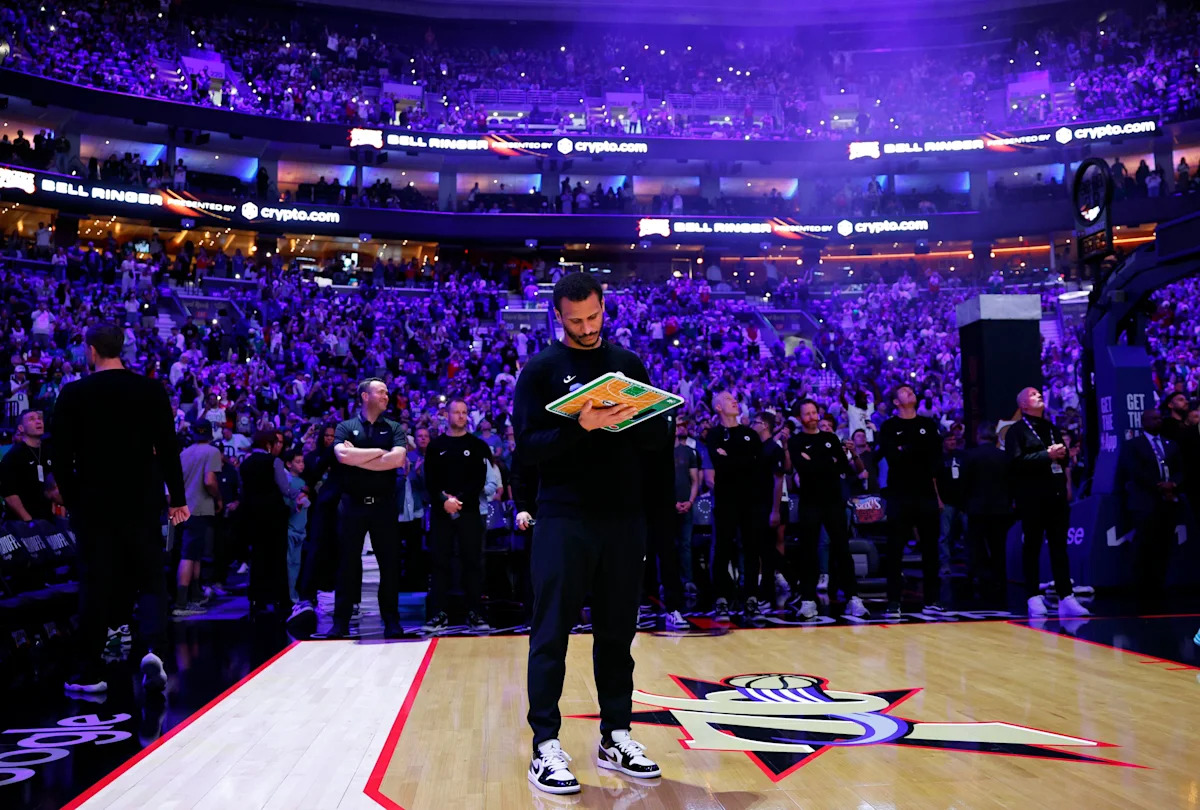
Maybe the challenge for Joe Mazzulla this season isn’t figuring out how to make an imperfect team play perfect basketball.
Maybe it’s trusting that a little imperfection is where some of this team’s best basketball might actually live.
Read the full article here