

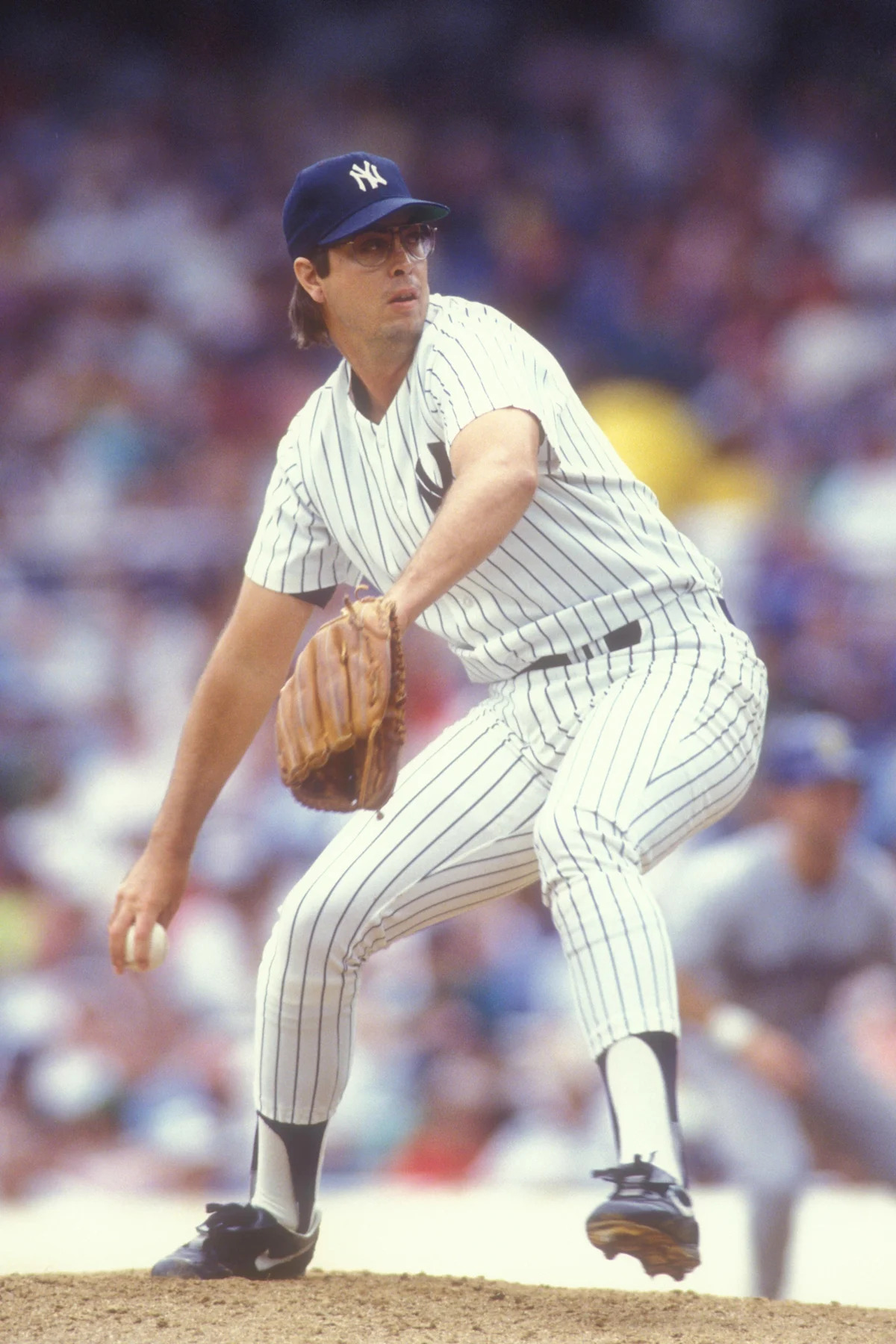
Trivia nights are a fun activity at local bars, breweries, and restaurants. The best part of trivia is confidently knowing the answer once it is asked. If you ever find yourself faced with the question, “Who is the only Major League Baseball player to be traded for the same Hall of Famer twice in their career?” the answer is former Yankee Eric Plunk. Another trivia tidbit: Plunk is not the reason behind the phrase or term “plunk,” meaning to hit a batter. No, that is simply a fun coincidence, as the term was coined well before Plunk was born or started throwing baseballs.
Eric Vaughn Plunk
Born: September 3, 1963 (Wilmington, CA)
Yankees Tenure: 1989-1991
Plunk grew up in California and attended Bellflower High School. He was drafted by the Yankees in the 4th round of the 1981 MLB June Amateur Draft. The 6-foot-5 right-handed pitcher had a plus fastball to go along with a good curveball, but scouting reports noted that Plunk would occasionally lose command of his offerings.
The Yankees had Plunk report to the Gulf Coast League after being drafted. Plunk went on to make 11 starts that season, most of them before his 18th birthday. In 1982, Plunk stayed in rookie ball, this time playing in the Appalachian League. After getting his feet wet playing professional ball, Plunk played the 1983 and 1984 seasons for the Yankees farm team in Fort Lauderdale. Over those two seasons at Single-A, Plunk posted a 20-22 record over 48 starts with a 2.81 ERA in 301.1 innings and had established himself as one of the Yankees’ top prospects.
Everything changed for Plunk on December 5, 1984. On that day, he was traded by the New York Yankees with Tim Birtsas, Jay Howell, Stan Javier, and José Rijo to the Oakland Athletics for star leadoff man Rickey Henderson, Bert Bradley, and cash.
Oakland assigned Plunk to their Double-A affiliate to start the 1985 season. Plunk made 13 starts in Double-A, going 8-2 with a 3.52 ERA. That was good enough to get the call-up to Triple-A Tacoma. Plunk would struggle and have to grind out the rest of the season, going 0-5 with a 5.77 ERA.
To start the 1986 season, Plunk was back in Tacoma. After making six starts, Plunk received his first call-up to the major leagues. Plunk made his debut against Toronto on May 12. Plunk stuck on the roster and finished the season with the Athletics, logging 120.1 innings, making 15 starts and appearing in 11 more games as a reliever.
After the season, the Athletics decided they wanted to see what Plunk could be as a reliever. He started the 1987 season back in Tacoma, but was called back up after tossing 34.2 innings with a 1.56 ERA out of the pen, picking up 9 saves in less than a month. Over the rest of the 1987 season in the show, Plunk appeared in 32 games, 11 of which were starts. His final line was 4-6 with a 4.47 ERA and two saves in 95 innings.
Heading into the 1988 season, the Athletics decided to use Plunk as one of the primary set-up men for Hall of Famer Dennis Eckersley. In 1988, Plunk threw 78 innings, all out of the pen, and posted a 3.00 ERA to go along with a 7-2 record. The Athletics made the playoffs after winning the AL West, eventually losing to the Dodgers in the World Series. Plunk worked 2.0 clean innings in the 1988 playoffs.
OAKLAND – MAY 18: Eric Plunk of the Oakland A’s pitches in a Major League Baseball against the New York Yankees on May 18, 1989 at the Oakland-Alameda County Coliseum in Oakland, California. (Photo by David Madison/Getty Images) | Getty Images
In 1989, Plunk would make history. After a solid start to the season, on June 21, he was traded from Oakland along with Greg Cadaret and Luis Polonia to the New York Yankees for Rickey Henderson. This was the first and only time to date that a player was traded for the same Hall of Famer twice. The Athletics, with Henderson, would go on to win the World Series in the Battle of the Bay. Plunk, coming full circle back to the team that drafted him, went 7-5 with a 3.69 ERA in pinstripes in 20 relief appearances and 7 starts. The Yankees would finish the season in 5th place in the division.
The Bombers would move Plunk back into his full-time relief role for the 1990 season. Plunk tossed 72.2 innings in 47 games. His ERA was 2.72. The team, however, was not good at all. Posting a record of 67–95, it was the Yankees’ first last-place finish since 1966 and the first last-place in the division era. 95 losses is the most ever by the Yankees, as the 103 losses in 1908 were by the Highlanders.

NEW YORK, NY – JULY 01: Eric Plunk #33 of the New York Yankees pitches during a baseball game against the Cleveland Indians on July 1, 1991 at Yankee Stadium in the Bronx borough of New York City. (Photo by Mitchell Layton/Getty Images) | Getty Images
Plunk was with the Yankees for all of the 1991 season. The team was better, but still not very good. Despite being such a strong reliever, the Yankees decided to use Plunk for spot starts in addition to relieving. Plunk’s ERA went up more than 2 full runs, and he was released by the Yankees following the season.
Prior to the 1992 season, Plunk signed with the Blue Jays but was cut after spring training. He then landed in Cleveland. The Land is where Plunk would spend the next seven seasons. Just like when he arrived in Oakland, Plunk found himself on another team that was on the verge of making a few World Series runs. In another fun piece of trivia Plunk was the first pitcher to win a game at Jacobs Field. Across those seven years in Cleveland, Plunk pitched 462.0 innings, all in relief. His record was 36-33 with a 3.25 ERA, and he picked up 26 saves.
In July of 1998, Plunk was traded by Cleveland to the Milwaukee Brewers for Doug Jones. Plunk pitched the rest of 1998 and the 1999 seasons for the Brewers. In 107 innings, he posted a 4.63 ERA and went 5-6. Plunk tried to play the 2000 season but appeared in 7 games for the Cubs’ Double-A affiliate before hanging up his spikes.
Over a 14-year career, Plunk went 72-58 with a 3.82 ERA. In total, at the major league level, he threw 1,151.0 innings and pitched in two World Series. He was hurt for Cleveland’s 1995 loss, but his teams could not pull off the win in either.
After his playing days ended, Plunk remained attached to baseball. Back in California, he started coaching and working privately with players looking to further their development at The Institute of Sports & Education in Corona, CA.
Happy birthday, Eric!
Read the full article here