

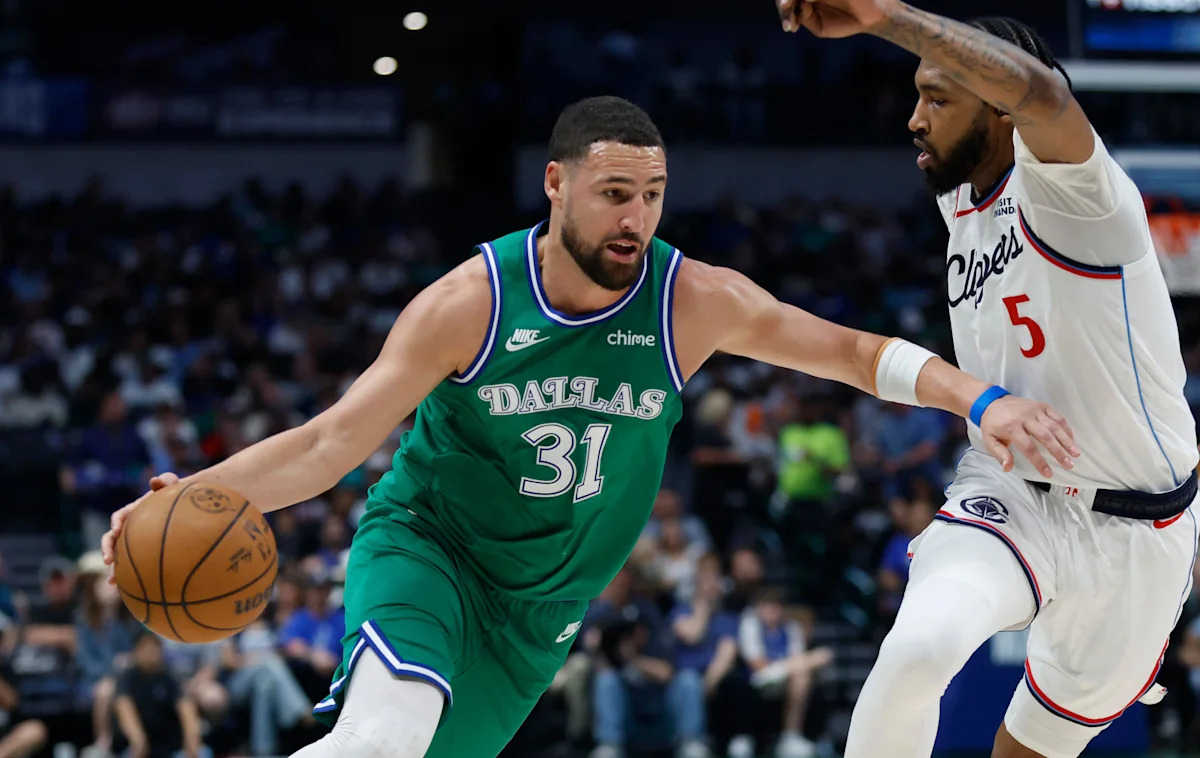
After two seasons with the Dallas Mavericks, Klay Thompson was ultimately reduced to a status ill-fitting with his Hall of Fame career. At the end, Thompson became an asset that the Mavericks couldn’t get anything for.
Sure, he’ll start his age-37 season in a couple months, now with the Miami Heat, after the Mavs bought out the final year of his three-year, $50-million contract on Friday. And sure, he can no longer defend like he once did or get up and down the court like he once did.
But the primary reason the Mavericks found it so difficult to find a trade partner in a deal for Thompson, which would have reportedly been the team’s preference, is, you guessed it. The NBA salary cap. To those familiar with cap-related intricacies, that’s obvious, but let’s go over the confluence of salary cap factors that contributed to the Mavs finally throwing their hands in the air and letting Thompson get away and go to Miami in return for a big wad of nothing.
Why would the Mavericks buy Thompson out?
On an expiring deal and with still with at least a little something still in the tank, you’d think Thompson would still hold at least some minute shard of value on the trade market. But going into his 14th season, he was never going to be a piece of any team’s long-term build. He was only ever going to attract attention from teams who felt like they were one player away from contending or competing for something meaningful.
The final year of his deal with the Mavericks was worth $17.5 million. Just two months before the start of the season, the number of teams that fit that bill is relatively small. The number of teams that fit that bill and also have enough cap space to absorb $17.5 million in exchange for what they view as Thompson’s worth is even smaller. The kinds of teams that would have an interest in Thompson would also, by definition, already be approaching the cap or the first apron hard cap.
Enter the Miami Heat. Murmurs centered on the idea of forward Nikola Jovic being packaged in a creative way and coming back to Dallas were just that. Even though the youngster makes similar money to Thompson, the Heat would never have done a deal sending Jovic to Dallas, especially after emptying the cupboard of most of their young talent in trading for Giannis Antetokounmpo this offseason.
But wishcasting creative trade scenarios misses the most obvious point here. With Thompson on the roster, the Mavericks were at 16 players with guaranteed contracts. You can’t ride into the season with 16 on the roster. Sending Thompson out and getting one player back was never really an option for Dallas.
An NBA team usually only buys a player out if it’s the last available option. We had reached that point here.
You mean they couldn’t get anything for him?
Not in terms of players coming back, no. So, ok. What about the ever-popular four-team Stretch Armstrong trade machine idea you just cooked up in your NBA Galaxy Brain? That would require finding that many teams interested in participating, each with something to gain and each with the cap room to make the Galaxy Brain deal work.
We’ve already established that the number of teams with wiggle room in late August under the highly restrictive cap system the NBA employs is a very small one.
Not even like a second-round draft pick?
Count me among the many who would have taken even one solitary future second-round draft pick to get off of Thompson’s contract, but doing one player for one draft pick is just as impossible, as it would require the team taking Thompson to have $17.5 million to work with under whatever rung of salary cap hell it was willing to exist in.
Again, a team looking to contend in 2026-27 by definition probably does not have $17.5 million of loose change to spare in late August. They have spent it all to field a team that the front office thinks is a winner. And, again, bringing more teams into the equation makes it less possible, not more, at this point.
Mavericks’ salary cap implications for 2026-27
Before buying Thompson out of the last year of his deal, the Mavericks sat roughly $2.2 million under the luxury tax line, which is set at $200 million and change. If Thompson signs the two-year, $13-million deal reported by multiple outlets, Dallas’ salary on the books for the 2026-27 season would decrease further between $3.9 million and $6.5 million. Thompson cannot be officially signed until Sunday, 48 hours after the buyout is completed.
They would still be operating over the soft cap of $164.961 million, but under both aprons and under the luxury tax, just as they were before the buyout. It’s a convoluted way of saying that the move really doesn’t do a whole lot other than put at least $3.9 million back into the pockets of the Adelson-Dumont Regime. Which, when you think about it, isn’t that what basketball is all about? It couldn’t have happened to a better bunch of folks, am I right?
The Mavericks put themselves in this position by assembling all sorts of questionable assets during Nico Harrison’s tenure as general manager and by being unable to dump all of what needed to be dumped. Getting nothing of value and liking it in exchange for a player like Thompson is one of the remnants of that calculus.
Read the full article here