

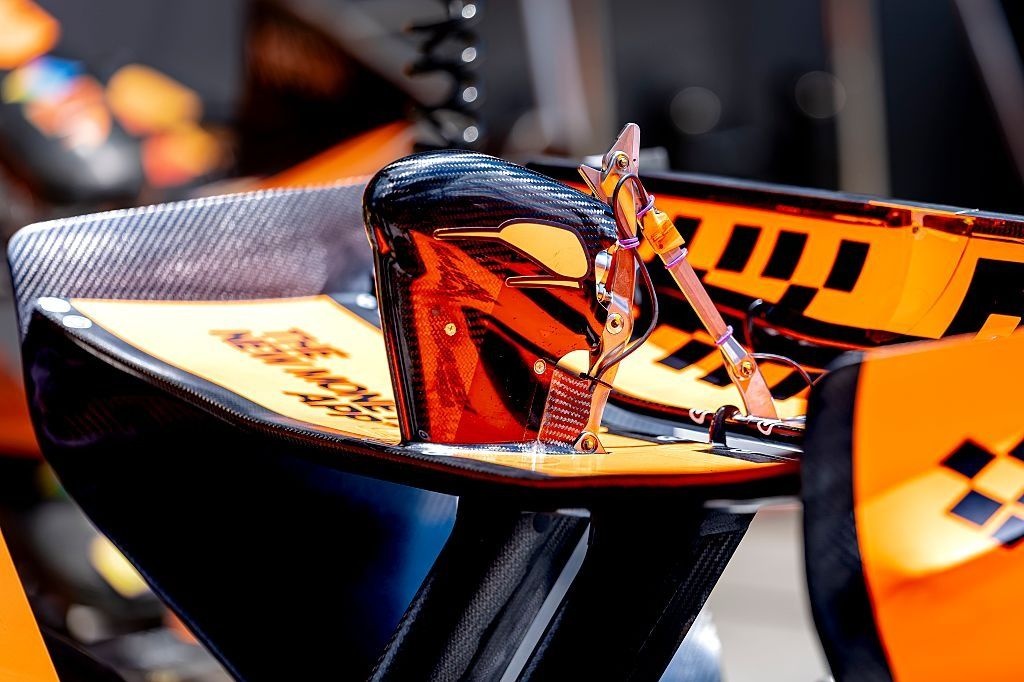
McLaren will race its version of the so-called ‘Macarena’ rear-wing concept – but not until an unspecified point in the future, according to team principal Andrea Stella.
It’s understood that the reason for not rushing to race the new rear wing is not linked to Red Bull’s well-documented issues with its similar design. Instead, McLaren is being cautiously pragmatic, since the rotating rear wing adds to the complexities of managing car behaviour as it moves in and out of Straight Line Mode (SLM).
McLaren planned to test its new wing in Austria but made a late decision to abandon the evaluation. It then waited until Hungary to run it for the first time in FP1 on Lando Norris’ car.
Max Verstappen crashed at the Red Bull Ring and Silverstone, prompting his Red Bull team to temporarily shelve its pivoting rear wing based on suspicions that a delay in airflow reattachment when the wing returned to cornering mode made Verstappen’s car unstable.
“I have to say it’s been a complicated project,” Stella told media including Autosport.
“Which was no surprise because when we saw Ferrari introducing the wing in Bahrain test and testing it in China in the first lap, [Lewis] Hamilton spun. And then it took a few more events to actually being in condition to race it.
“We knew it was going to be a complex project, so I have to say that our engineering department has delivered this project in a way that looks well-behaved – like the wing in terms of mechanical actuation, times of the actuation, because there’s some limitations by the regulations, not only for aerodynamic reasons.
Ferrari was the first team to run its rotating rear wing, which operates differently to the McLaren and Red Bull examples
Photo by: Alastair Staley / LAT Images via Getty Images
“And then the overall behaviour from an aerodynamic point of view, reattachment – so the time it takes for the car to regain the load, not only the load on the wing, the load on the entire car as driven from the wing.
“All this I have to say has been pretty consistent with expectation, so it’s been a positive sign off of this concept and we look forward now to introducing this concept at some future events.”
These concepts are a classic example of thinking-outside-the-box creative engineering that is possible for the first time this season because the regulations are relatively open. F1 first adopted the principle of legally shedding drag in a straight line with the Drag Reduction System (DRS) in 2011, which permitted the upper rear wing plane to flatten in prescribed areas of the track.
The speed and actuation procedure for this was clearly defined, along with the dimensions of the wing planes themselves. But under the new ruleset introduced this season, in which front and rear wing flaps can open in specified Straight Line Mode zones, the speed of transition from one state to the other is defined (within 0.4s), but not the means by which it moves between open and closed.
McLaren’s pivoting rear wing is closer to Red Bull’s than Ferrari’s, in that it uses a central actuator to manage the rotation rather than having a mechanism built into the endplates. Also like Red Bull’s, it pivots forwards rather than backwards.
The means of actuation gives it an element of air braking as it closes. The trade-off between the two concepts is that Red Bull and McLaren accept a degree of aerodynamic blockage from the actuator and its shroud in exchange for having a wider space between the upper and lower planes when SLM is active.
Ferrari’s also has to take a longer path between open and closed because of the angle of rotation.
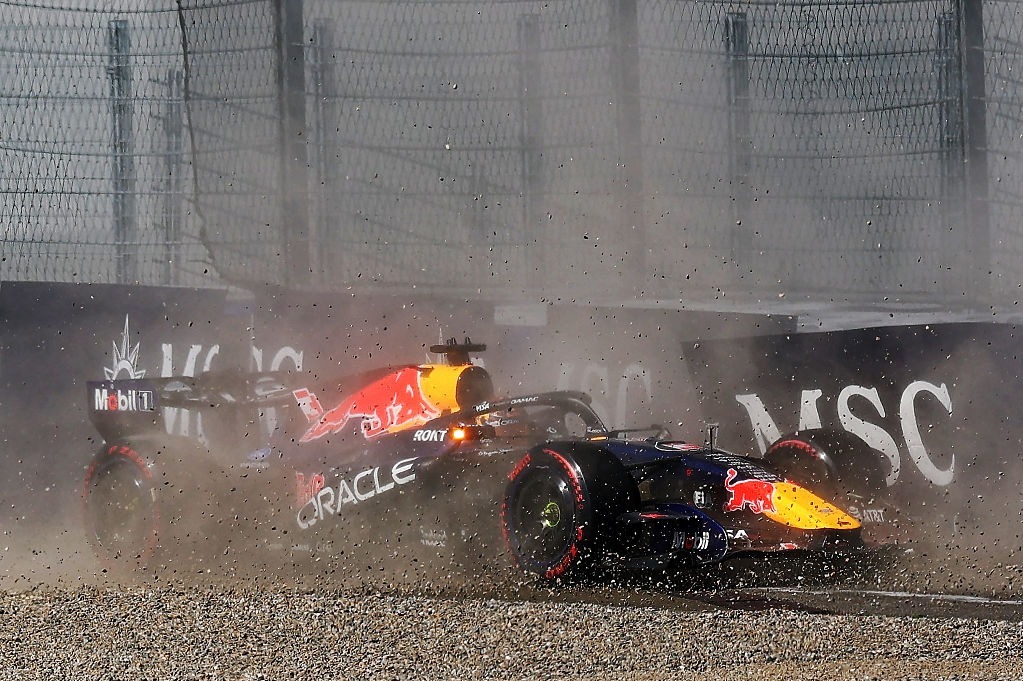
Verstappen shunted in qualifying in Austria, and a delay in airflow reattachment to the rear wing was cited as one possible contributory factor
Photo by: Getty Images
One of the less predictable effects of the new regulations has been the shift in tyre loading during the transition between SLM being on and off. This is because the airflow doesn’t reattach to the wing planes instantly, but takes fractions of a second to re-establish its path.
Teams knew ahead of the season that this would be a significant performance factor, but were unable to measure it accurately with simulation tools such as the wind tunnel and Computational Fluid Dynamics (CFD).
The true extent of the shifts in loadings, and their effect on car behaviour, could only be measured at the track.
This also applies to the theoretical benefits of the rotating rear wings. The airflow around the rear of an F1 car is tremendously busy because of the interaction between the car’s aerodynamic surfaces and the turbulent wake of the rear wheels.
Simulating this with great accuracy is very difficult in the wind tunnel, where model size is capped at 60% scale and the wind is generally blowing in one direction. Historically it is difficult to access a car’s aerodynamic performance when it’s in a state of yaw (i.e. turning), or facing different wind directions. The different deflection properties of the model tyres, as well as their smaller size, also has a tendency to skew results.
Hence McLaren has done a lot of FP1 running with large aero rakes fitted behind the rear wheels to validate substantial bodywork changes such as the latest-spec floor, introduced in Hungary, as well as its pivoting wing. Practical measurements trackside are the real proof (or otherwise) of any theoretical gains.
“There was a question about comparison with Red Bull, but I don’t think the wind tunnel is a major factor in terms of determining the aerodynamic behaviour in reattachment,” Stella said.
“I think you can use some other tools for that, and then the most important tool, especially when you have this sort of complicated project, even from an aerodynamic point of view, remains what you observe at the track. So it was important for us to acquire data here trackside, because you would have never relied on a wind tunnel only for such a delicate project.”
We want to hear from you!
Let us know what you would like to see from us in the future.
Take our survey
– The Autosport.com Team
Read the full article here