

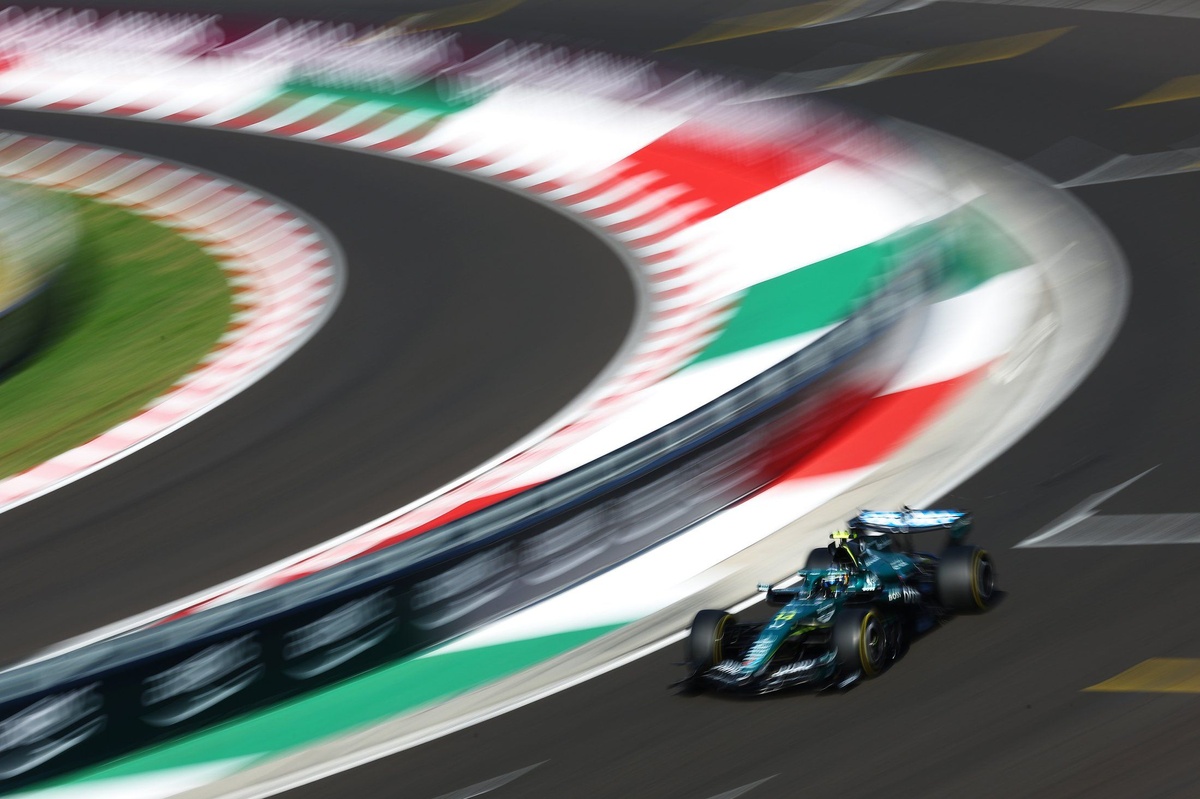
Aston Martin has been a mainstay of the Q1 elimination zone across the 2026 Formula 1 season, never once progressing to Q2 during the first 10 grand prix qualifying sessions of the year. Fernando Alonso broke into the second stage of sprint qualifying in Canada, but his shunt at Turn 3 in SQ1 stopped him from competing any further in the session.
Left significantly behind the eight-ball at the start of the year thanks to a spate of reliability issues, Aston Martin delayed its aero updates until the Hungarian Grand Prix, plotting the first stage of its recovery mission with a smorgasbord of new parts. The front end received a significant redesign, the sidepods were reworked, the floor was updated, and the rear end of the car also received plenty of attention.
Alonso’s break into Q2, then, was something of a boost to Aston Martin’s confidence. But how much were the updates worth? Let’s attempt to work that out based on the figures available to us.
Aston Martin’s regression without updates
The introduction of the updates followed the team’s regression, as the other teams improved with their own piecemeal improvements over the opening 10 rounds. In the first five races, Aston Martin was an average of 4.028% slower than the theoretical best laps of the weekend and in the subsequent five, this fell sharply to 5.311%.
Let’s outline this in terms of numbers to make the percentages seem more easily digestible. Let’s assume for a given circuit that the final Q3 lap was a 1m30.000s, or 90 seconds, which gives us our 100% time. Taking those averages, the Aston Martin would be expected to set a 1m33.625s in the opening five races, and a 1m34.780s in rounds five to 10.
This example suggests that Aston Martin physically got slower, so please consider this as a measure of the progress made by the other teams. To simplify this, the quickest Aston Martin time started out as 3.625s off the pace in the first example, and fell to 4.780s off in the second.
Fernando Alonso, Aston Martin Racing
Photo by: Alastair Staley / LAT Images via Getty Images
If nothing else, these deltas lend credence to one of F1’s oldest axioms: to stand still is to go backwards. In a situation with a steep development curve, as the first part of 2026 has shown, many teams have been caught out by this.
At the Belgian Grand Prix, Aston Martin was 5.405% behind Mercedes – the pacesetter that weekend, Alonso’s 1m50.002s paling in comparison to Kimi Antonelli’s 1m44.361s. That’s a 5.641s gap, albeit perhaps one exacerbated by the layout of the circuit, but the percentage deficit is consistent with those across the previous four races.
With the updates applied in Hungary, Alonso’s Q2 effort put him just 3.369% away from Lando Norris’ ultimate lap in Q3. In a direct comparison between the most recent two qualifying sessions, that’s a gain of 2.036%.
Hungary is not directly comparable to Spa, so it’s difficult to work out what the time gain is by comparing those sessions directly. But if we assume the 90-second lap again and plug those percentages in, we have an answer.
How much time has Aston Martin gained?
At Spa, we have our 5.405% deficit; assuming the best lap of the weekend is a 1m30.000s, this gives Aston Martin a 1m34.864s lap. That’s just under a tenth shy of our round five to 10 average, so it’s in the ballpark of the regression we’ve seen.
Using Hungary’s 3.369%, this brings Aston Martin up to a 1m33.032s lap. Over a 90-second lap, this gives a gain of 1.832s.
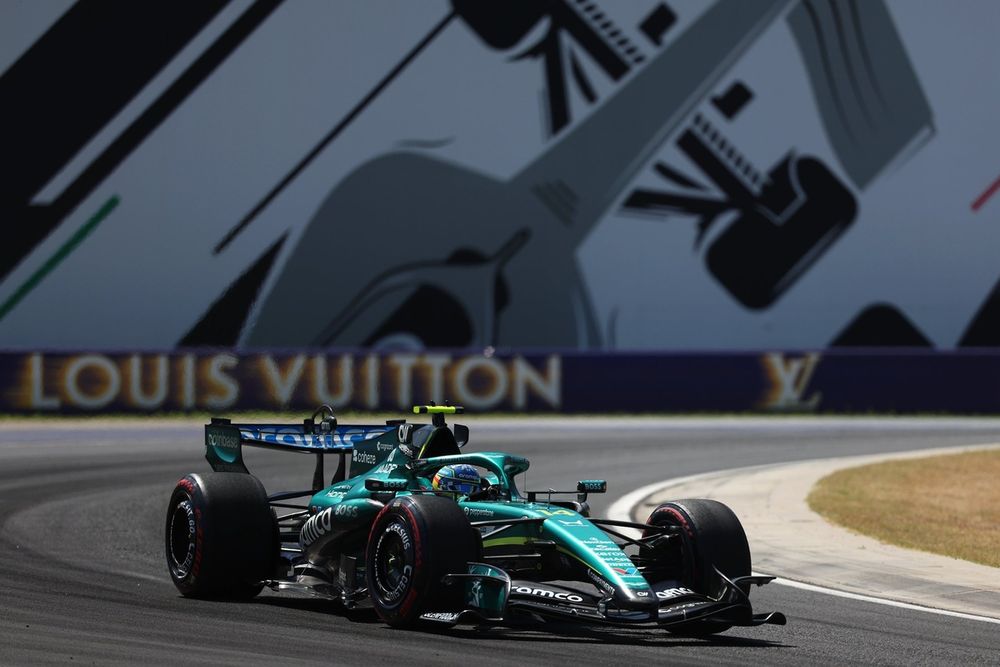
Fernando Alonso, Aston Martin Racing
Photo by: Alastair Staley / LAT Images via Getty Images
Let’s apply this theory to each of the two circuits: how would Aston Martin have performed in Spa with the new updates, and how would Aston Martin have fared in Hungary if it decided to delay the updates to after the summer?
Our best lap from Spa was Antonelli’s 1m44.361s, so using the 3.369% deficit, this brings Aston Martin onto a 1m47.877s. This isn’t enough to break out of Q1, but it would be enough for one of the Aston Martins to split the Cadillac pair. It is, nonetheless, a 2.125s gain on Alonso’s best time from Q1 in Belgium.
Had Aston Martin held back the updates for Hungary, its theoretical maximum would be a 1m21.380s, which would have yielded – unsurprisingly – a back row spot.
It does, however, put the Aston Martins a lot closer to the Cadillacs compared to the two-second deficit seen in Spa, demonstrating that the American team suffered a bit in the high-downforce stakes. Either way, Aston Martin theoretically gained 1.572s by running the update at the Hungaroring.
To answer the question the headline, the answer is “it depends on the circuit”, but over what we’d consider an average medium-length circuit where the pole time is circa 90 seconds, the updates have offered about 1.8s on one-lap pace. Assuming Hungary and Spa are the extremities of our range, it’s a gain of anywhere between 1.5s-2.1s depending on the length of the track.
How that carries over into race pace will be unknown, as we’ve not really seen any long runs from Aston Martin over the weekend, but if it’s running about 0.7-0.8s per lap faster than the Cadillacs on average across the race, then we can assume that the bulk of the pace has carried over onto Sundays.
We want to hear from you!
Let us know what you would like to see from us in the future.
Take our survey
– The Autosport.com Team
Read the full article here