

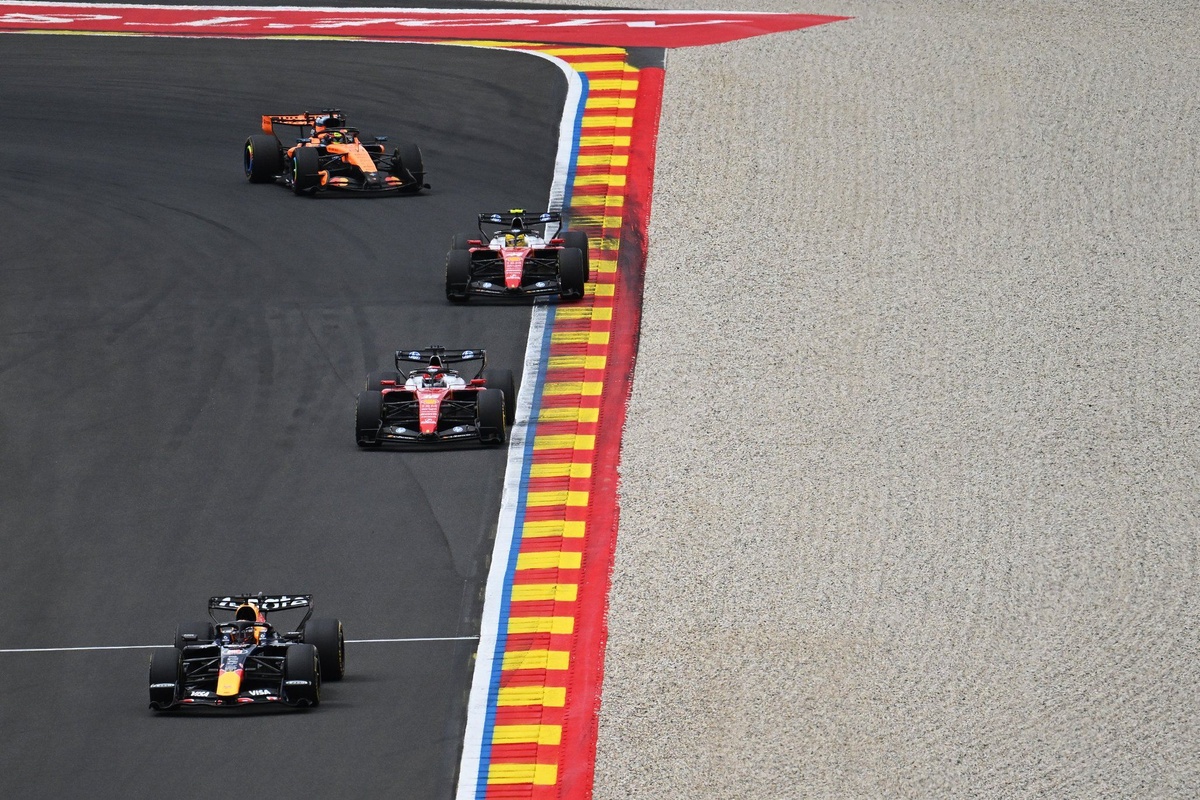
When the assembled media gathered in the McLaren hospitality on Saturday for Andrea Stella’s session, the team boss shared one of the most revealing quotes of this Formula 1 season.
“When we try to analyse this, it gets immediately quite complicated,” he said. “In fact, when I left the debrief to come here for this media session, there were still discussions ongoing as to why we see differences when these differences would not be scheduled in terms of the underlying parameters.”
In other words, F1 teams themselves do not always fully understand what is going on. That was the case for McLaren on Saturday evening, when Oscar Piastri lost a great deal of time to Lando Norris on the straights, and seemingly also for George Russell – who admitted in the media pen that he had no idea what was causing his straight-line deficit.
What exactly is happening?
According to Stella, it was related to the power unit’s “self-learning elements”.
This is not artificial intelligence in the way most people know it, but rather the effect of forward-thinking algorithms and self-learning systems that, based on many parameters, effectively predict the optimal deployment strategy.
It means the algorithm learns from previous laps, constantly adapting to the input it gets from the driver to optimise deployment for the next one, something Piastri said also applies to an out-lap.
“The engines are so complicated, they are sensitive to everything,” he said. “Even things you do on an out-lap can dictate what happens [next]. So, it’s a very tricky way of going racing, but it’s what we’ve got.”
The anticipation does not only take place from one lap to the next, but even during a lap itself. If there is a slight deviation from what is expected based on the settings and simulations, the algorithm predicts the optimal deployment strategy for the remainder of the lap based on that new reality.
This might sound positive, but naturally, it can catch drivers by surprise. The clearest example from last weekend involved Isack Hadjar in Q3. The Frenchman wanted to give Max Verstappen a tow and therefore waited for the four-time world champion on the exit of Turn 14.
Isack Hadjar attempted to tow his Red Bull team-mate in qualifying
Photo by: Andy Hone/ LAT Images via Getty Images
That was, naturally, not in line with the pre-determined deployment strategy, meaning the power unit became confused and Hadjar received an unexpected response when he got back on the throttle.
“What is difficult is to guess what the engine is going to give you, because once you stop out of Turn 14 and deliver the power again, the engine is a bit confused because you’ve stopped for no reason. The software is confused,” Hadjar said.
“On that first attempt in Q3 I had way too much power, so I pulled away from him. And the second attempt, I didn’t have enough. So if anything, he was catching me and I couldn’t tow him the whole way. That was very difficult to judge.”
While this is an extreme example, the power unit also reacts to much smaller differences. That is exactly why many drivers at Spa admitted they sometimes feel powerless.
“When you’ve got qualifying grids decided by computers behaving or misbehaving, it’s a pretty crap way of going racing,” Piastri explained.
“Here it’s obviously exaggerated a lot and made worse, but yeah, when you come in from a qualifying session, you look at all the corners and go, ‘I’m on par with my team-mate and yet I’m two tenths behind at the end of it’. It’s not a very nice feeling.”
How much influence do the drivers actually have?
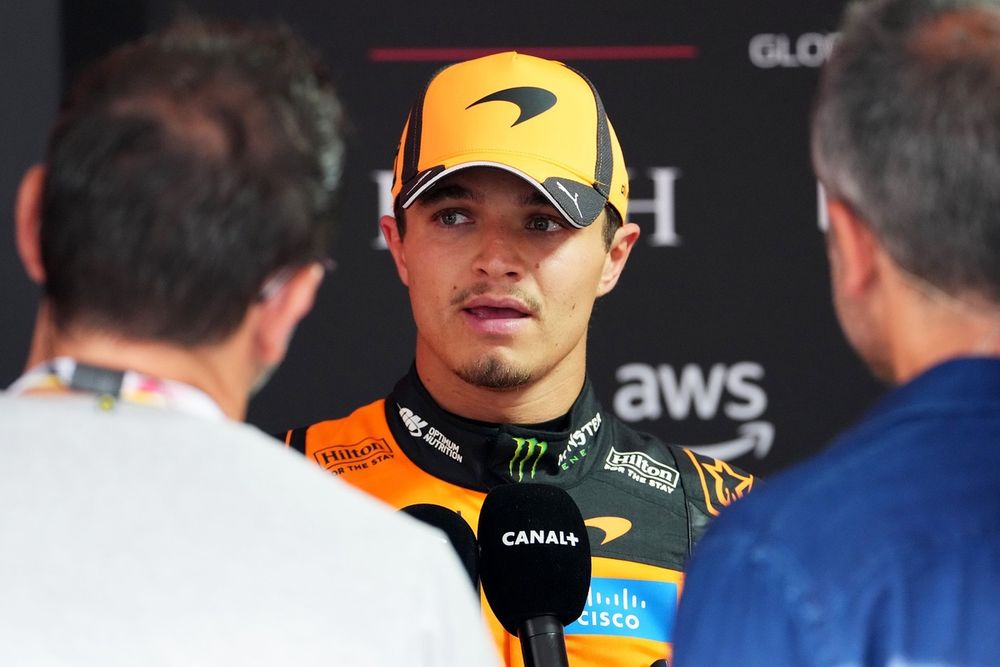
Lando Norris: ‘A lot of things are out of your control’
Photo by: Alex Bierens de Haan / LAT Images via Getty Images
That naturally raises the question of how much influence drivers have over these variations in deployment. Norris answered that question as follows at Spa.
“It’s got nothing to do with you as a driver, really. Sometimes it does and we’re talking about being a few metres early on the button or whatever. It just makes a big difference at times, but there are certain things within your control and a lot of things, way too many things, that are out of your control,” said the reigning world champion when asked by Autosport.
“It’s a shame that there’s so many things that can dictate your own pace in qualifying. It’s not down to the driver. It’s just down to hoping you get lucky that the power unit does what it should do and doesn’t do something silly.”
The answer is somewhat nuanced. Yes, part of it does come down to the driver, but mostly in the sense of extremely small input variations that can make a very large difference.
If drivers lift slightly too late at a certain point or apply more than 60% throttle too early on the exit of a particular corner, it affects the energy management. That is no longer in line with the pre-determined strategy, meaning the algorithm can adapt and anticipate what the optimal approach will be for the remainder of the lap.
It explains why Norris already told Autosport in China that drivers can no longer make the difference by having “the biggest balls”, but only by driving the power unit “correctly” – however unnatural that may sometimes feel.
It also explains why Mercedes initially told Russell after Silverstone that his unexplained deficit on the straights was probably related to his driving style. He worked on that ahead of Spa, but there the Briton concluded that the deficit remained.
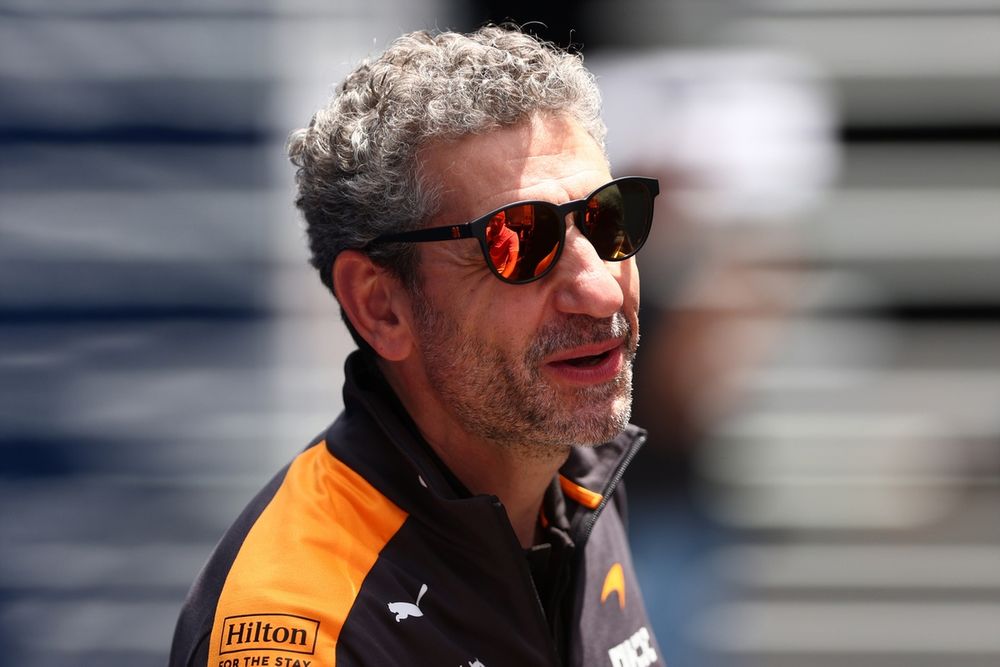
Andrea Stella warns that the “algorithm is sensitive”
Photo by: Marco Canoniero / LightRocket via Getty Images
That ties back to Norris’ comments, and also to what Stella explained over the weekend. According to the McLaren team principal, the tiny differences in driver input tell only part of the story. Other factors are genuinely outside the driver’s control, with changing grip levels and wind being two examples.
“The algorithm is sensitive to external parameters,” Stella explained. “Different would be if you have much more headwind, then the straight would last longer, and this would be a parameter that you can not necessarily include in a very robust way in your modelling, because this one has a certain random character.”
With stronger headwinds, the algorithm effectively assumes that a straight is longer than it actually is, meaning the predicted deployment no longer matches reality and the system anticipates the remainder of the lap based on those new circumstances.
“That’s why we talk about wind, grip level, driver’s input, these things may be more difficult to be captured in a modelling, and therefore in a simulation,” Stella said.
How does this affect the competitive picture?
These factors affect drivers in two different ways. The first is what Piastri and Russell experienced at Spa: less deployment at critical points around the lap, resulting in time loss compared to, for example, a team-mate.
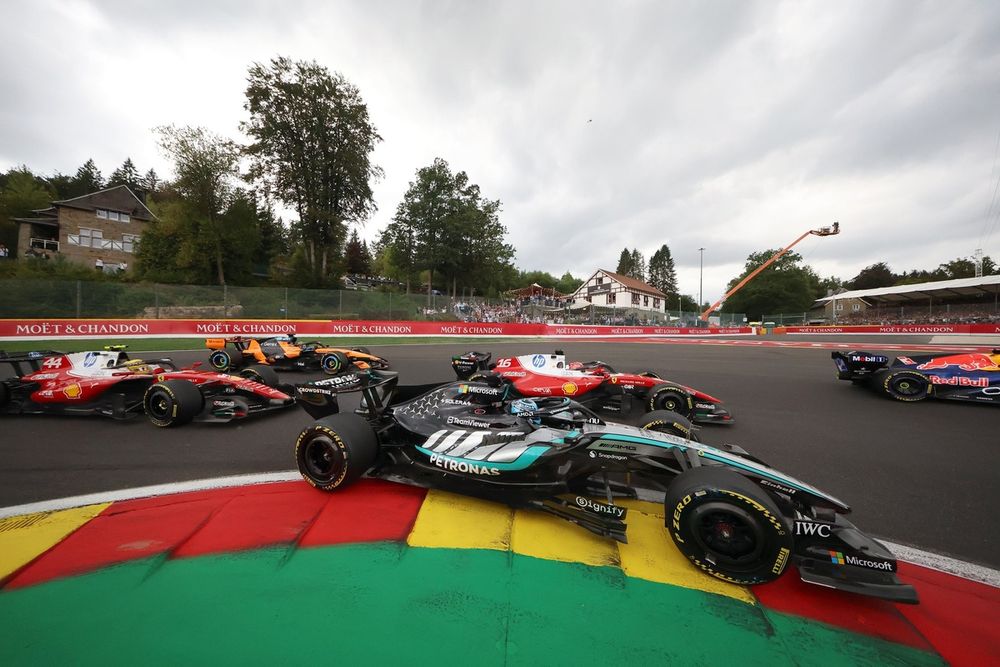
George Russell had deployment issues in Belgium
Photo by: Steven Tee / LAT Images via Getty Images
The second is that, according to Stella, it also affects the driving itself, for instance, because it can influence braking points.
“This is not only for the influence it has in the power-limited sections, in the straights, but also because it affects the braking points,” he said. “If you have an additional amount of harvesting with a super clip before braking, then you are approaching the braking [zone] 10 km/h slower, and your braking point changes.
“This is quite difficult to master, I would say, for the drivers, and it’s one of the reasons why I’m sure the drivers talk about the difficulties to exploit the power unit from a driving point of view. It’s not only to get the most out of the power unit, but also because the variations of the power unit affect the references as you approach a corner.”
It is precisely that unpredictability – and the fact it can be different every lap without the drivers seeing it coming – that makes continuously adapting difficult and, to a certain extent, unnatural.
Is there a solution?
When it comes to the answer to that final question, there is both good and bad news. The good news is that we will probably not be talking about it nearly as much in Budapest and Zandvoort, because those tracks are not as energy-poor and therefore place less emphasis on energy management than Spa.
The bad news is that these issues are unlikely to disappear anytime soon on energy-starved circuits. The first reason is that, according to the teams themselves, they are still being surprised by what Stella described as “random” factors.
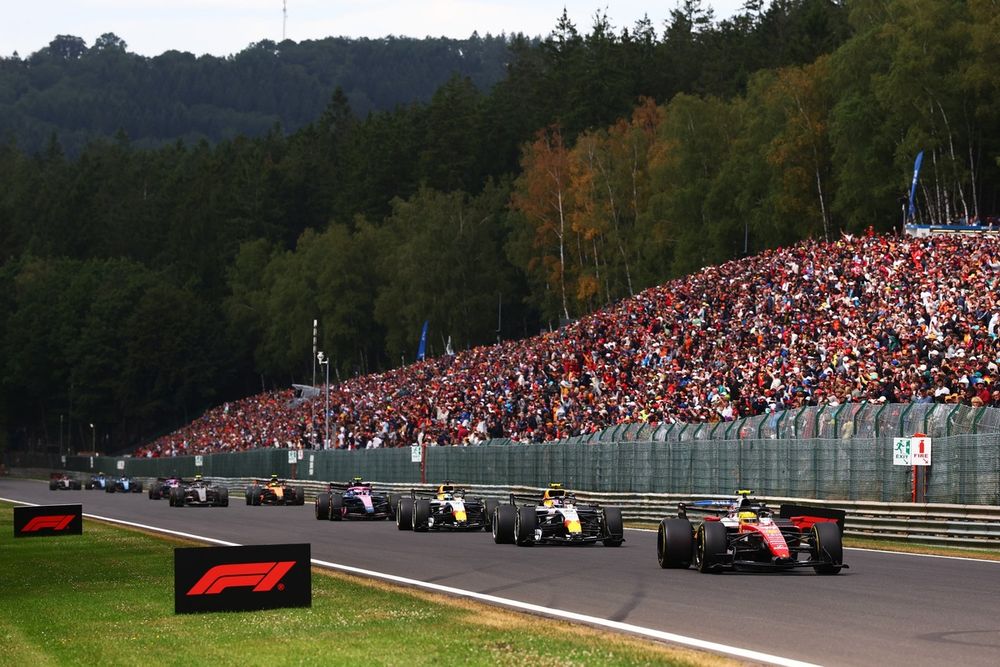
F1 will be susceptible to these “random issues” for some time
Photo by: Andy Hone/ LAT Images via Getty Images
“The investigation that has happened, I think, has only partly clarified or convinced ourselves that we understand the reason why there were deviations from the anticipated pattern of releasing the electrical energy. I think this somehow answers your question in that it’s not that we come here and we have a very deterministic understanding,” Stella admitted when asked by Autosport.
“There’s still some random factors, which I think they are only apparently random. In engineering, things happen for a reason rather than out of chance.
“It’s that sometimes these reasons are so sensitive to little parameters, that it looks like you can’t figure out, at least in the short term, the reason. So I think we are still a little away, I would say a few races away, from having a full understanding of the power unit behaviour and exploitation.”
It is linked to the models and simulation tools used by teams and manufacturers, allowing them to gradually gain a better understanding of these systems and reduce the number of unpleasant surprises. In that respect, McLaren revealed that, ahead of Spa, it had received several Mercedes HPP simulation tools it had been requesting for quite some time.
At the same time, Piastri’s honest assessment is that these characteristics are simply embedded in the DNA of these regulations. Yes, the two-step move towards a 60-40 split in 2028 will reduce the emphasis on electrical power somewhat, but according to the Australian it will not completely eliminate these shortcomings.
“It’s all to do with just how the systems manage things,” he said. “The change in fuel flow and the less deployment are not going to fix those specific issues. It has to do with how the engine is calibrated, how the engine learns, it’s kind of ingrained into these engines.”
We want to hear from you!
Let us know what you would like to see from us in the future.
Take our survey
– The Autosport.com Team
Read the full article here