

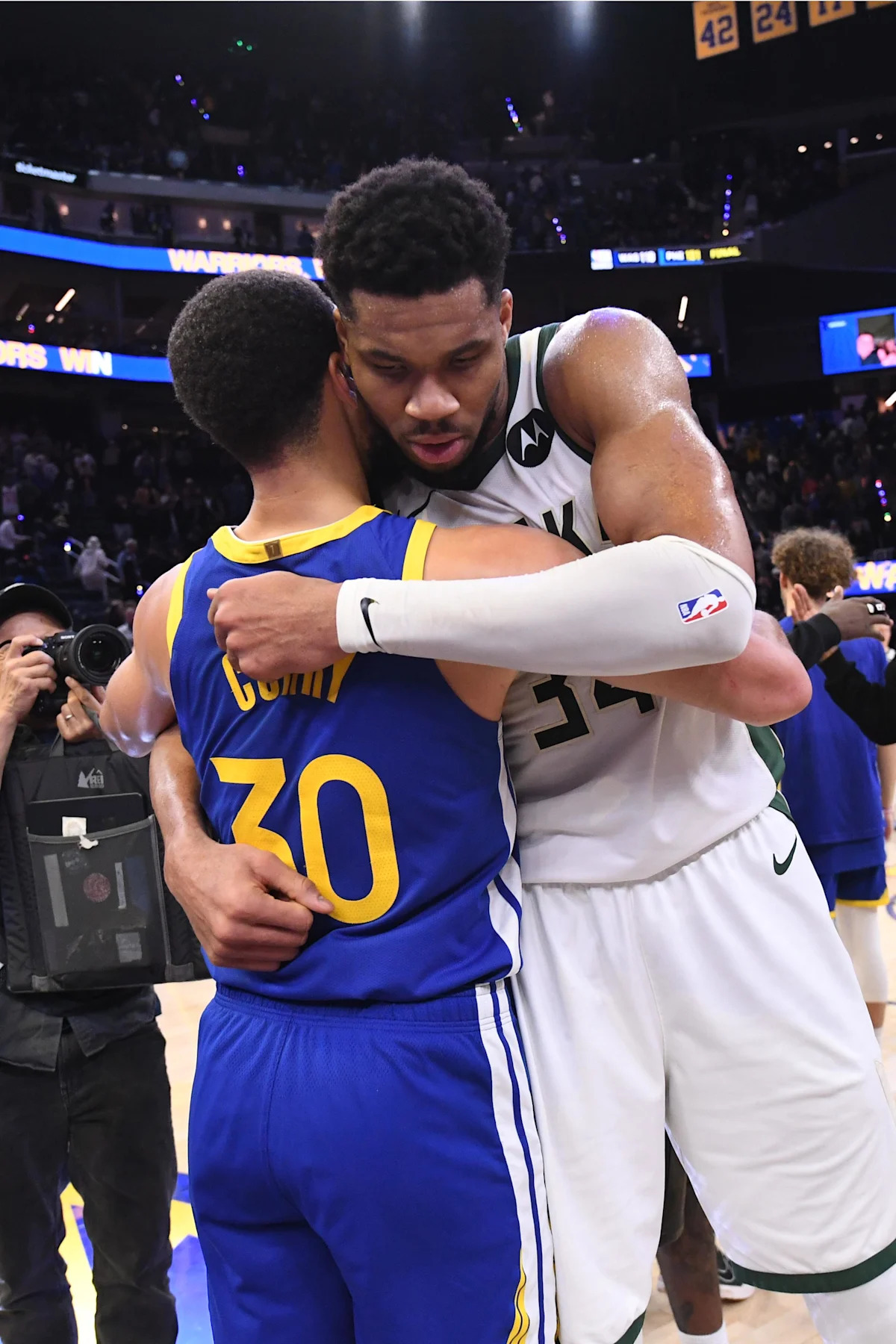
Oakland, June 2015. The Warriors finally break through, Steph Curry is the engine of it, and the Bay Area loses its mind in a way it had been waiting four decades to lose it. People were crying in bars. Strangers were hugging on BART. Nobody at that parade was thinking about an expiration date, they were just thinking about how good it felt to finally have this.
Eleven years later, Steph is still here. Still in the same uniform he won that first one in, still the engine, still hunting ring number five. The same number as Kobe Bryant, Magic Johnson, and Tim Duncan. Sit with that for a second, because that sentence isn’t supposed to include a guy who just turned 38 and still has a real argument for another one.
Now think about how geeked Bucks fans were in 2021. Giannis drops 50 in Game 6, hoists the trophy, and Milwaukee gets its first title in 50 years. Grown men were openly sobbing in the streets. That city felt like it had arrived, like this was the beginning of a run, not the peak of one.
Five years later, with that single championship still the only one on the shelf, Giannis is a Miami Heat player. That’s the entire gap between euphoria and an exit. Every parade feels like it’ll last forever. Almost none of them do. Giannis isn’t in Miami because he stopped being great. He’s in Miami because organizations can fail great players, even the ones who already delivered them a parade.
The deal that got him there is enormous. The Bucks sent Antetokounmpo and Bobby Portis to Miami for Tyler Herro, Kel’el Ware, Jaime Jaquez Jr., Kasparas Jakucionis, three first-round picks, a pick swap, and a second-rounder. That’s a franchise hitting the eject button and hoping the parachute opens before the ground does. And it didn’t happen overnight. The Bucks finally accepted their fate only after a 32-win season, a league investigation, and missing the play-in tournament entirely. Rather than mortgage what little future they had left trying to convince Giannis to stay, they pivoted toward maximizing the return. He was a two-time MVP with a championship already on his résumé, and it still took total organizational collapse to get everyone on the same page.
What got Milwaukee here wasn’t one decision. It was years of them. The locker room reportedly slid into chaos, with center Myles Turner later describing a level of dysfunction around accountability that stunned him once he saw it up close. Antetokounmpo’s frustration with roster construction dated back to the 2023 Jrue Holiday trade, a move one Bucks source openly admitted gutted the team’s defensive identity in exchange for offense they didn’t end up needing.
That’s the part that should scare every fanbase with a generational talent, even the ones holding a trophy. It’s never the trade demand that kills you. It’s the accumulation of small organizational failures that eventually convince a superstar the climb isn’t worth it anymore. The Warriors have made mistakes, plenty of them, but they’ve never let Steph reach the point where the relationship felt like it was quietly eroding underneath him the way Antetokounmpo’s did in Milwaukee. They kept showing him they were still trying, even when the results didn’t always cooperate.
Greatness alone doesn’t keep a superstar in your building, and apparently neither does a championship. Commitment does. Communication does. A front office willing to keep adjusting instead of asking the player to absorb every shortfall does.
Antetokounmpo gave Milwaukee a championship and over a decade of his prime, and five years after the parade, Milwaukee gave him back two fired coaches in three years and a roster that never replaced what it traded away. Of course that ends in Miami.
Steph Curry gave the Warriors four championships, the first arriving eleven years ago, and reshaped a generation’s basketball identity along the way. The Warriors responded by continuing to build around him through every phase of the dynasty instead of treating contention as optional.
Same parade energy. Same euphoria in the streets. One franchise spent the next decade giving its superstar reasons to stay. The other spent five years giving him reasons to leave. That’s how quickly confetti becomes a “For Sale” sign in today’s NBA. Dynasties don’t end because stars suddenly forget how to play basketball. More often, they end because organizations slowly stop earning the trust of the player who built them. Milwaukee found that out five years after the confetti fell. What the Warriors have managed to hold onto might be the rarest accomplishment in the league right now.
Read the full article here