

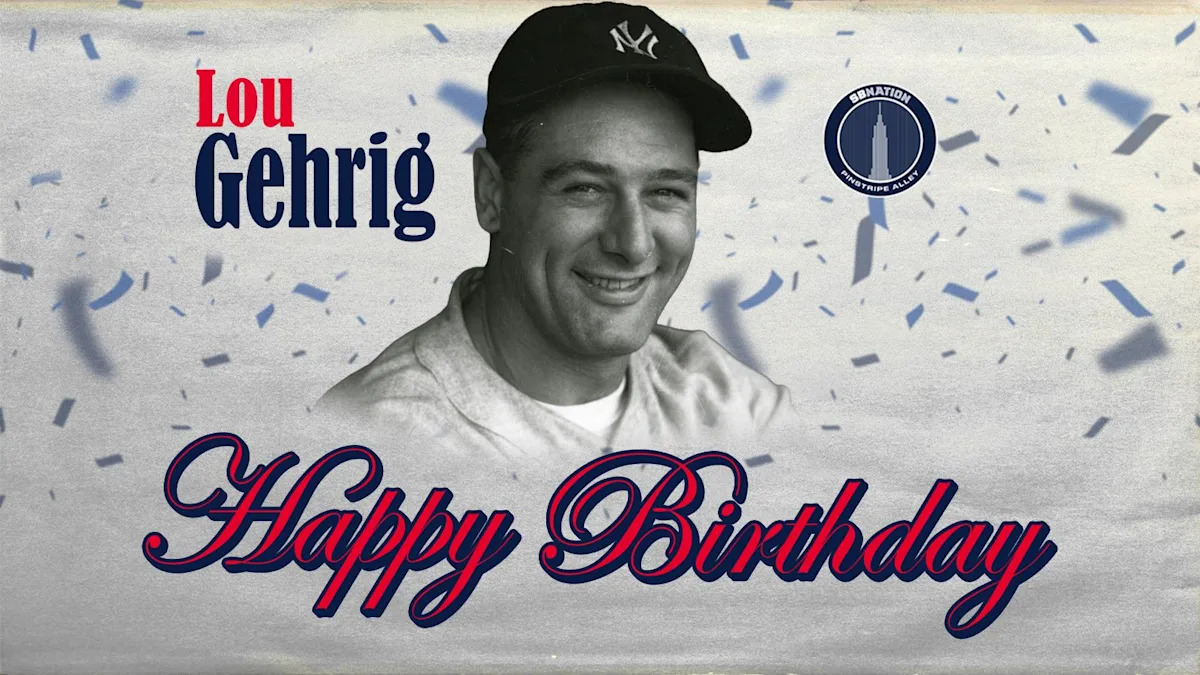
If you were to make a list of the most important baseball players, Lou Gehrig would rank quite high on the list. For one, he would also rank quite highly on the best players of all time list, but his importance goes beyond that. His famous iron man streak, its end, and Gehrig’s subsequent battle with ALS takes him to a level of recognition that goes past him being a Hall of Fame player. While it’s becoming less common as the disease has gained more and more notoriety over the years, but it’s not entirely uncommon to hear ALS referred to as “Lou Gehrig’s Disease.”
Today happens to be the “Iron Horse’s” birthday, so in his honor let’s take a look back at the legendary player, who means so much more than what he did on the field.
Henry Louis “Lou” Gehrig
Born: June 19, 1903 (New York, NY)
Died: June 2, 1941 (New York, NY)
Yankees Tenure: 1923-39
Gehrig was born in 1903 in the place in which he would become famous: New York City. His parents, Heinrich and Christina, were German immigrants who had three other children, but none outside of Lou lived past toddlerhood. Gehrig grew up speaking German at home, and even later formed a bond with Babe Ruth — also of German ancestry — by speaking to each other in the language. While he was growing up, Christina Gehrig was mostly the main breadwinner of the family, working as a maid, as Heinrich often struggled with alcoholism and epilepsy. Lou would often help his mother with her work and the two had a very close bond, with him calling her his “best pal.”
As you might expect as the child of immigrant parents from a place where baseball isn’t much of a thing, Gehrig’s parents weren’t initially thrilled with Lou’s love of baseball, which he formed at an early age. However, it quickly became clear that Gehrig was very, very good at the game. After his high school won the New York City championship, they were invited to take on the Chicago champions at the stadium now known as Wrigley Field. During the game, Gehrig hit a grand slam clear out of the stadium, which would’ve been an impressive feat for a major leaguer, never mind a high schooler.
Despite his baseball skill, Gehrig’s parents still hoped for him to get into business or another field, so he enrolled at Columbia University, where his mother worked at a fraternity house. He still had an eye on athletics, though, as he also played on the college’s baseball and football teams. In one 1923 game, Gehrig struck out 17 Williams College batters as a pitcher. That caught people’s eye, including that of legendary Yankee scout Paul Krichell.
After attending further games, Krichell came away even more impressed by Gehrig’s hitting and excitedly told Yankees GM Ed Barrow that he had found the “next Babe Ruth.” Despite his parent’s earlier reluctance, the money offered by the Yankees proved to be too much to not accept and he signed with the team on April 30, 1923.
In his first two years after signing with the Yankees, Gehrig played just 23 games combined across 1923 and ‘24. Despite that, he showed plenty of potential in his sparse chances, putting up a 209 OPS+ in 42 plate appearances. He also spent some time in the minors with the Hartford Senators, where he also opened eyes with 61 homers in 193 games. His talent was evident, and he was subject of poaching attempts. In 1924, Rochester of the International League tried to get him when the Yankees acquired Fred Merkle of “Merkle’s Boner” fame. However, his shot was on the horizon, and he took it by both hands.
In a moment that now lives in fame, Gehrig was given the start at first base on June 2, 1925. That day, Wally Pipp, a star of the 1923 World Series champions and a Yankee great in his own right, was given the day off. The legend is that he came that day with a headache and Huggins told him to just take the day off and rest. There’s also a line of thinking that, as the Yankees were struggling a bit in ‘25, Huggins decided to just get a look at a still-young Gehrig. Whatever the reason, the only people that day it didn’t work out for were Pipp and the rest of the league. Gehrig went 3-for-5 with a double on June 2nd. He wouldn’t leave the Yankees’ lineup again until 1939.
Huggins stuck with Gehrig for the rest of 1925, and the youngster repaid that faith with a very good season. The Yankees sold Pipp to the Reds the following offseason, confirming that the first base job was Gehrig’s. Gehrig improved in 1926, and then improved even more in 1927, as part of the dominant “Murderers’ Row” team. The 1927 championship was Gehrig’s second as he had been around for ‘23, but it was the first in which he was a regular, and would be the second of his seven in total.
From 1926-38, Gehrig was probably the second best player in all of baseball, behind only his teammate, Babe Ruth. Over the course of those 13 seasons in particular, he hit .343/.452/.640, with 472 home runs, 1913 RBI (cracking the 100+ mark every year), with a 182 OPS+ and 110.1 rWAR. In addition to 1927, the Yankees went on to win titles in 1928, 1932, 1936, 1937, and 1938. With the exception of the final one when he would’ve been in the early stages of his battle with ALS, Gehrig would’ve been the running for Series MVP had the award existed at the time.
The feats just kept on coming for Larrupin’ Lou. On June 3, 1932, he accomplished something that not even Ruth did, swatting four homers in the same game against the Philadelphia Athletics at Shibe Park. He was just the third player to do and the first in American League history. No other Yankee has done it in the 84 years since then; in fact, it’s only been 18 other times by players on any team.
View Link
Also famously, he never took a day off. From taking over the first base job in 1925 until early 1939, Gehrig played every single day, for a streak totaling 2,130. It shattered the previous record of consecutive games played and would take another legend in Cal Ripken Jr. to come along and break it. The fact that all the wear and tear that would’ve come with that streak never really affected his stats is also insanely remarkable.
The final full year of that dominant stretch was 1938, when Gehrig first started to notice that something was off. His stats for that season still ended up at an excellent level for a normal player, but a bit below Gehrig’s usual. He didn’t seem to have quite the power that he once had, noting “I see the ball all right and take a proper cut and seem to connect like I want to, but somehow the ball doesn’t seem to take the proper zoom.”
While Gehrig spent the following winter trying to exercise and regain his strength, the opposite was happening. Upon reporting to spring training, he was struggling even worse than he had the prior year, and even collapsed in the clubhouse on a couple occasions. Upon the beginning of the 1939 campaign, Gehrig went just 4-for-28 at the plate, and looked noticeably slower in the field and running the bases. On May 2nd, he went to manager Joe McCarthy and asked for a day off, the first in over a decade.
As he continued to sit out, Gehrig kept traveling with the Yankees, but the rest wasn’t changing anything. That eventually led to him checking into the Mayo Clinic in Minnesota, still searching for some sort of answer. The one he got wasn’t good. Gehrig was diagnosed with amyotrophic lateral sclerosis — then a relatively unknown condition but an absolutely devastating one. A return to the baseball field was out of the question, and ALS would likely take his life within a matter of years.
After the revelation that he would have to retire, the Yankees announced a Lou Gehrig Appreciation Day would be held on July 4, 1939. The event brought many dignitaries and former teammates out, including Ruth, even though the two had gone through a falling-out in prior years.
The ceremonies were held in between games of a doubleheader that day. After numerous speeches, Gehrig himself was invited to the microphone. While you can probably recite the most famous line by heart, in its echo-y, crackly recorded form, Gehrig said so much more than that on that day, and all of it is worth reading:
For the past two weeks you have been reading about a bad break. Yet today I consider myself the luckiest man on the face of the earth. I have been in ballparks for seventeen years and have never received anything but kindness and encouragement from you fans.
When you look around, wouldn’t you consider it a privilege to associate yourself with such a fine looking men as they’re standing in uniform in this ballpark today? Sure, I’m lucky. Who wouldn’t consider it an honor to have known Jacob Ruppert? Also, the builder of baseball’s greatest empire, Ed Barrow? To have spent six years with that wonderful little fellow, Miller Huggins? Then to have spent the next nine years with that outstanding leader, that smart student of psychology, the best manager in baseball today, Joe McCarthy? Sure, I’m lucky.
When the New York Giants, a team you would give your right arm to beat, and vice versa, sends you a gift — that’s something. When everybody down to the groundskeepers and those boys in white coats remember you with trophies — that’s something. When you have a wonderful mother-in-law who takes sides with you in squabbles with her own daughter — that’s something. When you have a father and a mother who work all their lives so you can have an education and build your body — it’s a blessing. When you have a wife who has been a tower of strength and shown more courage than you dreamed existed — that’s the finest I know.
So I close in saying that I might have been given a bad break, but I’ve got an awful lot to live for. Thank you.
After the festivities of that day, Gehrig retired back to his Bronx home with his wife, Eleanor, who he had met in Chicago back during the 1932 World Series. Mayor Fiorello La Guardia appointed him to a term as a New York City Parole Commissioner, which he performed for the remainder of his life. Said life sadly only lasted a little while longer. On June 2, 1941, Gehrig passed away just a few weeks shy of his 38th birthday, an age at which plenty of players are still on the field.
Following his death, Eleanor Gehrig devoted the rest of her life to ALS research and never remarried. A regular to Yankees Old-Timers’ Day, she did everything she could to keep his memory alive until her own passing in 1984. She said of Lou, “I would not have traded two minutes of the joy and grief with that man for two decades of anything with another.”
Just as a player, Lou Gehrig is an unquestionable Yankees and baseball icon. However, he also means so much more than that in many ways.
See more of the “Yankees Birthday of the Day” series here.
Read the full article here