

Although 2,500 miles apart and in different leagues and divisions, the Tampa Bay Rays and Los Angeles Dodgers have two notable ties binding the franchises together. One is renowned front office head Andrew Friedman, who spent the first decade of his baseball operations career with Tampa Bay before heading west to help build the Dodgers into the behemoth they are today. The other is their meeting in the 2020 World Series, one of the most unusual Fall Classics in league history given its neutral-site conditions during the coronavirus pandemic.
This week in Los Angeles, the Rays and Dodgers squared off in their annual regular-season interleague showdown. Just nine players who participated in that World Series are still around six years later, and two of them have changed sides (pitchers Tyler Glasnow and Blake Snell). Snell and Glasnow were unavailable to pitch for the Dodgers against their former team this week, as they remain on the injured list with fellow 2020 holdovers Will Smith and Kiké Hernández. That left five others — Mookie Betts, Max Muncy, Blake Treinen, Yandy Diaz and Shane McClanahan — plus managers Dave Roberts and Kevin Cash (the two longest-tenured skippers in MLB) as the only Dodgers and Rays who might’ve had memories from Globe Life Field evoked by facing off against each other.
Beyond the history, this week’s three-game set carried intrigue considering the ballclubs’ current place in the standings. The Dodgers and Rays entered Monday with the second- and fifth-best records in MLB, respectively, with these three games presenting a chance for each side to make a statement about where it ranks on the short list of the best teams in baseball. The Dodgers seized on that opportunity, sweeping the series in narrow but impressive fashion and putting another feather in the cap of the National League, which has looked much stronger than the American League this season.
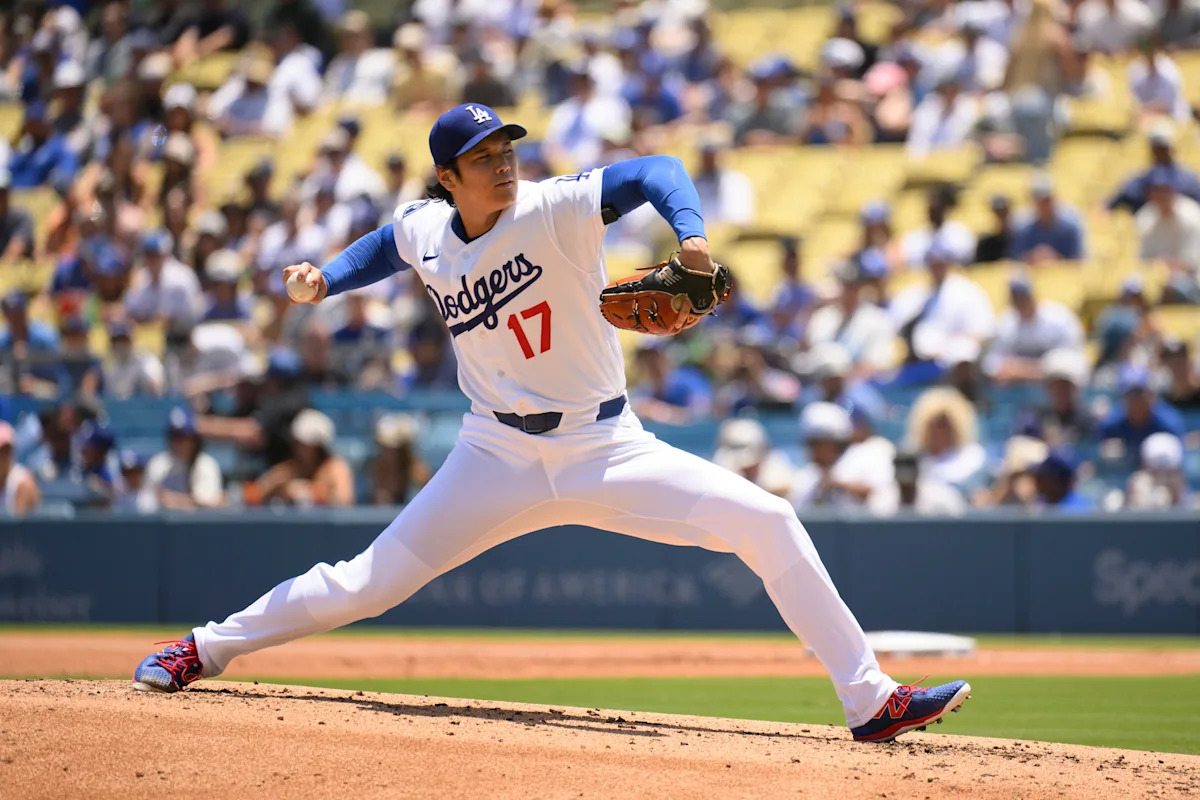
On Monday, the Rays failed to hold an early 3-0 lead, with veteran Dodgers lefty Eric Lauer plus four relievers holding Tampa Bay scoreless for the final seven innings en route to a 4-3 victory. A speedy pitchers’ duel unfolded Tuesday between Drew Rasmussen and Justin Wrobleski. Shohei Ohtani’s solo home run in the sixth inning represented the only scoring in Los Angeles’ 1-0 victory that took just 1 hour, 52 minutes to complete. Ohtani then took the mound on Wednesday and allowed four runs across six innings, but Los Angeles retook the lead on a Freddie Freeman two-run homer to nab a 5-4 victory and complete the sweep.
Here are four major takeaways from this week’s action at Chavez Ravine.
Kyle Tucker is still trying to find his groove
The rich appeared to get so much richer this past offseason, when the Dodgers splurged in free agency on the top position player available in Kyle Tucker and an elite closer in Edwin Diaz. But neither addition has made much of an impact so far. Diaz appeared in just seven games before needing elbow surgery; he could return and be a factor later on this season. Tucker has been available — he has started 71 of Los Angeles’ 75 games – but visions of him elevating this already-loaded lineup to an even more ridiculous level have yet to come to fruition.
On Monday, Tucker’s presence was felt when he smacked a game-tying, three-run homer in the bottom of the second inning against Rays right-hander Nick Martinez, a quick response after Tampa Bay jumped to an early 3-0 lead. That was just Tucker’s sixth home run of the season and only the second time all year he had driven in three runs in a game. After this week’s series, Tucker’s OPS sits at .726 — a far cry from the stellar career .865 mark with which he arrived in Los Angeles and 95th among 157 qualified hitters this season.
If the surface-level stats aren’t troubling enough, Tucker’s underlying metrics paint a concerning picture. His batted-ball data is down across the board, with career-low marks in average exit velocity, hard-hit rate and barrel rate through nearly three months of play. He is still drawing walks at an above-average clip, but his strikeout rate has spiked to a career-high 20.1%. In other words, there’s little to point to under the surface as a sign that Tucker is about to return to his exceptional career standards.
Perhaps this is a small-sample blip for a player still adjusting to his new surroundings. His track record makes it difficult to imagine that his true talent level has suddenly plummeted. And to be fair, Tucker is not alone in making a meek first impression as a marquee free-agent signing. Alex Bregman has been similarly mediocre as Tucker’s de facto replacement as the middle-of-the-order star with the Cubs. Bo Bichette — another short-term, humongous AAV recipient — has been downright disappointing so far as a Met. Pete Alonso has been an above-average bat with the Orioles but hardly transformative.
But because of Tucker’s status as the clear-cut best player available in last winter’s free-agent class — and because the four-year, $240 million contract he signed is so gargantuan — his performance would seem to invite more scrutiny. Yet Tucker’s lackluster showing thus far has largely flown under the radar as the Dodgers have continued to win with him contributing only occasionally. Whether that dynamic changes down the stretch and into October remains to be seen, but Tucker’s production is worth monitoring.
Shane McClanahan returns to Dodger Stadium
It was four years ago that a 25-year-old Shane McClanahan took the mound as the starting pitcher for the American League in the 2022 All-Star Game at Dodger Stadium, an honor reflective of his status as one of the burgeoning aces in the game. A lot has changed for the lefty since then, as McClanahan continued to excel over the next year before elbow trouble wiped out the entirety of his 2024 and 2025 seasons That took McClanahan far out of the spotlight after a sizzling start to his career and raised questions about how much he would impact Tampa Bay’s rotation moving forward.
But McClanahan methodically worked his way back and rejoined the Rays’ starting staff to begin this season. That he has stayed healthy and taken the ball for 14 starts is a triumph in and of itself; that said, the results have been a mixed bag. After rattling off four consecutive scoreless starts to lower his ERA to 2.27 on May 12, McClanahan allowed four runs in three of his next five outings. That run of shaky form set the stage for his start Wednesday at Dodger Stadium, his first appearance on that mound since the Midsummer Classic four years ago.
The struggles continued. Command was the primary culprit this time around, as McClanahan walked a season-high five batters and completed a season-low 3 ⅔ innings. While he finished with only two earned runs on his ledger, McClanahan’s early exit put pressure on Tampa Bay’s shaky bullpen to cover more innings than planned, and the Rays’ relievers were unable to contain the Dodgers in the later frames.
Still, there were some positive signs from McClanahan’s outing. While his control was shoddy, his stuff was coming out hot. He unleashed six fastballs in excess of 98 mph, a new season high. He notched strikeouts on his slider and curveball. His changeup — which has rated as one of the most effective offspeed pitches in the league — featured its usual nasty tumble.
If there is any pitcher who deserves patience amid a rough stretch, it’s McClanahan. Missing two full seasons is a lot to come back from, both physically and mentally, and it’s clear that McClanahan is still shaking off the rust even as his workload has swelled. If the Rays are going to be relevant in the American League postseason race, they’re going to need him. And even if Wednesday was a hiccup for the lefty, there’s reason to believe he can return to form in due time.
Shohei Ohtani the pitcher falters, but Ohtani the hitter is heating up
Shohei Ohtani’s chances of keeping up in the NL Cy Young race have become more daunting with each passing week. That has a lot to do with his top competition for the award, as Jacob Misiorowski and Cristopher Sánchez have continued to pitch at a ridiculously high level while amassing workloads that will be impossible for Ohtani to match. But Ohtani also hasn’t done himself any favors recently, as the Dodgers’ right-hander has surrendered four runs in consecutive outings after allowing seven total across his first 10 starts. Both last week in Pittsburgh and on Wednesday against the Rays, Ohtani left the game trailing, but the Dodgers rallied to let him off the hook.
For mere mortal pitchers chasing a Cy Young Award, failing to dominate in a given outing will linger as a frustrating letdown, and there’s nothing they can do but wait for their next start. Ohtani, however, has the luxury of distracting himself from a poor pitching performance by helping his team with his bat. It was a little over a month ago that he was mired in a slump at the plate that had some questioning whether his newfound focus on his pitching was costing him effectiveness in the batter’s box. An 0-for-5 on May 11 against the Giants dropped his OPS to .767 through 41 games.
Since then, Ohtani hasn’t just gotten back on track — he has been the best hitter in baseball. His 234 wRC+ over his past 30 games is tops in MLB by a comfortable margin, even ahead of sluggers Nick Kurtz (217) and Yordan Alvarez (203), not to mention a host of other prolific position players who have combined to throw zero innings for their teams. So sure, the Cy Young Award might prove to be out of reach for Ohtani by the end of the season. But can he earn a fifth straight MVP Award? No doubt.
Tampa Bay is dealing with a power outage
By not homering on Tuesday or Wednesday, the Rays fell behind the division-rival Red Sox into sole possession of last place on the league-wide home run leaderboard. Tampa Bay has hit just 58 home runs across 71 games this season. At their current pace, the Rays would finish with 132 home runs, which would be the fourth-lowest total in franchise history, ahead of only the 1998 (111), 2014 (117) and 2001 (121) squads. Those teams won 63, 77 and 62 games, respectively.
This year’s squad, however, is playing at a 93-win pace, even after getting swept by the Dodgers. Exceptional starting pitching has been the driving force behind the 2026 Rays’ success, but Tampa Bay has also found ways to score without the long ball; Wednesday’s four-run fifth inning was just the latest example. While they occupy the basement in homers and lag far behind the pack in batted-ball metrics, such as barrel rate, hard-hit rate and average exit velocity, the Rays have relied on strong contact skills and aggressive baserunning. They rank 27th in slugging percentage but third in batting average, fourth in OBP and eighth in stolen bases while boasting the lowest strikeout rate in the league at 19%.
At the same time, this offensive profile is the product of a top-heavy lineup that features a few legit bats and a whole bunch of meager hitters. It’s astounding how much of Tampa Bay’s offensive output is dependent on its top three hitters: Junior Caminero, Yandy Diaz and Jonathan Aranda, who account for more than half of Tampa Bay’s homers (39) and more than 40% of its total bases. All three are capable of crushing the ball consistently, but the rest of the lineup packs so little punch that the team-wide slugging statistics are some of the worst in the league.
Having three hitters that good is enviable in a vacuum, but the drop-off beyond them is as severe as you’ll find in any other lineup league-wide, at least among contending teams, and it’s difficult to identify any other hitters on the roster who are likely to emerge as potent bats. This puts enormous pressure on Caminero, Diaz and Aranda to both stay healthy and keep raking, and it suggests that Tampa Bay should be seeking offensive upgrades as aggressively as anyone come the trade deadline.
Read the full article here