

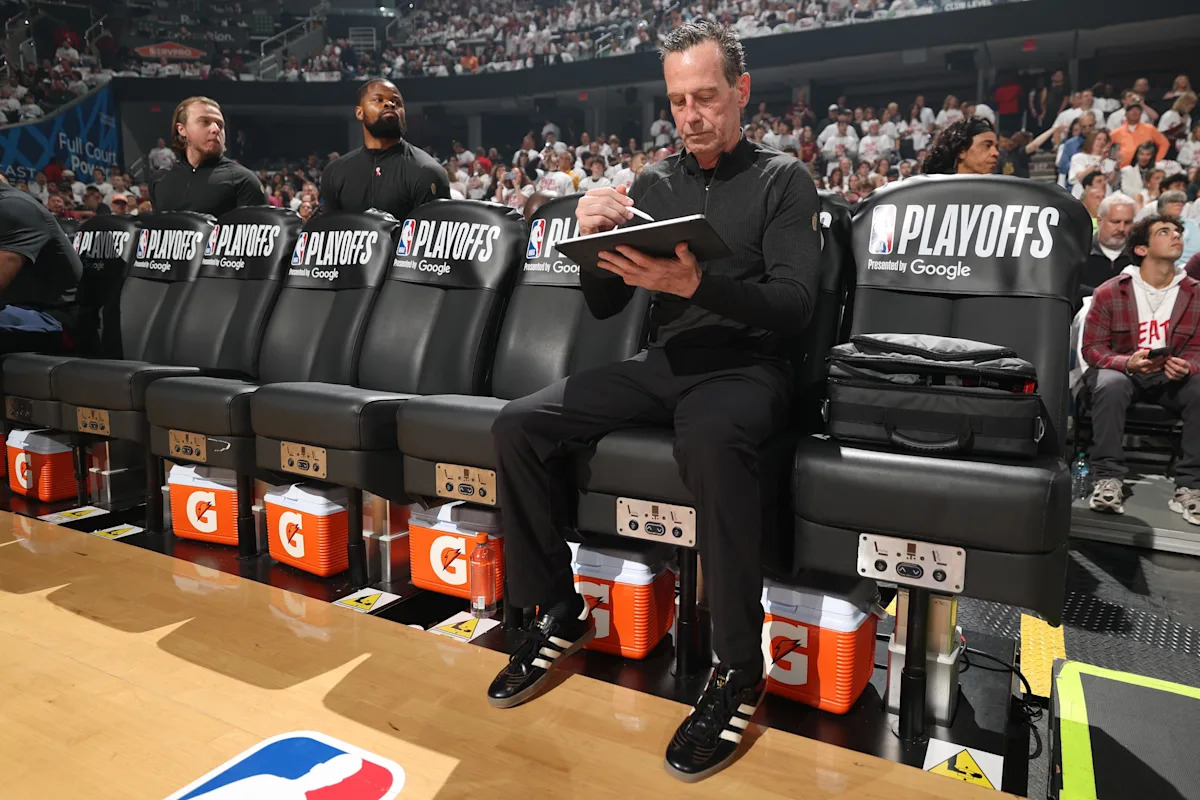
Our season review of the Cleveland Cavaliers continues with Kenny Atkinson and the coaching staff.
As is the case with our postgame report cards, a “B” grade represents a player or group meeting the standard we expect from them.
Cavs’ record
-
Regular season: 52-30 (-12 from last season)
-
Playoffs: 8-10 (+3 from last season)
Atkinson was dealt a rough hand this year.
The front office’s moves last offseason didn’t pay off. Trading Isaac Okoro for Lonzo Ball was a miss, as were the signings around the edges of the roster.
Additionally, injuries were a recurring issue throughout the year. Max Strus didn’t play until the spring. Darius Garland missed the start of the season, and when he did return, he wasn’t close to the All-Star version we saw the year before. The group also missed time from both Jarrett Allen and Evan Mobley.
Atkinson deserves credit for keeping this season on the rails. The group continued to be bought in, even during their slump, and were able to keep their heads above water. This could’ve easily been a lost season.
Support us and Let ‘Em Know with Homage!
Anything bought from the links helps support Fear the Sword. You can also shop all of Homage’s Cavs gear HERE. The link to the new City Edition shirt can be found HERE.
Then, Atkinson was forced to adapt again when they traded for James Harden.
Atkinson understands that this is a player’s league first and foremost. He sacrificed his personal preference to fit the style that worked best with this group given the limited time left in the season.
The Cavs blended Harden’s isolation system with some of the off-ball movement concepts we saw from them during their 64-win season. Making those adjustments on the fly with limited practice time is an incredibly difficult task, and not one many coaching staffs would’ve succeeded in doing.
The trades and the injuries resulted in the starting lineup they used most in the playoffs, only spending four regular-season games together. Yet, the Cavs were able to make it further in the playoffs than they have at any point since 2018. That’s a remarkable achievement.
At the same time, Atkinson deserves criticism for some of their biggest losses in the postseason.
The adjustments in the first two rounds weren’t as quick as they should’ve been. Against the Toronto Raptors, he took too long to find ways to get the bigs involved. The Cavs weren’t ready for the first two games against the Detroit Pistons, and he failed to get his group prepared for Game 6.
Atkinson also deserves a good portion of the blame for the disastrous Game 1 loss to the New York Knicks. He kept Harden on the court late, allowing him to get picked on by Jalen Brunson. By the time the defensive adjustment came, it was already too late. The offense ground to a halt. Atkinson couldn’t find a way to get it jump-started down the stretch in the fourth, even after timeouts.
The Cavs probably don’t win the series if Game 1 ended differently. The Knicks are playing at an incredibly high level right now. But at the very least, Cleveland could’ve made it a competitive series if they had held on to Game 1.
Figuring out how to balance the impressive regular season and frustrating playoffs is difficult for a project like this.
On one hand, Atkinson showed that he can make the absolute best of a bad situation. He continually raised the baseline of a group that had no business winning more than 50 games with the amount of injuries, roster turnover, and off-years from the supporting cast.
Simultaneously, he didn’t elevate this group in the postseason. It never felt like the players were in the best position to succeed, and the adjustments came far too late, if they came at all. That is concerning for a group that wants to compete for titles over the next few seasons.
Overall, I’m going to lean more positive. The playoff shortcomings don’t happen if this season goes off the rails, as it could’ve.
Grade: B-
Read the full article here