

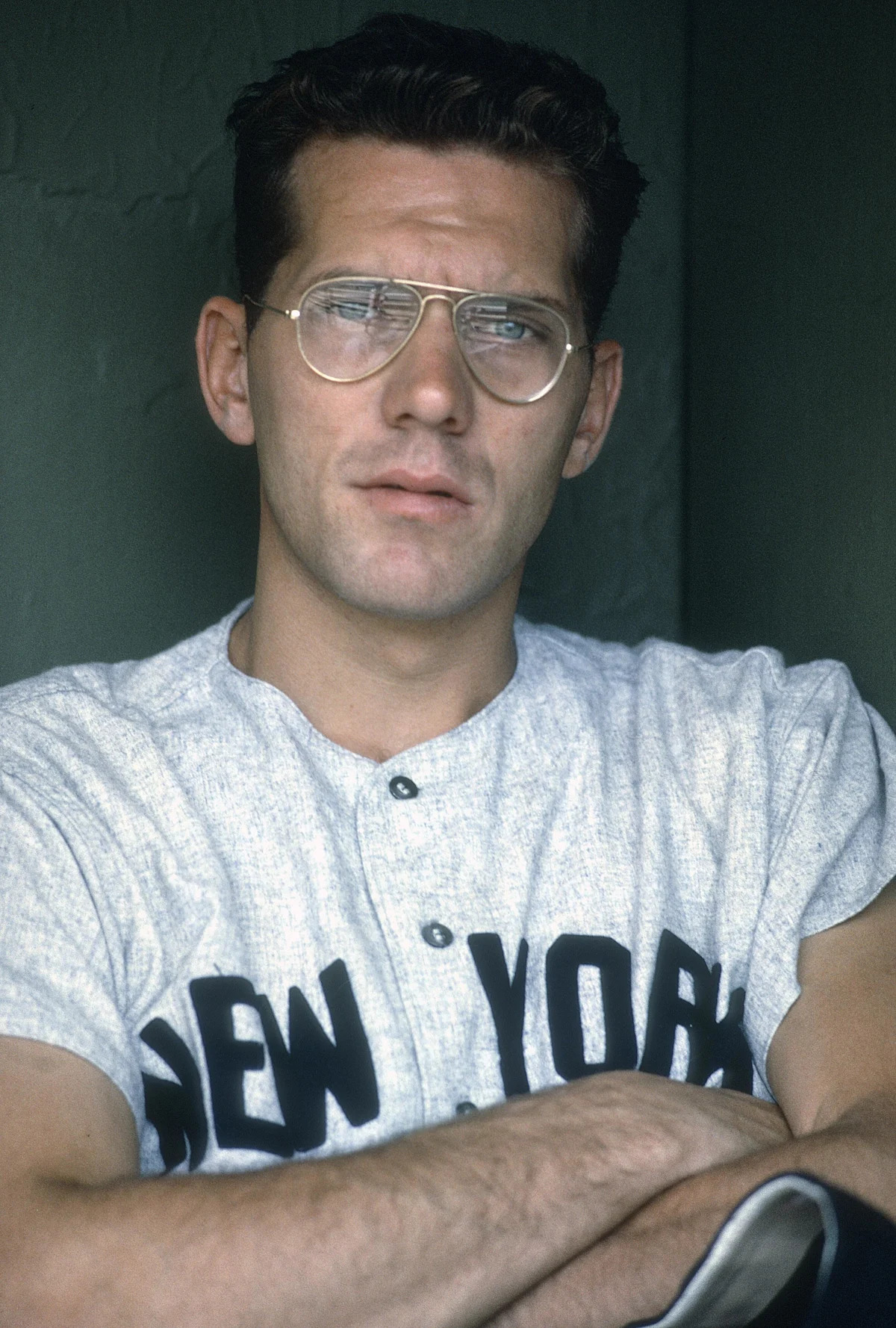
The game of baseball requires many player archetypes to compete for positions on major league (and professional) rosters. Sluggers, contact hitters, and defensive wizards all have their place within the game. But there’s another group of players (albeit a smaller genre) who are still around and have made their way onto World Series-winning rosters: the utility players.
This group usually has a higher floor and lower ceiling than the others, but if you can find an excellent one, the goal is to keep him around as long as possible. And while a player like Phil Linz wasn’t a star utility man, he still carved out a seven-year career in the major leagues, while also being the key cog in one of the most famous stories in Yankees history.
Philip Francis Linz
Born: June 4, 1939 (Baltimore, MD)
Died: December 9, 2020 (Leesburg, VA)
Yankees Tenure: 1962-1965
Born in Baltimore, Maryland, Linz grew up playing baseball. He wasn’t the biggest kid, but he was good enough to be signed by the Yankees straight out of Calvert Hall College High School in 1957. His hometown squad in the Baltimore Orioles didn’t sign him because one of their scouts, Walter Youse, was also Linz’s head coach at Calvert Hall, and he knew that Linz’s vision was terrible. He couldn’t see and, most importantly, he refused to wear glasses. But after signing, he began wearing them in the minor leagues.
In 1957 and 1958, Linz, at 18 and 19 years old, played Class-D ball for the Kearney Yankees in Kearney, Nebraska, and the Auburn Yankees in Auburn, New York. He batted .230 with Kearney and then, following that first season in the minors, saw his average jump up to .283. In 1959, he got promoted to the Class-C Modesto Reds, where he hit .298 in 141 games played, and he saw another jump to Class-B with the Greensboro Yankees in 1960 at the age of 21. He hit for over .300 for the first time in his career (.321 to be exact) in 126 games, excelling in the contact area of the game as he hit only four homers out of his 505 at-bats and 162 hits. He also won the Carolina League batting title that season by .0002 points as well.
Linz’s performance year-over-year earned him the call-up to the Double-A Amarillo Gold Sox, where he played 105 of his 119 minor league games that season (the other 15 were when he was called up to Triple-A Richmond). He hit .349 in Double-A with an .851 OPS. He won his second straight minor league batting title that season, earning a trip to the major leagues and the opportunity to wear the pinstripes for the first time.
While he did receive that chance in 1962 under manager Ralph Houk, it wasn’t in a full-time role. Instead, Linz battled for the starting shortstop position in spring training, lost to Tom Tresh (who ended up playing 157 games that season), and was used as a utility player, playing all around the infield and even a few games in the outfield, mostly as a pinch-hitter or pinch-runner. In total, he played 71 games that season, slashing .287/.316/.372. And despite not playing a game in the postseason, he still received a World Series ring after a 4-3 series defeat of the San Francisco Giants. It was more of the same in 1963, playing where his manager needed him and as a pinch-hitter or runner in 72 games. He did go back to the World Series that year, but the Yankees were swept by the Los Angeles Dodgers. However, this time he did manage to make three separate appearances, all of which were of pinch-hit variety. Linz’s biggest feat was singling off Sandy Koufax in Game 4.
The 1964 season was the best for Linz in a variety of areas, including games played, on-base percentage, OPS, and OPS+. But that wasn’t the biggest story of the season for Linz. Instead, the biggest story came because of a hobby. On a road trip to Chicago to play the White Sox, Linz ended up purchasing a harmonica for fun. But following the wrong end of a four-game sweep in a tight pennant race, the harmonica was the last thing that Yogi Berra, a first-year manager unhappy with his team’s performance before going to play the Boston Red Sox, wanted to hear from the back of the team bus.
Linz decided to practice the instrument to take his mind off not playing during the series, and began playing the only song he knew: Mary Had a Little Lamb. And, of course, it sounded as good as a first-time harmonica player could make it sound. The rest of the story is told best by Yankees player and former teammate of Linz, Jim Bouton, in his book “Ball Four:”
“Yogi, who was in the front of the bus, stood up and said, “Knock it off.”
Legend has it that Linz wasn’t sure what Berra said, so he turned to Mickey Mantle and asked, “What’d he say?”
“He said play it louder,” Mantle explained.
Linz didn’t believe that. On the other hand he didn’t stop. In a minute Yogi was in the back of the bus, breathing heavily and demanding that Linz shove that thing up his ass.
“You do it,” Linz said, flipping the harmonica at him. Yogi swatted at it with his hand and it hit Pepitone in the knee. Immediately he was up doing his act called, “Ooooooh, you hurt my little knee.” Pretty soon everybody was laughing, even if you’re not supposed to laugh after losing, especially a doubleheader.”
The story went around like wildfire, as team journalists who were on that bus couldn’t wait to write it and turn it in to their editors for publication. Linz was inevitably fined $200 (approximately $2,148.52 today) for the incident, even though it blew over and he wasn’t suspended. However, while earning $14,000 on his contract that year, he also received a $5,000 endorsement deal from harmonica maker Hohner, making the $200 not even a dent in his earnings. He also received $200 from Houk for music lessons.
But the story got even better when it was viewed as the turning point for the Yankees’ season. They lost the first two games in Boston but went on a 23-6 run, finishing 30-13 the rest of the season to finish ahead of the White Sox for the American League pennant by one game. From then on, Linz became a legend.
Linz ended up becoming the starting shortstop following an injury to Tony Kubek’s wrist, and he batted leadoff against the St. Louis Cardinals in the World Series. He was given the leadoff hitter position and hit .226 with two solo home runs off Barney Schultz and Bob Gibson, but the Yankees ultimately lost the title in seven games and then Berra was fired after the season.
Linz was with the Yankees for one more season under a new coach (playing 99 games and batting .207) before being traded to the Phillies for utility player Ruben Amaro in a one-for-one deal. He appeared in only 63 games over a season and a half before he was traded in July of 1967 to the New York Mets for second baseman Chuck Hiller. In 102 total games for the Mets, he hit .209 with a 46 OPS+. Linz played his final season of major league baseball at age 29 in 1968 after rejoining the Mets because he still wanted to play. But his best days were behind him, and he moved on to the restaurant business, where he created and owned a sports bar, Mr. Laffs, for 23 years, along with a couple of other restaurants. Linz passed away at the age of 81.
One of the most famous Yankees to play the game came not from his ability to crush the baseball over the outfield fences, but instead from a measly harmonica. The legend of him will live forever through books, articles, and oral stories from Yankees legends who passed it down through generations. Happy birthday, Phil.
Read the full article here