

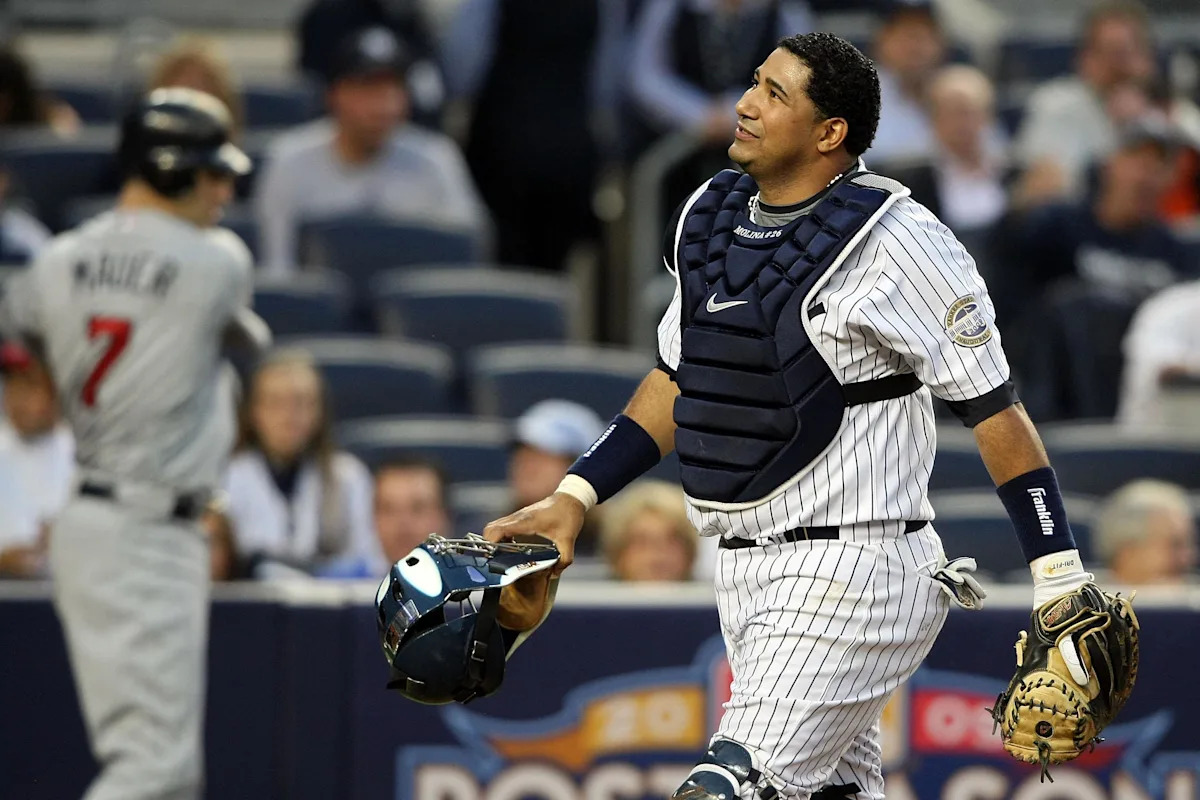
In our current data-driven era of baseball, pitch framing has emerged as the single most impactful facet of catcher defense. Stealing strikes by presenting borderline pitches in the zone is a skill that far outweighs blocking dirtballs or stopping the run game in terms of overall impact. It took a while for front offices to fully realize that fact, but those who watched José Molina behind the plate probably had a good sense of the defensive revolution that had yet to come.
Molina was more than your average backup catcher and brother of possible Hall of Fame Yadi and eldest Bengie: he was a masterful framer and pitch-caller who helped teams win a few subtle nudges at a time. While he only played 181 games in pinstripes, his impact outweighed that modest total—and his tenure concluded with a World Series win.
José Benjamin Molina
Born: June 3, 1975 (Bayamon, PR)
Yankees Tenure: 2007-09
Molina was the middle child of three boys born into a baseball obsessed family—all of whom would grow up to become catchers in Major League Baseball. Bengie, the oldest, graduated high school the first year Puerto Rican players became draft-eligible, but ultimately went undrafted through both high school and college, leaving him disillusioned and ready to quit baseball in 1993. But José, whose own star was rising, intervened. José was set to try out for a pair of scouts for the Angels, and convinced Bengie to join him.
While José and Yadier had found their home behind the plate early on, Bengie only switched to the catching position as a result of this tryout. He didn’t have the footspeed to hack it as an outfielder or left-side infielder, but he’d shown promise as a catcher and the Angels signed him to a contract a few days after they had gotten a look at him. He had his younger brother to thank.
The same year he helped Bengie get into professional ball, José was drafted by the Cubs in the 14th round out of high school in Vega Alta. By the time the youngest brother Yadier was in his senior year of high school six years later, José had finally made the show with Chicago. He picked up his first two MLB hits in his debut against the Reds on September 6, 1999, then followed with his first RBI the following day.
Molina spent 2000 in Triple-A with the Cubs and was released at season’s end. Not content to finish with just 10 MLB games to his name, he signed with his brother’s organization, the Angels, in July of 2001. After earning another brief stint in the Majors that year, José would settle in as Bengie’s backup in July of 2002. Together, the Molina brothers would help the Angels capture their first and only World Series title in franchise history. José got into six playoff games, though he only received one at-bat.
José remained with the Angels mostly in a backup role for the next four full seasons and part of a fifth, even as Bengie departed to Toronto and the bat-first Mike Napoli succeeded him as starter. Despite a lack of thunder at the plate (he peaked in Anaheim with a 76 OPS+ in 2004), José’s defense made him sought after by other clubs seeking extra depth behind it. That included the Yankees, who, ahead of the 2007 Trade Deadline, acquired Molina for minor league pitcher Jeff Kennard. Molina would back up fellow Puerto Rico native Jorge Posada for the remainder of the year, while also hitting .318 in 29 games—not too shabby for a guy who usually didn’t hit much.
The Yankees fell painfully to Cleveland in the ALDS, then endured a down year by their lofty standards, missing the playoffs in 2008. That meant that the home run Molina hit on September 21st against Baltimore’s Chris Waters in the Yankees’ home finale would wind up as the very last home run in the history of The House That Ruth Built.
View Link
Molina played 100 games in 2008, the first time he had done so as a big leaguer, and he led the majors with a 44-percent caught-stealing percentage, nabbing an AL-best 33 of 42 baserunners.* Posada missed much of the year with a shoulder injury, and 36-year-old Iván Rodríguez only came aboard after the Trade Deadline. Pudge struggled and was not retained by the Yanks, but Molina continued on in the Bronx for 2009.
*More celebrated for his framing, Molina also had a good arm behind the plate, throwing out 36.8-percent of baserunners in his 15-year career.
Posada, of course, returned with a vengeance, hitting to a 125 OPS+ as the Bombers took aim at the Fall Classic. Molina, meanwhile, started serving as the personal catcher to new free agent acquisition A.J. Burnett—Burnett’s ERA with Molina behind the plate was over a run and a half better than with Posada, with whom he struggled to get on the same page. Manager Joe Girardi valued Posada’s bat, but he knew that to get the best out of his No. 2 starter, he had to sit the proud longtime Yankee in favor of the framing savant Molina.
The Burnett-Molina battery was up-and-down in their ensuing run to the World Series, but there were a few outstanding performances from A.J. In their first playoff game together, Burnett worked around erratic command to post six innings of one-run ball against the Twins in Game 2 of the ALDS. In Game 2 of the ALCS against the Angels, Burnett stifled the Halos to the tune of two runs on three hits over 6.1 frames.
Then came the duo’s finest work: World Series Game 2. Cliff Lee had overpowered the Bombers the previous night to give the defending champion Phillies a 1-0 series lead. The Yankees found themselves trailing in a series for the first time all postseason, and needed a big performance on the mound. They would get one from Burnett. Despite surrendering the initiative on an RBI single from Matt Stairs in the second, Burnett ensured the Phillies would get nothing more from him the rest of the night, striking out nine and completing seven dazzling innings. Four of those punchouts, including the pair he picked up in the seventh, came on pitches on the corners beautifully framed by Molina. The defensive whiz got an out on his own in the fourth as well, picking Jayson Werth off first base in the fourth.
Backed by that remarkable effort on the mound and behind the dish, the Yankees won Game 2 to tie the World Series. They went on to take Games 3 and 4 in Philadelphia and withstood a Game 5 blowup from Burnett on short rest to clinch their 27th title on their home field.
Molina would go on to play five more seasons in MLB—but he had played his last game with the Yankees. Those five years would, however, come with fellow AL East teams, giving the Yankees and their fans regular reunions with good ol’ José. First, the Blue Jays had him as a backup in 2010 and 2011 (peaking on offense in the latter with a 104 OPS+), then he finished up his career with three seasons (and almost 300 games!) with the Rays. This was right around the time that pitch framing became a little easier to quantify behind the scenes, and Tampa Bay felt that even though Molina was in his late thirties and would simply never hit much, he was still such a superb defender that it was worth making him their de facto starter.
Perhaps the best way to acknowledge what Molina brought to the table is to compare his annual Baseball Reference WAR to his FanGraphs WAR and Baseball Prospectus WARP. Baseball Reference does not incorporate framing, but the latter two sites have both done so since 2008.
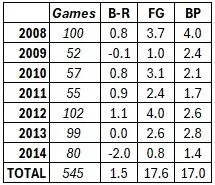
Your mileage on framing might vary, but there’s no denying that Molina had a seismic defensive impact whenever he stepped behind the plate, especially in comparison to his non-fraternal contemporaries.
Molina featured on the second-place Team Puerto Rico in the 2013 World Baseball Classic—where he finally got to play with Yadi, now an All-Star with the two-time champion Cardinals—before retiring at the end of the 2014 campaign. He spent several years coaching in the Angels organization under GM Billy Eppler, who had helped bring him to the Yankees during his previous role as an assistant general manager. Since leaving in 2021, he’s skippered in the Mexican League and is currently the manager of Saraperos de Saltillo.
Molina’s defensive style was not totally of a piece with the framers of today. These days, MLB catchers are rather blatant with their frame jobs; since the strategy is so widely adopted now, one needn’t be overly subtle about it. Catchers like current Yankee starting backstop Austin Wells are quite proficient at stealing strikes. But they don’t quite do it as artfully as José Molina did. As Ben Lindbergh once detailed at Grantland, Molina was a true artisan of his craft, always positioned in the right spot to perfectly frame a borderline pitch, without having to move his glove more than a few inches. Growing up watching the Yankees clubs that Molina played on, I learned from early on that you can never have too many quality backstops.
See more of the “Yankees Birthday of the Day” series here.
Read the full article here