

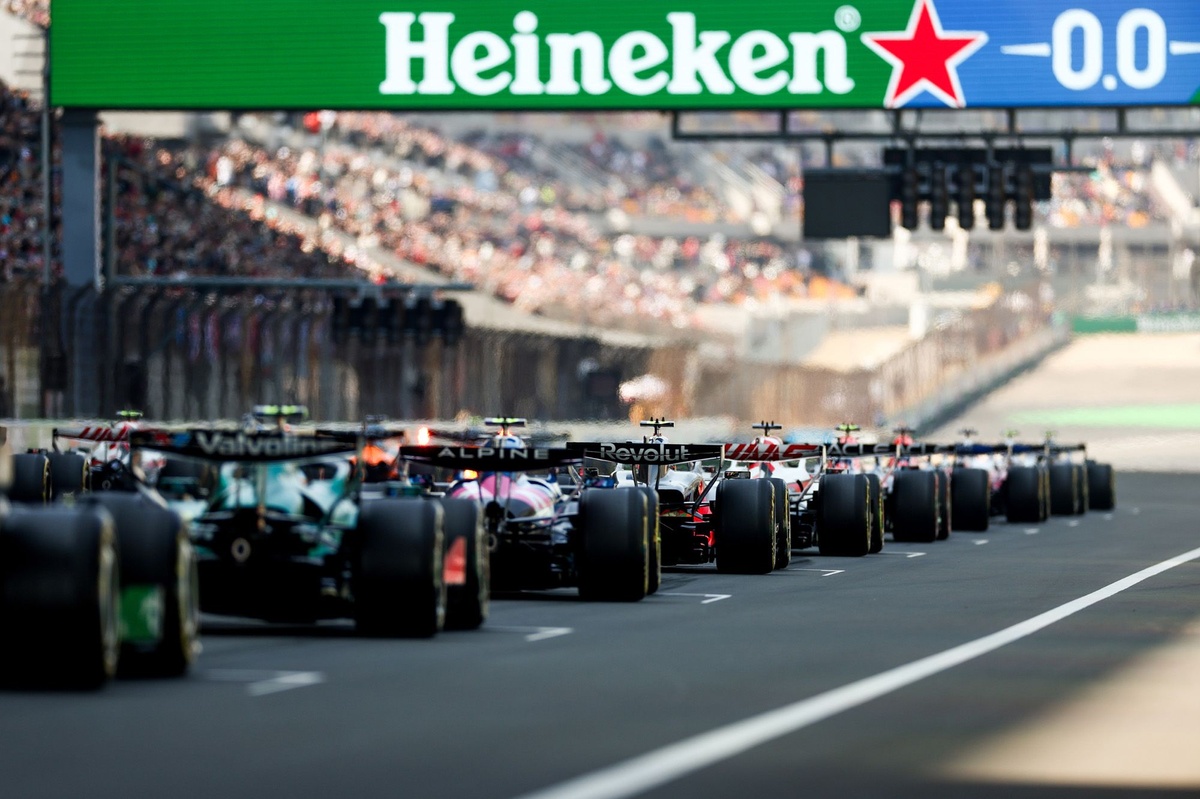
There is much more at stake than just a matter of technology behind the debate over the engine that will power the Formula 1 cars of the future. Over the past five years, the championship’s financial growth has been staggering: revenue has risen from $2.1billion in 2021 to $3.9bn in 2025, drastically changing the landscape. F1 teams have become companies capable of closing their annual financial statements with profits that, in some cases, have exceeded $100million – figures that were unthinkable just a few years ago.
The engine regulations that took effect this year were developed in a F1 landscape very different from today, one still heavily reliant on contributions from manufacturers that have been essential to the championship’s very survival. The compromise that shaped the current power unit arose from the need to bring in new automotive giants following the departure (and subsequent return) of Honda – and then the belated exit of Renault.
Fearing it would be only Ferrari and Mercedes left at the table, F1 accepted a series of compromises. In the short term, the move proved successful: Honda returned, Audi announced its official entry, and Red Bull launched its Powertrains project with Ford – a choice partly forced by the lack of credible alternatives.
Five years later, however, the landscape has changed. The new power unit did not have a particularly successful debut, and, above all, Formula 1 no longer depends so crucially on the financial contributions of the manufacturers. Recently, FIA Technical Director Nikolas Tombazis recalled how, in 2021, the manufacturers involved in defining the second generation of power units were convinced that, in the medium to long term, internal combustion engines would gradually disappear. The transition to electric power seemed inevitable, but five years later, that prediction has not materialized.
The experience gained during this period led Tombazis to clarify a specific point: “We need to protect the sport from the world macroeconomic situation, meaning we cannot be hostage to automotive companies deciding to be part of our sport or not.” The automotive market may take directions that do not necessarily align with what is best for F1. And while in the past the series was forced to yield to manufacturers’ demands in order not to lose vital funding, today it can sit at the negotiating table with strength, backed by the record revenue growth recorded in recent years.
Andrea Kimi Antonelli, Mercedes, Lewis Hamilton, Ferrari
Photo by: Andy Hone/ LAT Images via Getty Images
Behind the future choice between an evolution of the current electrified power unit or a naturally aspirated V8 with KERS lies a clear intention: to build the future of F1 by focusing exclusively on the interests of the sport. F1 and the FIA, aligned on this issue, have the opportunity to set the rules of the game. There will, of course, be discussions with the manufacturers, but the engine suppliers will have far less leverage than in the past.
The idea of simplifying everything offers many advantages: the creation of an engine better suited to racing needs and significant cost savings. But the key point is probably another: a less complex power unit would also pave the way for independent projects, following the model of Cosworth, which for decades was a central presence in F1. A private manufacturer could develop a competitive unit to make available to customer teams, becoming a safety net in the event that an official manufacturer suddenly decided to leave the championship – or if a team wanted to go their own way.
Finally, there is one last aspect, which is less visible but no less important. Today, customer teams often find themselves in a subordinate position when it comes to casting their vote at the F1 Commission. The alignments are clear: customer teams tend to align with the manufacturer supplying its power unit. The prospect of being able to count on a concrete alternative would profoundly shift the political balance, reducing the influence of the factory teams like Mercedes and Ferrari.
Is this scenario possible? An initial answer will come from the choice of powertrain planned for 2030 or 2031.
If a highly electrified and highly technical philosophy prevails it will mean the manufacturers have succeeded in maintaining the status quo. But if a specification is chosen that is much simpler and accessible to independent manufacturers it will mean F1 could enter a new phase. Manufacturers will continue to be key players, but their influence in the political and technical management of F1 could be drastically reduced.
We want to hear from you!
Let us know what you would like to see from us in the future.
Take our survey
– The Autosport.com Team
Read the full article here