

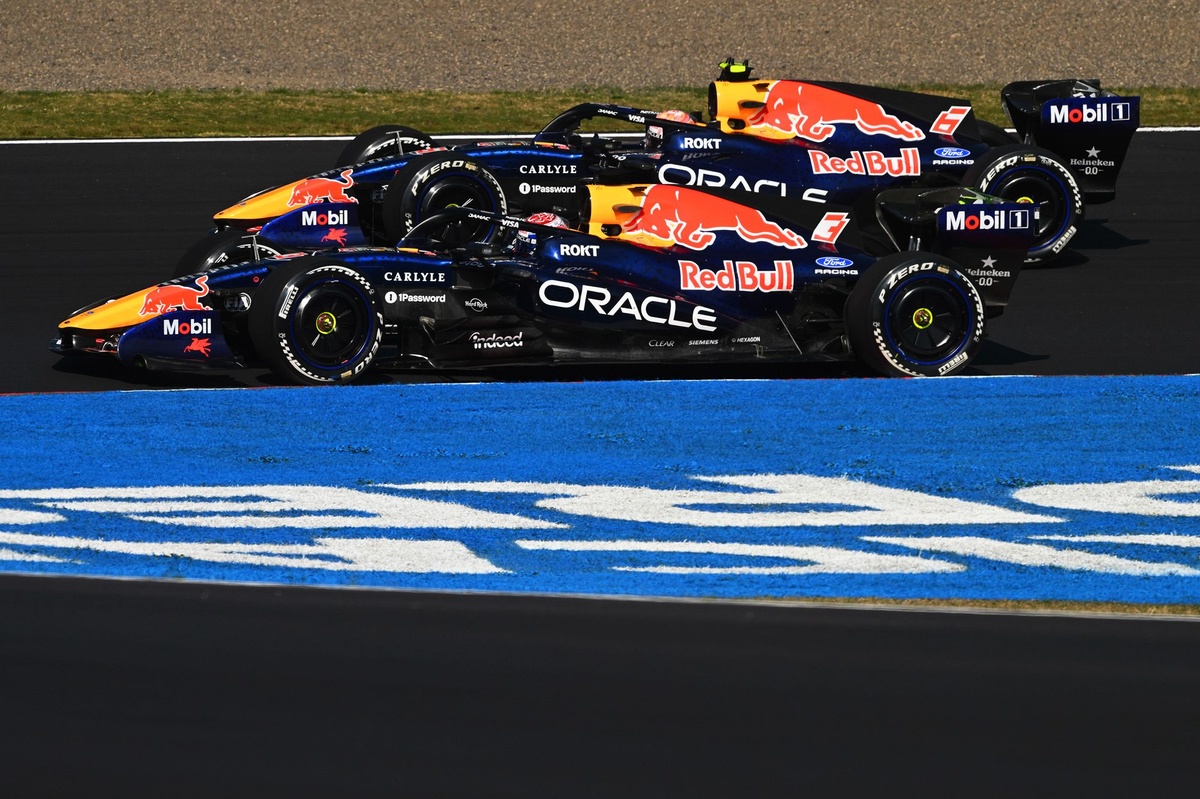
Many in the paddock had expected a difficult start for Red Bull under the new technical regulations, but for a different reason than the one currently at play. Ahead of winter testing in Barcelona and Bahrain, the biggest question marks surrounded the all-new power unit, with Mercedes team principal Toto Wolff stating that Red Bull had “the Mount Everest to climb”.
Wolff then completely changed his tune in Bahrain by stating that Red Bull would be “the absolute benchmark” on the power unit side. Although Max Verstappen immediately saw through that remark – “just wait and see how fast Mercedes will be in Melbourne” – and Wolff’s comment was clearly politically loaded, there is still a small element of truth in it.
The Red Bull Powertrains-Ford engine is actually not that bad. Verstappen acknowledged as much after the Japanese Grand Prix. When Autosport asked him whether, after spending countless laps behind Pierre Gasly’s Alpine, he had been able to learn anything from the energy deployment of the Mercedes power unit, he stressed that this was not the main issue.
“I think our deployment was good. That’s also not our biggest problem, to be honest. I think actually from the engine side, yes, correlation and a few things like calibration can be better, but in terms of pure power, it’s not our worst thing for sure,” Verstappen said. “We’re not like Mercedes, they’re super strong, but we have a lot more work to do, definitely a lot more work to do on the car.”
That last point was underlined by the balance problems Red Bull encountered in both China and Japan. Verstappen indicated that the car – unlike in previous years, when Red Bull often managed to turn things around just in time for qualifying – did not respond to any of the set-up changes, and team-mate Isack Hadjar went even further. The Frenchman revealed that the car was so “undriveable” in Suzuka that it even became dangerous at times.
Two factors why Red Bull looked better in Melbourne
This underlines what team principal Laurent Mekies openly acknowledged on Sunday night: Red Bull has a lot of work to do. It does, however, raise the question of why things looked relatively better in Melbourne. After all, Hadjar qualified third there and Verstappen drove through the field after his crash in qualifying, a recovery drive that ultimately earned him sixth place.
Max Verstappen, Red Bull Racing, Pierre Gasly, Alpine
Photo by: Andy Hone/ LAT Images via Getty Images
It looked much better than in China and Japan, where Verstappen was stuck behind a Haas and an Alpine, although Mekies would like to put that into perspective: “We left Melbourne thinking that we were one second off Mercedes and half a second off Ferrari. I guess the biggest difference in Melbourne was that McLaren looked within reach there. And actually, Max came back from P20 to bump into what was the first McLaren.
“Then we see that gap largely increasing in China, and you have seen us starting to scratch our heads about car balance and car characteristics. And then in Japan, it also didn’t look good at all on Friday and Saturday. Certainly, there is nothing to be happy about in the race, but in terms of overall gap to the competition, it looked not too dissimilar to the Melbourne picture in terms of one second to the best guy, and half a second to the best Ferrari. But now, McLaren is at that same level. So, we are a distant force. That’s the reality.”
Red Bull still estimates the gap to Mercedes to be roughly similar to Melbourne, although the numbers show that the deficit has grown in qualifying. Hadjar was 0.785s off pole position in Australia, the gap increased to 0.938s in China (Verstappen) and in Japan it even reached 1.200s (Hadjar).
This is mainly because Red Bull still found a reasonable car balance at Albert Park, whereas in China and Japan the team never got the RB22 in a good operating window. That last point is worrying, since both drivers and Mekies acknowledge it cannot be explained by set-up alone.
“We certainly think that in China we made a step back, and we measure that not only against the top guys but also against the midfield that got closer to us,” Mekies admitted.
“I don’t think it’s a product of the number of corners only. I think it’s somehow there is a layer where in certain cornering speeds and cornering conditions we lose some performance compared to what our package is supposed to give us. So this we need to work on. It was a touch better in Japan compared to China, especially in the race. We didn’t see it because we were, again, a distant force, and it doesn’t interest anyone to be a distant force.”
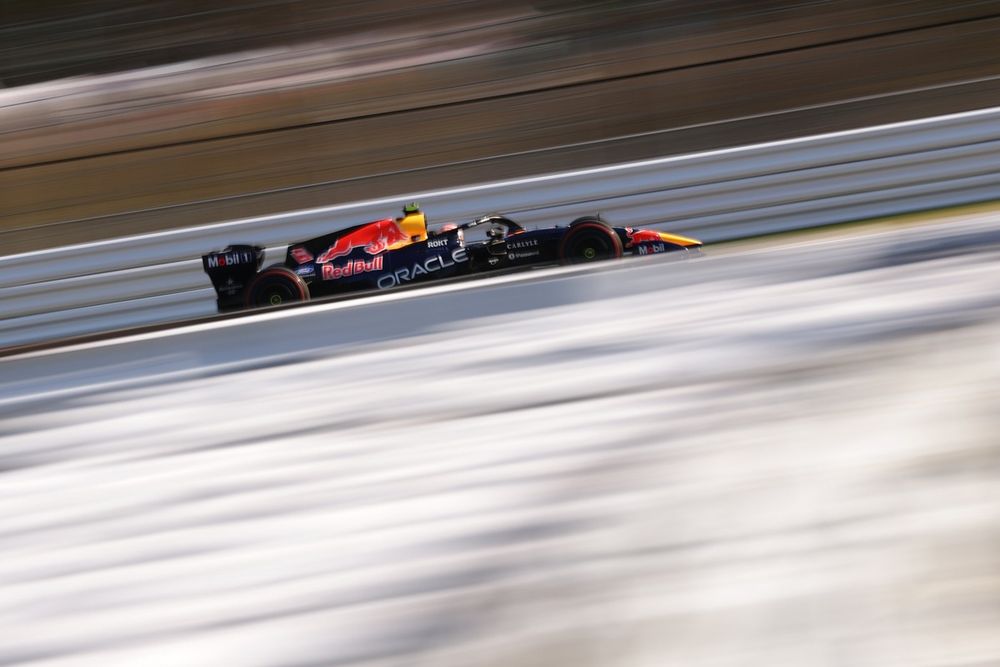
Isack Hadjar, Red Bull Racing
Photo by: Lars Baron / LAT Images via Getty Images
The explanation why Red Bull looked better in Melbourne than in China and Japan is twofold. Firstly, Red Bull has struggled far more over the past two race weekends to get the car into an acceptable window, something that is crucial to understand ahead of the upcoming races.
Secondly, as Mekies pointed out, McLaren was not yet at full strength in Australia, which made Red Bull look better than it actually was. Down Under the focus was still largely on understanding the power unit, and in that area Red Bull was already quite strong in Bahrain. Since then other teams – especially McLaren together with Mercedes HPP – have taken big steps forward, which has exposed Red Bull’s weaknesses on the chassis side more clearly.
A search for the deeper causes
The only good news for Red Bull is that the team now has a few weeks to address those shortcomings. However, a crucial first step is actually understanding the problems, as that was not yet the case in Japan. Verstappen told Dutch media that the upgrade package seemed to have little effect, underlining that simply introducing new parts makes little sense if the deeper issues are not yet fully understood.
Mekies did, however, express confidence that Red Bull will make significant progress in that respect.
“We need the time to dive deep into our data,” he said. “We need the time to simulate back what we see in the data into the tunnel, into our simulator. Try some sensitivities and all of that we can do without racing. Does it mean you come to Miami and you have solved everything as a miracle? No. But again, am I confident that the teams will get to the bottom of that understanding and start bringing improvements already in Miami? I think that’s what you will see.”
Red Bull has two priorities in that regard. Pure performance must be found, but the balance of the car also needs to be improved dramatically to such an extent that the drivers once again have a weapon they can push with – something that was especially lacking in the Esses at Suzuka.
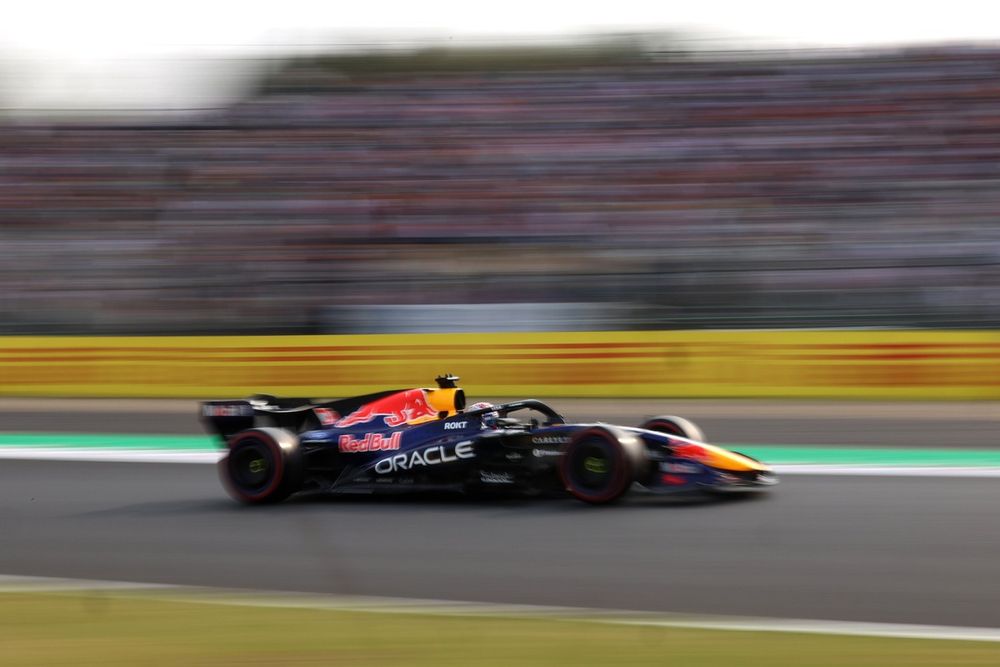
Max Verstappen, Red Bull Racing
Photo by: Alastair Staley / LAT Images via Getty Images
“There is a layer of us not being able to extract enough from the package and to give something Max and Isack can push with. And I’m not suggesting that it’s set-up tuning. I’m just saying there is something we are wrestling with, with that car, that adds to our underlying lack of performance.
“Now, trying to solve this sort of complex issues and trying to understand complex limitations is our core business. So, as much as it feels bad when you are at the back of the top teams like now, that’s precisely what the whole compass is set up to do, to get to the bottom of complex limitations like that and nail them, bring developments that can mitigate them and improve. It feels bad now, but I have full confidence that that’s exactly what our team is very good at.”
However, the figures below from data partner Paceteq show that Red Bull’s deficit in terms of pure race pace has not been this large in 11 seasons, making it clear that there is a great deal of work to be done in Milton Keynes.
We want to hear from you!
Let us know what you would like to see from us in the future.
Take our survey
– The Autosport.com Team
Read the full article here