

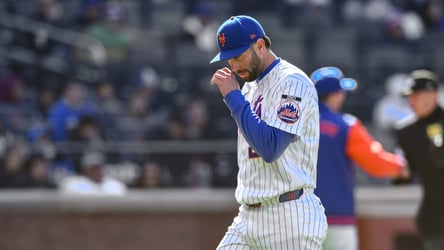
Even after David Peterson allowed five runs in the first two innings of Wednesday afternoon’s 7-2 loss to the Arizona Diamondbacks, it would be fair to say the New York Mets starting rotation has largely inspired confidence this season.
Only five teams’ rotations have struck out more batters, and two of them have played a full game more than the Mets had as of late Wednesday evening. Nolan McLean has looked ace-ready. Kodai Senga has pitched with more power than he did in 2025. Freddy Peralta has yet to be at his best, and he has still been very good.
But if cracks are going to spread – and when it comes to major league starting pitching, they almost always do – Wednesday offered a glimpse into where they might find room.
After allowing a run on two hits in the first, Peterson was vexed with small ball and pummeled with hits in a four-run second inning before retiring 11 of the last 12 batters he faced. Inconsistency, not total ineffectiveness, has been his undoing: Since he worked in and out of traffic through 5.1 scoreless innings in his first start of the year, Peterson has allowed 10 runs over 9.1 innings in his last two, scattering 15 hits and four walks. His ERA is 6.14.
Two mediocre starts seem like far too small a sample to dislodge a pitcher who was an All-Star in the first half of last season, though Peterson did struggle in the second half. His manager confirmed as much after the game, when asked if he was considering making a change in the rotation.
“As I’m sitting here right now, no,” Mendoza said.
Exactly why Peterson is pitching less effectively seems to be a subject of debate. Mendoza suggested that Peterson was struggling to execute his pitches in side right-handed hitters, leaving pitches meant to land on his glove side out over the plate.
“When he’s going well,” Mendoza said. “The two-seam comes in, the slider down and in to righties. And like I said, right now, he’s having a hard time.”
Peterson, meanwhile, admitted that while he did require mechanical adjustments after that troublesome second inning, he thought pitch selection, rather than execution, was his problem.
“I don’t think I’ve had a problem executing the pitch,” Peterson said. “I don’t think we’ve gone there enough. I think we’ve relied on the sinker and change-up too much and allowed hitters to sit over the plate. In my eyes, it’s more about usage than it is execution.”
Apr 2, 2026; San Francisco, California, USA; New York Mets starting pitcher David Peterson (23) throws a pitch against the San Francisco Giants during the first inning at Oracle Park. / Robert Edwards-Imagn Images
Whatever the issue, Peterson seems likely to get plenty of time to address it. For one thing, none of his potential rotation replacements are currently applying pressure. As recently as spring training, the Mets rotation looked sturdy – maybe even deep. But in the weeks since, a series of worrying developments – none of them remotely catastrophic – have nonetheless whittled at its edges.
Sean Manaea’s velocity still hasn’t come back, and he is trying to rediscover his best stuff in the bullpen while also keeping his pitch counts high enough to start. He allowed two runs on five hits (unaided by a few defensive miscues) in four innings following Peterson Wednesday, the second straight time he has followed his fellow lefty into a game.
He said he felt better, that his secondary stuff felt sharper than it had in his last outing – the product, in part, of working on leaning over less so he can rotate through his delivery more easily.
“I thought he was aggressive. The way he was moving on the mound, threw with his delivery,” Mendoza said. “I thought he was good.”
Mendoza initially suggested they would consider reincorporating Manaea into the rotation after a few turns through the rotation. But Wednesday, Mendoza said they will stick with the five starters they have used so far instead.
“It’s just where we’re at right now with this turn, where everyone is at and how they’re bouncing back,” Mendoza said. “I think that’s the bottom line. We wanted to be flexible. We wanted to leave it open just to make sure that [if] somebody comes in and says, ‘Hey man, I might need an extra day,’ then you can always make an adjustment. That was the whole idea coming out of camp.”
Some of the Mets less convenient would-be rotation options are not knocking forcefully at this exact moment, either. Christian Scott, who looked like an obvious first call-up after a strong spring training, allowed six earned runs in 3.1 innings in his first outing for Triple-A Syracuse. Jonah Tong walked three and allowed four runs in 1.2 innings in his second Syracuse outing, though of course, their samples are minuscule, too.
Two or three starts do not make a season. The question Peterson will now answer is whether they will become a problem.
Read the full article here