

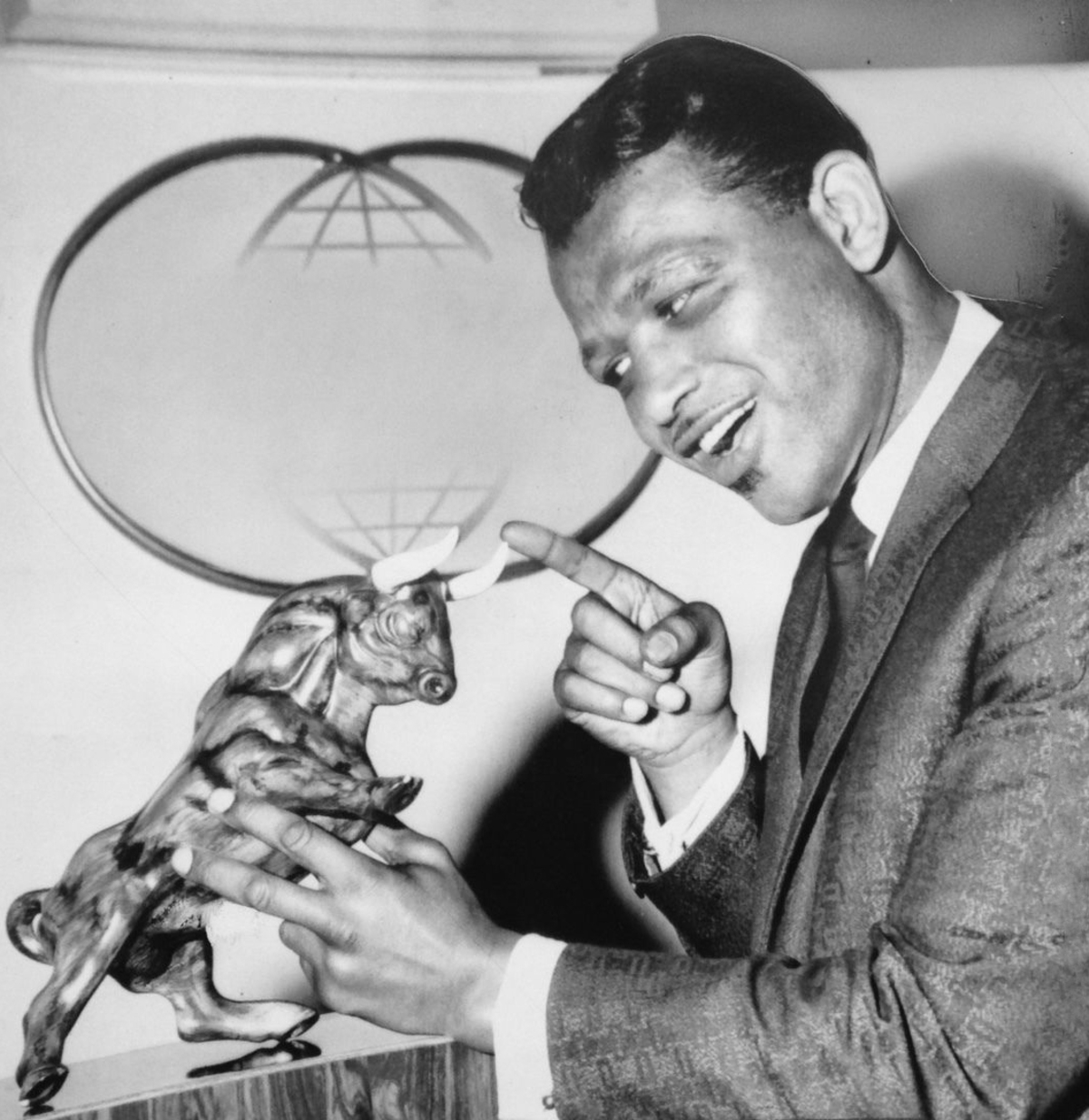

To find a modern parallel, you would have to imagine a fighter today competing every three weeks for ten years without ever slipping up.
“[He] may be the greatest fighter of all time, Sugar Ray Robinson. 174 wins, 19 losses, most of ‘em when he was old, six draws, 108 knockouts. That is a lot of knockouts. That is a lot of fights,” said analyst Atlas on his channel.
By the time Robinson headed to London to face Randy Turpin in July 1951, he had already completed a career’s worth of greatness, with a record of 128 wins, 1 loss, 2 draws.
That stretch included a 40-0 start and a 91-fight unbeaten run that spanned nearly a decade. It wasn’t compiled against soft opposition or during a protected rise. Robinson fought constantly, often multiple times a month, and still kept winning.
His lone loss, a decision to Jake LaMotta in 1943, which Robinson corrected by beating “The Bronx Bull” five times over their legendary rivalry.
In 1950 alone, Robinson fought 19 times. For context, many modern champions fight 19 times in an entire career.
“He had a 91-fight unbeaten streak – that is pretty good. Those losses, like I said, most of ‘em came when he was old, way beyond his prime,” said Atlas
Atlas is right to point out that Robinson’s 19 losses are deceptive. When Robinson finally retired in 1965 at age 44, he was a shell of the man who ruled the 1940s. More than half of his career defeats came in the final five years of his 25-year stint in the ring.
If Robinson had retired after the “Saint Valentine’s Day Massacre” win over LaMotta in 1951, his winning percentage would sit at approximately 98 percent. Instead, he stayed long enough to become a five-time middleweight champion, a feat that added to his legend but padded his loss column.
The Joey Maxim fight is often cited as the great “almost” of Robinson’s career. Leading on all scorecards before the 104-degree heat forced him to quit on his stool, Robinson nearly bridged a massive weight gap to claim a third divisional title.
However, his greatness at welterweight requires no such justification. At 147 pounds, Robinson was the perfect blend of technical brilliance and concussive power. When you look at that 74–1–1 run in that weight class, you aren’t just looking at a great record; you are looking at the most perfect version of a fighter to ever lace up gloves.
Robinson wasn’t padding that record against journeymen. During that run, he beat Hall of Famers and top-tier contenders like Jake LaMotta, Tommy Bell, Kid Gavilan, and Fritzie Zivic.
Sugar Ray was cleaning out an era of boxing that was significantly more populated and competitive than the modern landscape.
What makes 74–1–1 truly incredible is the frequency. In the 1940s, Robinson would often fight twice in a single month. Maintaining that winning percentage while your body is under constant 15-round stress is something modern sports science can barely explain. He didn’t have training camps in the way we think of them today; he was simply in a perpetual state of combat.
While his middleweight years gave us the legendary battles and the five titles, the 147-pound Robinson was the closest thing to a flawless fighting machine the world has ever seen.
It’s the gold standard. Every welterweight since Leonard and Hearns to Mayweather and Crawford is inevitably measured against that specific 74–1–1 ghost.
Read the full article here