

There has been no bigger critic of the 2026 Formula 1 regulations than Max Verstappen. The four-time world champion first caused a stir during pre-season testing when he labelled the new ruleset as “anti-racing” and like “Formula E on steroids” due to the increased reliance on electrical energy.
His fears were that the new power units would create a kind of racing that has been witnessed across the opening three rounds of the season, where drivers are downshifting on straights, lifting and coasting into corners, and using super clipping to harvest energy.
This has therefore caused ‘yo-yo’-style battles where drivers struggle to streak clear after making an overtake, and although it has resulted in additional wheel-to-wheel battles – the 2026 Australian Grand Prix had 75 more overtakes than last year – Verstappen claims it’s all “artificial”.
He made comparisons to the ‘Mario Kart’ gaming series, adding “if someone likes this, then you really don’t know what racing is about”. Of course, one could argue that he’s only making these statements in frustration at suffering a poor start to the year, he is ninth in the championship, but as he quite rightly pointed out, the Red Bull driver already voiced these concerns back when he was enjoying supreme dominance in 2023.
So what exactly did he say at the time?
Verstappen’s comments at the 2023 Austrian GP
It was at the 2023 Austrian Grand Prix when Verstappen was asked by Autosport about the regulations, though the question didn’t come out of the blue. In the days leading up to the race, concerns regarding various aspects of 2026 had emerged with erstwhile Red Bull boss Christian Horner calling for a rethink of the move towards more electric power.
Christian Horner, Team Principal, Red Bull Racing, in the Team Prinicpals Press Conference
Photo by: Mark Sutton / Motorsport Images
“We need to make sure that we don’t create a technical ‘Frankenstein’,” he said, “that would require the chassis to compensate to such a degree with the mobile aerodynamics and reduce the drag to such a level that the stroke would be affected.
“And that the characteristics of these engines are not… that the heat engine does not become a generator to recharge a battery. I think this problem could easily be solved by simply adjusting the ratio between thermal power and electrical power.”
So those quotes were put to Verstappen, who first said: “I’ve been talking about that as well with the team and I’ve seen the data already on the simulator. To me, it looks pretty terrible. If you go flat out on the straight at Monza, I don’t know what it is, like 400 or 500 [metres] before the end of the straight, you have to downshift flat out because that’s faster. I think that’s not the way forward. Of course, probably that’s one of the worst tracks.”
This specific point is often the main one that is taken from his comments at the time, as it does reflect a factual reality: sections that were previously driven at full throttle are no longer. This was evident during qualifying in Melbourne, particularly down the long run before Turn 9, as well as the straight leading up to 130R at Suzuka.
Verstappen added: “But for me, the problem is, it looks like it’s going to be an ICE [internal combustion engine] competition, like whoever has the strongest engine will have a big benefit. But I don’t think that should be the intention of Formula 1, because then you will start a massive development war again, and it will become quite expensive to find probably a few horsepower here and there. I think it actually should be [the] opposite.”
Here, the Dutchman claimed F1 should not be a competition dictated by engines, but quite frankly, when has the title not been won by the car with the best power unit? It could also be argued that the introduction of Additional Development and Upgrade Opportunities (ADUO) will make any engine advantage potentially less decisive as the championship progresses through these regulations.
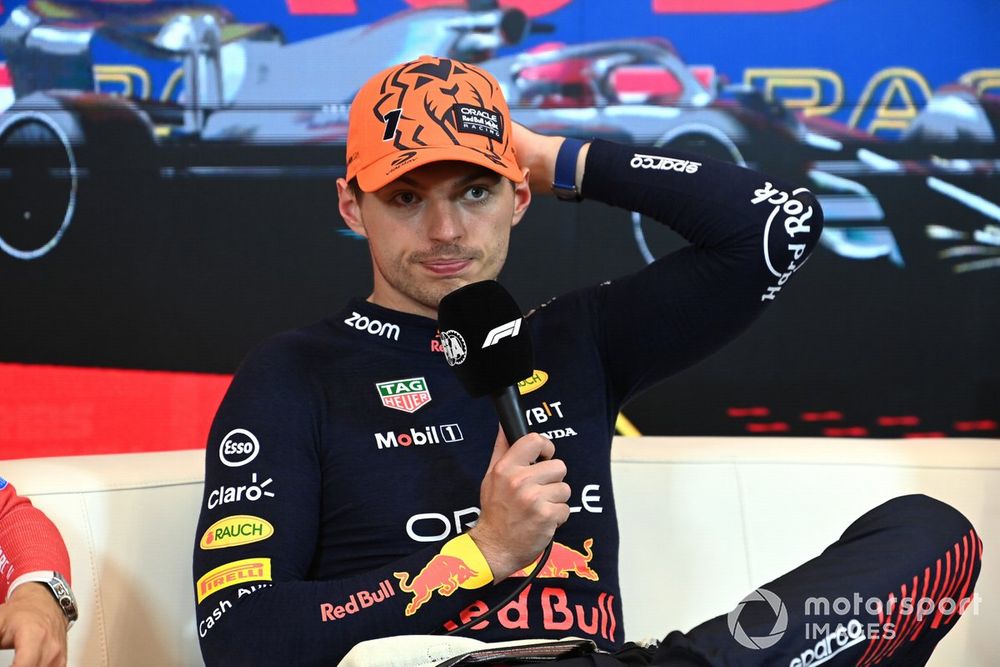
Max Verstappen, Red Bull Racing, 1st position, in the Press Conference
Photo by: Mark Sutton / Motorsport Images
There is also no reason to believe that a vision of F1 making the chassis the key element of performance differentiation would be any less likely to lead to a costly development race for a few points of advantage here and there.
The next part of Verstappen’s comment read: “Plus, the cars probably have a lot less drag. So, it will be even harder to overtake on the straight. And then I think yeah, you have the active aerodynamics, which you can’t control. Well, it will be… I don’t know… the system will control it for you. Which then I think makes it very awkward to drive, because I prefer to control it myself.
“Of course, when you’re behind someone, maybe you need more front or more rear. These kind of things. If the system starts to control that for you, I don’t think that’s the right way forward.”
Here, Verstappen was referring to an active aerodynamics system over which the driver has no control. The reality of 2026 is quite different, as the activation of active aerodynamics is entirely in the driver’s hands, with the slight caveat that the wings can only be flattened in zones predefined by the FIA.
So his comments now in hindsight clearly indicate a subject that was still in its infancy and how things have changed significantly since then. While the idea that drivers do not always have control over the 2026 F1 cars has not entirely gone away – Verstappen and Lando Norris raised this issue after Suzuka, though in relation to the engine – the fact remains that active aerodynamics are indeed controlled by the driver.
Verstappen concluded: “Plus, the weight is going up again. So yeah, we have to seriously look at this because ’26 is not that far away. At the moment, to me, it looks very bad from all the numbers and what I see from the data already. So, it’s not something I’m very excited about at the moment.”
Start action
Photo by: Alex Bierens de Haan / Getty Images
But the opposite has in fact transpired, as the minimum regulatory weight has decreased from 800kg to 768kg. Though because of such a drastic and sudden drop, there are many cars on the 2026 grid that are still overweight.
So although various points from his comments three years ago do not correspond to the reality of today, it does show that Verstappen has been pessimistic about the new era from the very start. That is not the case, however, for Mercedes boss Toto Wolff, whose team has dominated the early rounds of this year.
Back in 2023 he was also asked about Horner’s comments and proceeded to question the motive behind what the Briton was saying, as Red Bull had taken on the mammoth task of making its debut as a power unit manufacturer in 2026.
“I think what scares him the most is that his engine programme is not moving forward,” said the Austrian, though ironically the power unit is arguably the strongest part of the RB22.
“So you always have to ask yourself, what is the real motivation to say this kind of thing? This [the drastic change in the engine regulations] will not happen. No chance. So I don’t know why these things are being raised.
“We have developed this regulation for many years, with the involvement of all car manufacturers. It was a compromise that allowed Audi to join the sport and Honda to stay there. This is the best situation we can imagine for F1.”
The new engine regulations were validated in August 2022 and were indeed central to major brands like Audi joining and Honda making a U-turn on its initial choice to leave – however, Renault did make its departure at the end of 2025.
Wolff added: “Is it a challenge? Do our chassis designers say ‘how are we going to do this?’ Yes, it’s true. But it’s great. These regulations will no longer change. They will no longer be postponed, because the world must be innovative in sustainability. We need to reduce emissions and we are very excited.”
We want to hear from you!
Let us know what you would like to see from us in the future.
Take our survey
– The Autosport.com Team
Read the full article here