

Thursday night was supposed to be a marquee matchup featuring the NBA’s brightest young stars.
On one side, there’s Minnesota Timberwolves guard Anthony Edwards, an electrifying superstar on and off the court. On the other, Detroit Pistons point guard Cade Cunningham, the face of the dominant No. 1 seed in the East. A game between two playoff teams, but moreso, a showcase of the NBA’s next big American star.
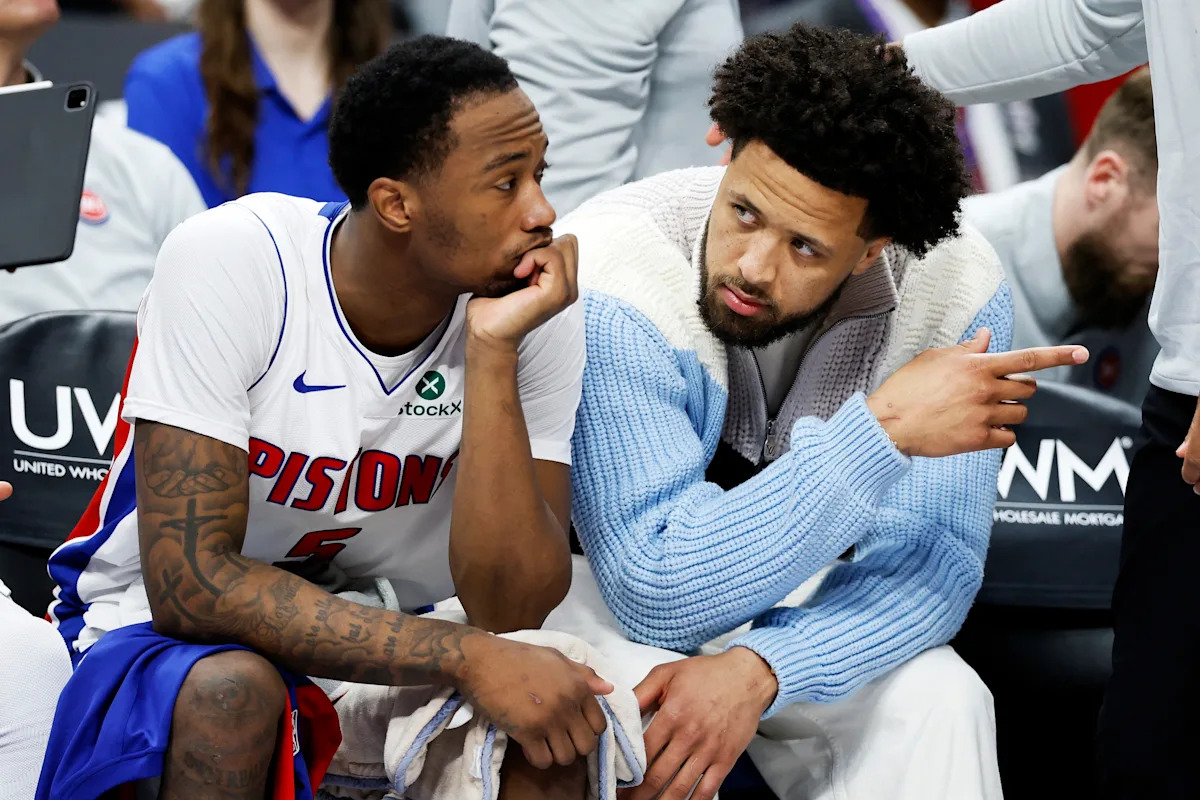
Unfortunately, we won’t get that matchup. Cunningham is too injured to play, sidelined with a collapsed lung suffered in a March game against the pitiful Washington Wizards.
It’s yet another example of NBA fans not being able to watch the intended star showcase that the NBA and its players had wanted. Rather than Cunningham’s face on league promotions, it’ll be Jalen Duren, a burgeoning All-Star, but hardly a household name or widely recognizable to the average sports fan.
Cade Cunningham (right) has been sidelined with a collapsed lung. (AP Photo/Duane Burleson)
(ASSOCIATED PRESS)
Luckily for NBA fans, the later blockbuster should live up to its box-office billing. The top-seeded OKC Thunder will be facing the surging Los Angeles Lakers and the injury report is sparkling clean. Which is key because, although it will be the third matchup of the season between these two teams, it’s notably the first one in which the stars on both sides will be healthy enough to give it a go. We might finally get LeBron and Luka going against SGA, Chet and JDub.
Man, this feels rare, doesn’t it? More often, the typical national TV game is an injury-scarred Timberwolves-Pistons matchup rather than the star-studded Thunder-Lakers.
NBA fans should cherish the later national TV game’s star power. Because it is incredibly uncommon in today’s NBA for both teams to be fully staffed.
For the first time, we studied the data and found out how rare it actually is. And the results should have everyone in league circles worried about the long-term effects of star outages on the NBA’s biggest marketing platforms. A question hanging over all of it: How long will fans continue to tune in when the stars are consistently missing?
The 33% full-star problem
For NBA fans, the new TV deal should be seen as a major win. By adding Amazon Prime and NBC/Peacock to the mix, the average fan will have access to dozens more games beyond what’s available locally or tucked away on League Pass. Ratings on national TV games are up 13% this season, according to Sports Media Watch tracking, thanks in part to adding NBC’s large audience to the mix.
But NBA fans who are just tuning in to the season might have trouble seeing familiar faces.
This season, star availability has plummeted from about 80% last season to just around 60%. Chances are, if you want to watch the big game, and you actually want to see all the stars playing, you won’t be in luck.
For weeks, Yahoo Sports has been tracking the star power on national TV games in order to get a stronger sense of the NBA fan experience and better understand the depths of the concerning injury crisis.
In a typical week during the season, there are multiple games broadcast on either Prime, NBC’s family of channels (including Peacock) and Disney (ESPN or ABC) in which there is at least one star on both rosters. To determine what classifies as a star, we turned to the NBA’s official Player Participation Policy established in 2023 which defines a star player as one that is an All-Star or All-NBA player in the current season or any of the previous three seasons.
This criteria works as a handy catch-all. For example, the Philadelphia 76ers boast three stars in Joel Embiid, Tyrese Maxey, and Paul George — tied for the most such stars on one roster. Some overachieving squads may fall through the cracks, like, say, the Charlotte Hornets, who have zero players who qualify (LaMelo Ball was an All-Star too long ago to qualify and the sharpshooting Kon Knueppel isn’t yet an All-Star). But generally, these parameters do a fine job of approximating a team’s star power, which is why the NBA and the NBPA agreed to put it in ink within official league rules.
These are the marquee matchups, the ones in the NBA schedule that are largely protected by the league’s schedule-makers and TV partners to ensure that the games aren’t being played on back-to-back sets, which tend to see more star absences than usual. In effect, they’re de facto playoff games folded into the 82-game slate. The idea is to give the biggest games the best chance of healthy stars.
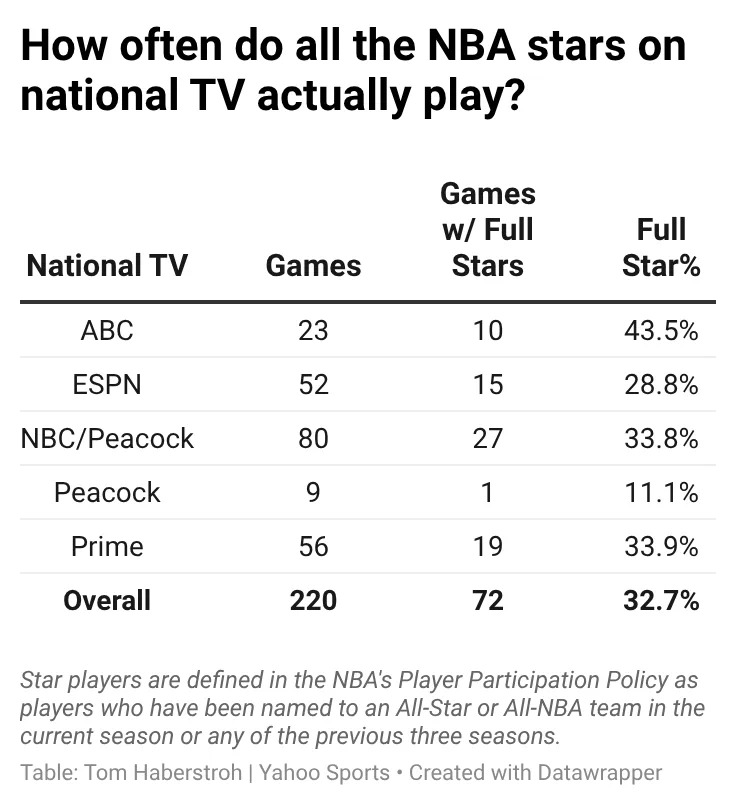
All in all, Yahoo Sports determined there were 220 national TV games with at least one star on both sides of the matchup.
Of those 220 games, what would you guess is the number of times that both teams suited up their full complement of stars?
Would you guess 200?
Maybe 150?
It’s less than 100. Way less.
Turns out, only 72 of the 220 games featured all of the stars on the rosters.
That’s 32.7%. Less than one-third of the national TV games.
Said another way: About two out of three national TV games will have at least one star player in street clothes.
In other team sports, this may not be such a problem. After all, baseball fans are conditioned to not see Shohei Ohtani or Aaron Judge on their screens when they tune in to the big game; any individual baseball player is rarely on screen even if they’re playing in the game.
The NBA? The whole brand is built on seeing the stars. And really seeing them. Unlike the NFL, there are no helmets and facemasks in the NBA that shield the stars and keep the audience at a distance. There are no shoulder pads. When Anthony Edwards flexes and roars into the crowd, fans can practically feel it.
These days, the feeling that fans typically get is disappointment.
What’s also interesting is that the star availability varies by TV network. According to the Yahoo Sports study, in nine of the exclusively Peacock (non-NBC) games with stars on both sides, only one of them featured all the stars, a full star percentage of 11%. But for ABC games, which are on Disney’s biggest network platform, the full-star percentage checked in at 43%, more than triple that of Peacock. (ABC’s full-star percentage was the highest of the channels.)
Sometimes a TV partner strikes out completely. Take for instance, on Feb. 5, the NBA scheduled the Golden State Warriors against the Phoenix Suns on Amazon Prime — a star-studded matchup that the Average Joe Sports Fan would reasonably expect to see Stephen Curry, Jimmy Butler and Devin Booker facing off with two teams in the playoff hunt. None of those stars played. Curry was out with knee soreness. Butler had torn his ACL. Booker (ankle) and his high-scoring teammate Jalen Green (hip) were injured. Instead, the game was promoted with Dillon Brooks and Brandin Podziemski leading the way.
On that front, it’s easy to understand if Amazon TV execs were frustrated with the state of affairs in its first season as a league partner. The Warriors-Suns game came in a stretch of the schedule in which six straight Prime games from Jan. 23 to Feb. 6 saw at least one star sidelined (in games in which both teams had star players). In fact, there have been 22 Prime doubleheader nights that had at least one star rostered on both teams, and in only two of those 22 Prime doubleheaders did we see the full slate of stars. They occurred months ago in December.
The more star power, the higher likelihood there’s a player missing in action. The 32.7% full-star playing figure dwindles to 27.7% when there are multiple stars rostered on each side of a national TV game. In the five marquee games with a trio of stars on the rosters, only one came through (Cleveland at Philadelphia on ESPN in mid-January).
_8906.png)
A stroll through social media on these nights reveals a swarm of jilted fans. Placing blame on the players feels misguided, though it’s easier to criticize familiar faces than anonymous medical personnel or league execs. The game is faster than it has been in decades. The 3-point shot stretches the demands beyond anything we grew up with. Furthermore, players enter the league with excessive AAU and youth sport miles on the tires that wear the tread thin.
So what does the league do?
Adjust the schedule
If the league wants to raise that 33% in any meaningful way, it should think long and hard about making every game feel bigger.
One way to do that: reduce the number of games in the schedule. Adjust the schedule in such a way that we can get rid of back-to-backs, reduce in-game injuries (you can’t get injured if you don’t play) and rebuild the trust in the audience. Like I suggested in January, make the game a 58-game season. It wouldn’t guarantee zero percent star outages. Only a zero-game schedule can do that. But it’s hard to imagine a world in which star players aren’t substantially healthier, fresher and bouncier in a 58-game schedule with no back-to-backs.
Trust is hard to find in today’s media environment. I’m a kid of the ‘90s. There were no cell phones or WiFi. I trusted my TV programming because it delivered. I knew when “The Simpsons” were on and what channel it was on (FOX was 5 in my neck of the woods).
In the same way, I knew when the big game was on. I could reach for the trusty TV Guide book on my coffee table or flip on the Cablevision channel on my cable that scrolled the shows. There wasn’t any searching or flipping between streaming apps and choosing profiles and inputting passwords. I knew what channel the game was on (ESPN was 36 and NBC was 4).
It was quick. It was reliable. It was easy. Nowadays, I can’t blame my 14-year-old nephew who would rather wait until the day after to check the highlights on YouTube. I get his frustration when every time he wants to see Giannis play, it might be Kevin Porter Jr.’s face on the thumbnail instead because Giannis is sidelined. When I was his age, the biggest stars regularly played 82 games or damn near close. It was genuinely jarring to see my favorite players in street clothes. Now, it’s surprising to see when they’re not.
In a competitive media environment, trust in the product is everything. When I fell in love with the NBA, I was captivated by the marketing campaign line: “The NBA: Where Amazing Happens.” ”Lately, it feels more and more like “The NBA: Where A Missing Star Happens.” And that’s a shame.
Read the full article here