

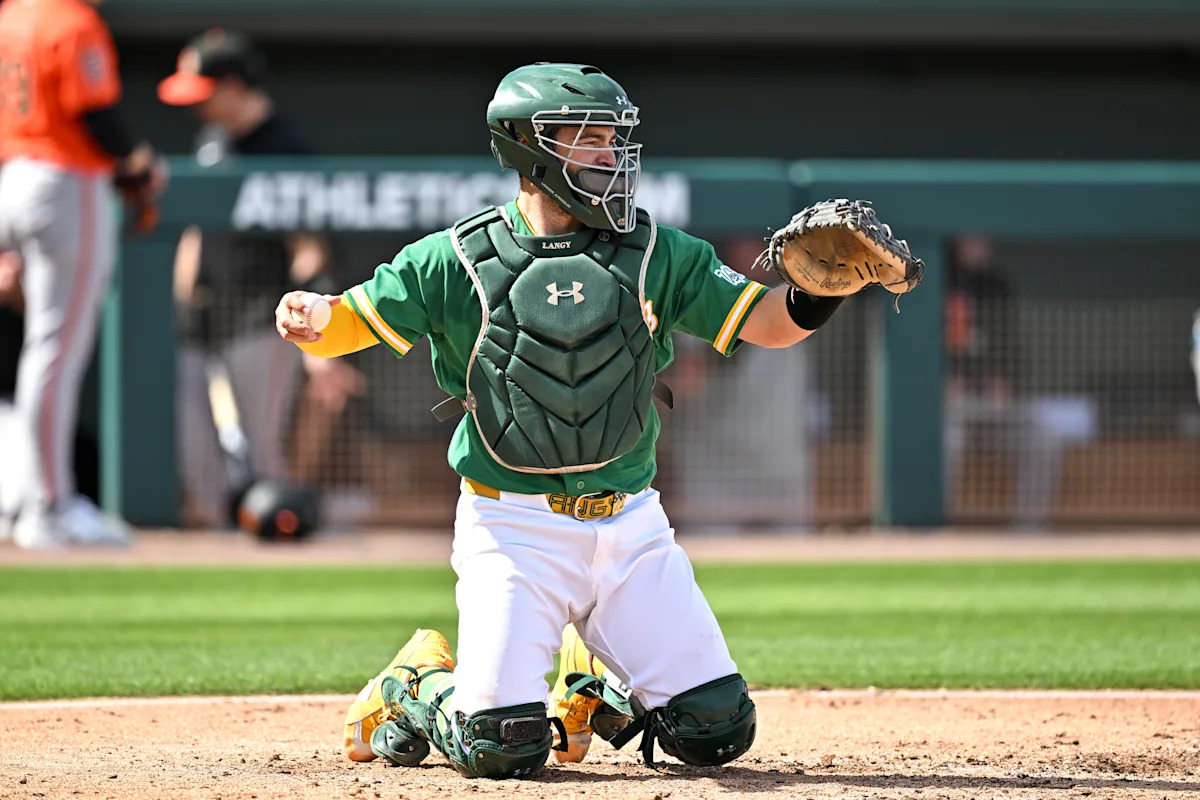
From the moment I introduced myself to Shea Langeliers it was clear he was just an easy guy to talk to. Friendly, personable, and laid back, Langeliers’ manner belies the insane job description of a major league catcher. That became one focus for our interview Saturday, March 14th, starting with the newest challenge. Pun intended.
Nico: So as I was thinking of questions, I was just realizing how many different aspects of catching there are that you can ask somebody about. And I want to get into that, what that’s like. But starting with ABS, which is kind of the newest thing that you have to manage, I know during spring training you’re doing a lot of experimenting. But when you’re thinking ahead to the regular season, when you have to make the best decisions, what is the thinking right now as far as, when and who and how you’re going to navigate challenges?
Shea: Yeah, I think to start with, I think just catchers as a whole probably have the best feel for the strike zone. Obviously with the ABS, there’s little changes here and there. So I mean, that’s part of (what) spring training’s for, kind of like what you’re saying, get a feel for that, feel it out.
As far as the situations, it’s kinda, I think the borderline ones are gonna be tough, especially early in the game. It’s kind of like,Nico: if there’s like a blatantly obvious one that you know for sure is a strike, obviously we’re going to challenge those. But probably do our best to save at least one challenge late in game, big situation, leverage situation where, you know, if we’re on offense, there’s runners on base. Obviously, if we’re on defense, there’s runners on base. Just for those big situations that can change a game, you definitely want a challenge.
Nico: So to the first thing you said, are you thinking you want the catchers to sort of be in charge of the challenges more than the pitchers?
Shea: Yes. Obviously, and rightfully so, the pitchers, as a mentality, they think everything’s a strike. And we want them to think that way. We want them to be aggressive on the mound. So it’s kind of just that buffer is the catcher, because we can let them know, hey, no, it’s just off, it’s just down, it’s just up, that kind of thing. We’ve got a better feel for that because they’re out there, you know, competing and doing their best and we want them to stay aggressive.
Nico: Now, maybe you picked the wrong time in your career to improve something, but you improved your framing a lot in the last year. How valuable do you think that is now?
Shea: I think there’s still a lot of value to it. It’s going to be interesting to see how it plays out, especially the first month or two in season, how these challenges are used kind of around the league. Because if you run out of challenges early in the game, it’s kind of, we’re back to last year how it was pretty much. It’s just kind of straight up.
So we’ll kind of see that, kind of knowing off the top of my head some of the best framers around the league like Patrick Bailey, (Alejandro) Kirk, (Cal) Raleigh. I think opposing teams going into that game are gonna know that these guys are the best framers in the league. So they might be more apt to challenge on those borderline ones cuz they know they get calls cuz they make everything look good. It’s gonna be interesting to see how that plays out.
Nico: Well, I wonder if those guys are going to intentionally frame pitches to look like balls that are strikes to get challenges. I mean, there’s a lot of psychology.
Shea: Yeah, there’s a lot of different ways you can look at it. It’s going to be interesting.
Nico: So, to my first point, ABS is just one of so many things that you’re having to juggle as a catcher, not even talking about hitting. So if you could give our readers an idea of just like what your work day is like as you’re preparing — in camp, of course, you’ve got a million pitchers, but even during the regular season, the preparation, you know,the part that we don’t see.
Shea: Yeah. I mean, I could talk about it for a long time.
Nico: Feel free.
Shea: Try to put it simply. So obviously each individual pitcher has their own strength and you want, for the most part, to pitch off of their strength. And on any given night, obviously, it’s a big league lineup. Every team you play, every team’s got the capability of scoring a bunch of runs at any point, right? So like, night in, night out, you’re scouting the best players in the world. You’re trying to figure out, “OK, what’s the hitter’s strength and weakness? What’s my pitcher’s strength and weakness? And to overlay that, what’s the best plan of attack?”
How are we going to go about this? And there’s certain times where it’s like, off the top of my head, Aaron Judge, it’s like, “We don’t want Aaron Judge to beat us if we’re playing the Yankees.” If somebody else beats us, it’s kind of like — obviously you don’t want to lose, but you don’t want to let the best player in the game beat us on any given night. So it’s an overlay of everything. What is my pitcher’s strength? What does he have that day? Who’s in the box? What’s their strength? I mean, I could go on and on.
Nico: Well, so when we see a pitch called during a game in real time, how much of that is coming from pregame preparation and conversation, and how much is coming from reading the hitter, reading the situation in real time?
Shea: Yeah. So you’ve got plan A, B, C, right? You’ve got your plan pregame. We’ve got our whole pitching meeting before the game, how we want to attack guys. And I would say the plan A, when plan A works is when the starter goes seven innings and gives up zero one runs and punches out ten. That’s when plan A works.
Plan B is when something (goes sideways), the pitcher doesn’t have something that day, the offense is doing something different than we thought they were gonna do, you kind of reroute.
And then plan C is kind of just like, all right, how do we figure this out and stay in the game? So it’s any given night. I would say obviously I could look at a box score of how the starting pitchers night went, and that guy, that was plan A, that was plan B, that was plan C. Being a good catcher in the game is how quick can you notice that reroute and get to plan B, plan C, because you get hurt when you try to stick to the plan longer than you should. Yep.
Nico: Now, how old were you when you first knew or decided you wanted to be a catcher?
Shea: I started catching full time my sophomore year in high school. So yeah, 16, 17, somewhere around there.
Nico: Did you have any idea all that it entailed mentally and physically?
Shea: Well at the time, my dad told me that being a catcher that can hit is the fastest way to the big leagues. Obviously I don’t think he knew the full scale of everything that catchers have to do day in and day out, but obviously everything worked out.
Nico: You know, your scouting report when you were a minor leaguer was a little bit more leaning to “defense first, bat second”. And in the majors, if anything, it’s been flipped. And I’m just curious how you explain or see that.
Shea: Yeah, I would agree with that. I still, obviously, my mentality has always been and always will be catching first. It’s the most important thing. Kind of control the pitching staff, control the game, get us into the rhythm of the game. Anything offensively is kind of a plus in my mind. Obviously, I want to do to the best of my physical abilities what I can do offensively. But yeah, it is kind of funny how coming through college, I mean, I always viewed myself as a defensive first catcher.
But it is kind of funny how stuff like that flips and it could flip again, we don’t know. So it’s just, yeah, I mean, simply put, you just try to be the best player that you can. And then when you bring everything you got to the table every night, it’s interesting to see how it works out.
Nico: Now, every time we see a foul tip, we have a really good sense of how physically wearing catching is. I’m interested in the mental, psychological piece, like how draining it is to have to do all the pieces that you have to do as a catcher.
Shea: Yeah, I mean, it can definitely be overwhelming. I think that was probably the biggest learning curve for me when I first got to the big leagues. It’s just all the information that you have to keep track of being the catcher. And then you have to hit on top of that. So figuring out a way to balance that and the information that you take.
Because everybody digests information differently. There’s certain information that works for me and I understand. Other catchers it’s probably different. The way that they, it’s like a little tidbit on a hitter. It’s like, okay, I mentally know how to pitch that guy. And some people probably see it differently. So it’s just figuring out what works for me, how I digest information to keep it simple and keep my mind free and able to compete.
Nico: So how would you describe your personality? Like, what you bring, not just to the game, but to life, as Shea, not Kirk, not Raleigh?
Shea: I’m not a rah, rah guy. I’m not going to go out there and yell at people. More of like a laid back, probably like calm strength. And just kind of like, I know for me personally, I’m going to bring everything I got every night. I’ve got 100 % confidence that these guys are going to do it too. So it’s kind of like a silent leadership type deal. Yeah.
Nico: What has been your one moment so far that stands out as, like, if I retire today, I’ll always have this moment?
Shea: I mean, right now, I guess it’s probably the Grand Slam off Skubal last year. Just obviously, best pitcher in baseball, come up with the bases loaded and it’s kind of just you’re so in the moment that everything obviously everything worked out in that moment is really special and to be able to do something off a guy you know that’s at the top of his game at the top of the game is pretty special.
Hopefully Langeliers’ best and most memorable moments are actually yet to come. Next up on Monday, the Denzelope: Denzel Clarke.
Read the full article here