

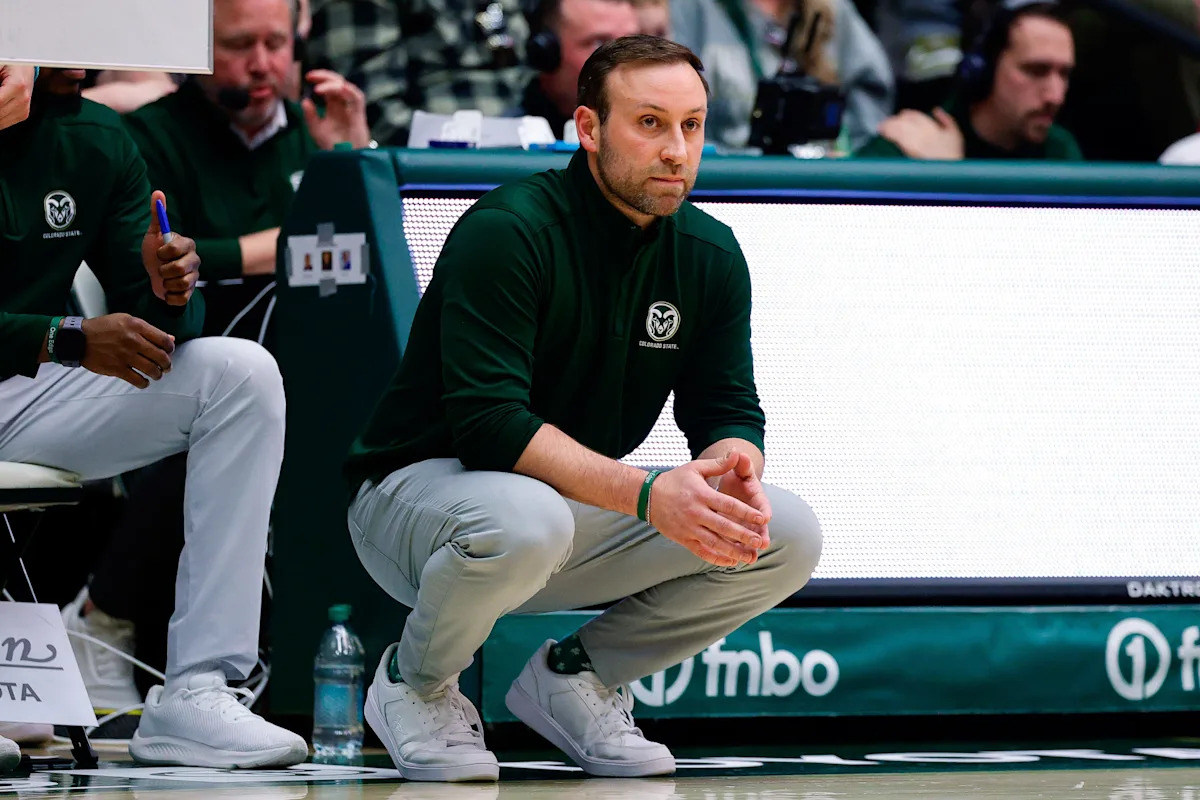
FORT COLLINS, Colo. — Someone in the Colorado State athletic department knew what they were doing.
After Ali Farokhmanesh held up a green-and-gold jersey with his name on the back of it, officially marking the start of his tenure as the Rams’ men’s basketball coach last March, he bent over and reached under the dais where he was set to speak to the crowd gathered inside Moby Arena, the school’s 60-year-old gym.
The self-professed crier emerged holding a box of Puffs tissues, drawing a laugh from the audience. His voice briefly cracked as he began to speak, but as the realization of a life-long goal swept over him, the tissues weren’t necessary.
REQUIRED READING: Does win at New Mexico impact postseason outlook for Colorado State?
“This is surreal,” Farokhmanesh said. “This is a dream I’ve had since I was a little kid.”
He’s likely not the only person who feels a certain way seeing him roam a college sideline.
With the start of the NCAA tournament looming, Farokhmanesh once again enters the national consciousness, with clips of his iconic game-sealing 3-pointer from Northern Iowa’s stunning upset of Kansas in 2010 airing on highlight reels that television networks play throughout March Madness. With a single, unforgettable shot, Farokhmanesh embodied the frantic magic of the NCAA tournament and became a college basketball folk hero, a six-foot-nothing white guy from a mid-major who took down one of the sport’s powerhouses.
Now, nearly two full decades removed from his one shining moment, Farokhmanesh is in his first season leading a Division I program, having been promoted to head coach at Colorado State shortly after Niko Medved left for Minnesota. The early results have been encouraging, with the Rams at 20-10 and riding an eight-game win streak heading into their regular-season finale on Saturday, March 7 against Boise State.
In the role, he’s trying to carve out a legacy in the game beyond a play that still allows his lengthy Iranian last name to roll effortlessly off the tongue of any college basketball fan all these years later. The glory he once earned as a player is now something he’s working to get achieve as a coach.
“I’m proud of what happened. It obviously meant a lot to me,” Farokhmanesh said to USA TODAY Sports. “But it’s a completely different, new journey.”
Ali Farokhmanesh’s March Madness game winner
As unlikely as Northern Iowa’s win over Kansas in the 2010 NCAA Tournament was, the path there for the game’s most consequential player was even more improbable.
Despite being a first-team all-state honoree in Iowa, Farokhmanesh came out of high school without a single scholarship offer from an NCAA or NAIA school, even after sending out letters and highlight tapes to nearly 150 Division I programs. Even Iowa, where his mother was the school’s volleyball coach at the time, didn’t show interest.
He ended up at the junior-college level, going from Indian Hills Community College to Kirkwood Community College, both in Iowa. At Kirkwood, his scoring (16.3 points per game) and shooting (47.3% from 3) grabbed the attention of many of the same programs that overlooked him two years earlier, including Northern Iowa, where he committed for his final two seasons of eligibility.
In his season at Kirkwood, he displayed a tireless drive to improve, forcing himself to make 400 shots a night. His routine was so intense that the screws in the shooting gun he used during his workouts wore out. Those habits carried over to Northern Iowa, where he started every game for a Panthers team that made the NCAA tournament in 2009.
“There wasn’t a day in the two years we had Ali with us as a player that he wasn’t in the gym before practice or after practice or in between classes or coming back at night,” Northern Iowa coach Ben Jacobson said to USA TODAY Sports. “It was one of those things that everybody knew. His teammates knew it. His coaches knew it. Our fans knew it.”
As a senior in 2009-10, the Panthers won a then-program-record 30 games and won the Missouri Valley Conference championship for the second-consecutive season. Farokhmanesh was one of the team’s most valuable contributors, averaging 9.7 points per game and making a team-high 77 3s (if his 152 career made 3s over two seasons were doubled to reflect a full, four-year college career, it would comfortably be a program record).
After a 69-66 win against UNLV in the first round — a game in which Farokhmanesh made the game-winning 3 with 4.9 seconds remaining to deliver the program its second-ever NCAA tournament victory — No. 9 seed Northern Iowa arrived at what many thought would be the end of the team’s road.
Two years removed from a national championship, Kansas once again looked like the country’s best team, with a 33-2 record, the tournament’s No. 1 overall seed and a roster that featured five future NBA Draft lottery picks and five players who would earn consensus All-American honors at some point during their college careers.
Despite those odds, Northern Iowa got off to a hot start, leading by eight at halftime thanks to 11 points from Farokhmanesh. The Jayhawks stormed back in the second half, getting within a point, 63-62, with 42.8 seconds remaining after a Sherron Collins jumper. On the ensuing inbounds pass, Northern Iowa broke Kansas’ press, with Kwadzo Ahelegbe firing a pass up to Farokhmanesh, who caught the ball behind the 3-point line with only one Jayhawks player standing between him and the basket.
With a one-point lead and a seven-second difference between the shot and game clocks, Farokhmanesh could have easily held on to the ball, waited for some teammates to join him on that end of the court and bled precious seconds away as the Panthers continued their upset bid.
For a split-second, he appeared content to do just that, holding the ball and getting ready to take a step to his right. His movement sent the lone Kansas defender retreating to the basket, leaving the career 37.5% 3-point shooter with an enormous cushion to fire. He squared his feet to the basket and did what would have been unimaginable for most players: pulling up for a shot that, if it went awry, would have given the Jayhawks the ball with a chance to win the game.
The big gamble came with an even bigger reward. The shot swished through the net to give the Panthers a four-point lead with 35 seconds left, icing a stunning 69-67 victory, sending Northern Iowa to the Sweet 16 and instantly turning Farokhmanesh into a March icon.
A shot of a triumphant Farokhmanesh leaning back and screaming to the rafters appeared on the cover of Sports Illustrated the following week, with the headline “Divine Madness.” Media requests from across the country flooded in. The Panthers’ practices, which had been open throughout that season, had to be closed because so many people had showed up to watch them.
Through it all, Jacobson was impressed with how his team and its overnight celebrity of a shooting guard approached their newfound fame.
“There was a moment or two when we kind of looked around at each other like ‘Whoa, this is a big deal,’” Jacobson said. “But outside of those, for the three or four days between the Kansas win and the game against Michigan State, it was kind of business as usual.”
A 59-52 loss to Michigan State six days after the Kansas win marked the end of Farokhmanesh’s college playing career. His time in college basketball, though, was only just beginning.
REQUIRED READING: March Madness bubble watch: Pressure builds in final week of regular season
Realizing the dream
Coaching can be something of a happy accident or a fallback plan for some in the basketball world, a way to stay connected to the game after their playing days come to a dreaded end.
For Farokhmanesh, it was always a life he envisioned for himself.
His parents, Cindy Fredrick and Mashallah Farokhmanesh, were college volleyball coaches, with Frederick serving as the head coach and Farokhmanesh as her assistant at stops at Weber State, Washington State, Iowa and UNLV. Though Ali Farokhmanesh eventually gravitated to basketball, he grew up around practice facilities and locker rooms. His heroes weren’t just global basketball superstars, but volleyball players. While his parents were at Washington State, Jason Gesser, the Cougars’ all-conference quarterback, was his babysitter. Ryan Leaf, who went on to be the No. 2 overall pick in the 1998 NFL Draft, came to his birthday party.
At Northern Iowa, he majored in finance and briefly thought of a career in that field, but those plans only bounced around in his head for so long.
“That lasted maybe like a month,” Farokhmanesh said. “Then it was basketball.”
He embarked on a professional career overseas, playing in Switzerland, Austria and the Netherlands. By the end of his fourth season, priorities started to change. He got married and had his first child. Even though he had a lucrative offer to keep playing, he knew he wanted to start his coaching career sooner rather than later.
He sent out his resume and mined his connections in the basketball world, looking for an all-important foot in the door. He found one at Nebraska, whose coach at the time, Tim Miles, was close with Jacobson. Farokhmanesh texted and called Miles about an open graduate assistant role. He eventually got a response while the Cornhuskers’ coach was on vacation.
“What happens is when you have too many Mai Tais in Cabo, you hire Ali Farokhmanesh by accident and it works out great for everybody involved,” Miles said, with a laugh, to USA TODAY Sports.
Two weeks after the conversation in 2014, Miles had Farokhmanesh come in to work out six players as he watched. He was hired on the spot.
“You’re always wondering about some former players that weren’t your former players, right?” Miles said. “Ali’s a hero at Northern Iowa. What’s he going to be like? Is he going to rest on his laurels, like, hey, I was a player, I’m going to come in and work with these guys and they should listen to me? What I noticed about Ali immediately was he invested in people. He wanted to get guys better. Even in his interview, he walked in and approached himself like a young coach who was eager to get in the gym, work with guys, pour into guys and help make them better. Anybody who ever meets Ali likes Ali. Maybe not Kansas fans, but everybody else. I immediately knew I wanted him on my staff.”
As much as Farokhmanesh embraced the role, it was an adjustment.
“That was probably the hardest thing about being a GA — it was hard to get past not looking at yourself as a player,” he said.
After three seasons at Nebraska, Farokhmanesh got his first opportunity as an assistant when Medved, a former assistant for Miles at Colorado State, hired the former Northern Iowa star to join his staff at Drake.
“He’d never been the point person on signing a player and this and that, but I’ve always just trusted my gut,” Medved said to USA TODAY Sports. “You could just tell. He had a great personality. He knows how to connect with people. If you can really connect with people, if you can teach people, if you love it…when you combine those three things, you’ve got a guy that’s really talented and is going to be successful. For me, it was a no-brainer.”
Medved orchestrated a 10-win improvement in his first and ultimately only season at Drake, after which he was hired at Colorado State and brought Farokhmanesh with him.
There, he turned the Rams into one of the most consistent winners in the Mountain West Conference, winning at least 20 games in five of his final six seasons and leading Colorado State, which had just three NCAA tournament appearances in the 28 seasons before he was hired, to March Madness in three of his final four seasons. Along the way, the Rams were able to recruit, develop and retain future NBA players like David Roddy, Nique Clifford and Isaiah Stevens, even in the age of the transfer portal.
When Medved, a Minneapolis native, left for his alma mater the day after the Rams’ buzzer-beater loss to Maryland in the second round of the NCAA tournament last March, there wasn’t much of a question about who would succeed him. Within four days of Medved’s departure, Farokhmanesh was being introduced as Colorado State’s new coach.
REQUIRED READING: March Madness bracketology: NCAA Tournament projection has changes on bubble
Ali Farokhmanesh with Colorado State
Inside the same arena where he held up a box of tissues 10 months earlier, Farokhmanesh’s dream is now a reality.
With a whistle around his neck during an early February practice, the 37 year old is active, firing off passes to his players, crouching down in a defensive stance, providing one-on-one instruction and doing what he can to help reverse the fortunes of a team that had lost eight of its previous 11 games.
For as much as Farokhmanesh had envisioned getting to this point in his career, and for the 11 years of work he put in as an assistant, there’s something slightly unnerving seeing him like this, as a fully-formed adult with well-coiffed hair who drives his four kids around in his Toyota Sienna minivan rather than the triumphant 21 year old with onions the size of beach balls that he’s been immortalized as for nearly half his life. In some ways, he’s less a coach than a symbol of how much time has passed since that fateful shot and a reminder that, yes, you really are that old.
It’s a peculiar type of fame Farokhmanesh has navigated from the moment the ball passed through the net.
In some ways, it’s inescapable, the kind of thing he’ll receive calls about every March from reporters asking him to relive one of the NCAA tournament’s most storied plays. While at Nebraska and, especially, in his lone season at Drake, Farokhmanesh was recognized most places where he went and was more famous than the men for whom he worked. He’s been able to have fun with it, too, like when the Omaha World Herald had him interview Kansas fans at the 2015 NCAA Tournament in Omaha about their worst March Madness memories, unaware of who they were speaking with.
While the shot’s rarely something he’ll bring up unprompted, it’s still understandably a source of pride for him.
“We always joke with him…he didn’t talk about it, but if you walked into his office, the first picture you saw was the Sports Illustrated cover,” Medved said, with a laugh.
Over the past three or four years, as the shot fades further in the distance, Farokhmanesh said he started to be recognized more as a coach rather than a player. Around Fort Collins, particularly now, he’s much more likely to be asked about the Rams than his dagger against Kansas.
For his players, many of whom were toddlers when he graced that Sports Illustrated cover, it’s something their parents are much more likely to know about Farokhmanesh. If they seem a little too astonished to learn about their coach’s past, he won’t hesitate to challenge them to a shooting competition.
“Sometimes, they’ll bring it up later and they’re really surprised,” Farokhmanesh said. “I don’t know if I give off a vibe like I couldn’t play back in the day or something.”
Lest anyone forget Farokhmanesh could ball back in the day, his first Colorado State team is a pretty fitting reflection of its coach. Through their first 30 games, the Rams are making 39.6% of their 3s, the fifth-best mark among 365 Division I teams. They haven’t been shy about firing from deep, either, with 48.8% of their shot attempts this season coming from beyond the arc.
“I’ve always enjoyed teams that share the ball, that cut and move and play with pace,” Farokhmanesh said. “It’s what I grew up watching and loving to watch and playing in those types of systems. I’ve always been attracted to or lean toward skill over mostly anything else.”
Lately, it’s been a fruitful strategy. After its midseason lull, Colorado State has won eight games in a row, tying it for the sixth-longest active win streak in Division I. Its most recent victory, a road win against a New Mexico team on the NCAA tournament bubble, gave it at least 20 wins in a season for the sixth time in the past seven years. Though the Rams would almost certainly need to win the Mountain West tournament to earn a spot in the NCAA tournament, it has been an unquestionably successful debut season for Farokhmanesh, especially after Colorado State lost six of its top seven scorers from last season.
If that early promise translates to sustained success as the Rams move on to the newly reconfigured Pac-12 next season, fans across the country will have a different reason to think about Farokhmanesh whenever the calendar turns to March.
“The story of him and the shot and all the stuff like that, that’s a big story,” Medved said. “That was a moment in time. But that’s only a small part of the story. At the end of the day, nobody makes it unless they can actually do the job and they’re caring and they work. His reputation now has nothing to do with that. His reputation now is because he’s a terrific coach.”
This article originally appeared on USA TODAY: How Ali Farokhmanesh went from March Madness icon to Division I head coach
Read the full article here